Figure Us Out · Celebrity Couples
Barack and Michelle Obama: The Ice Cream Was Easy. Leaving on Time Took Practice.
A first kiss on a Chicago curb, two strong opinions, and the difference between correcting a detail and questioning your partner.
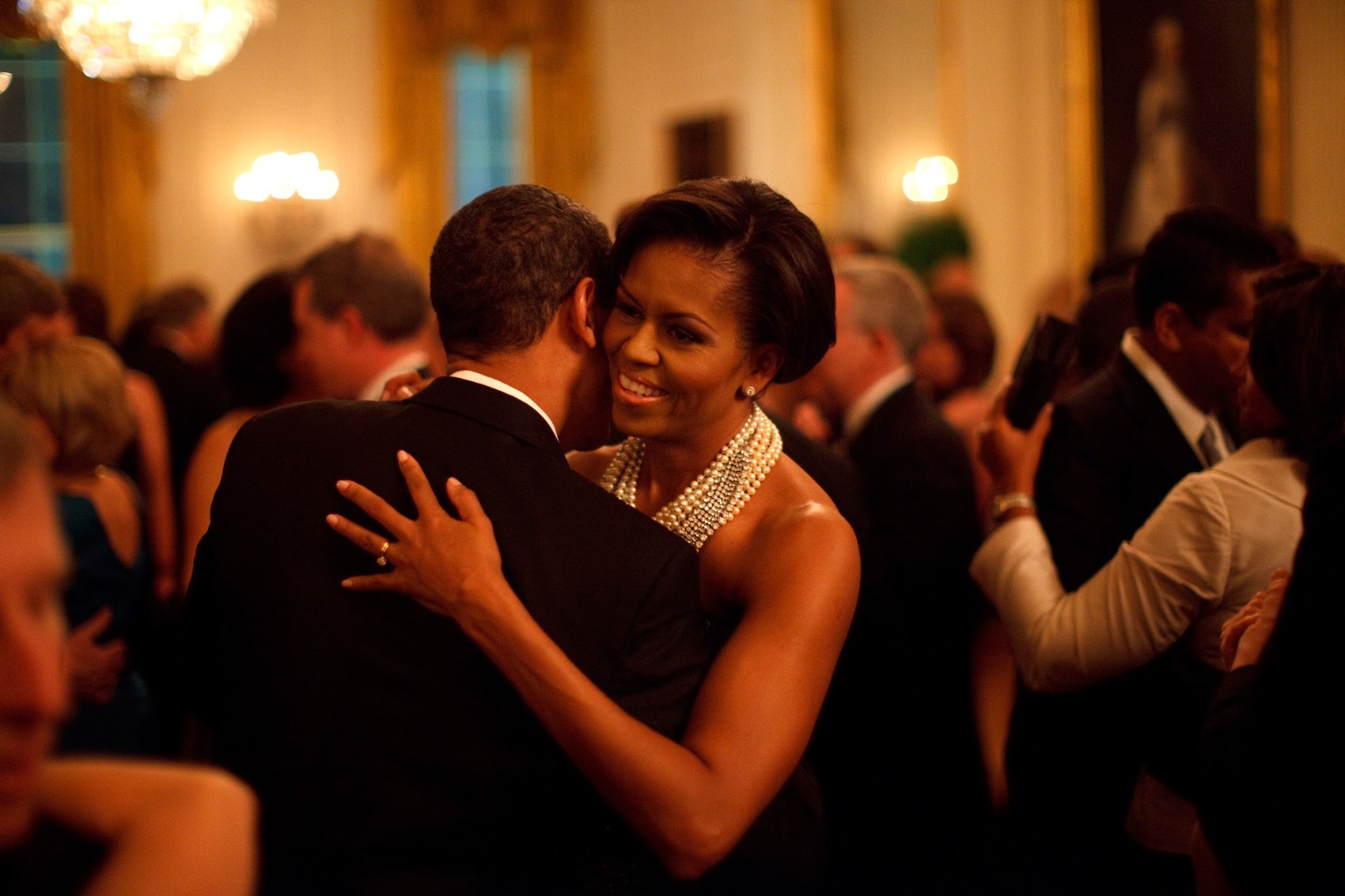
Barack and Michelle Obama dancing at the Governors Ball on February 22, 2009. Photo: Pete Souza / The White House. Source · U.S. federal government public domain.
Resized for this article. Archival event photograph, not an illustration of the imagined relationship scenes. No endorsement is implied.
Barack and Michelle Obama can agree on an awful lot and still have had different ideas about what time to leave the house.
On her podcast in 2025, Michelle described a habit that used to frustrate her: being ready to go while Barack was still getting ready or looking for his glasses. She also said he'd improved over the years. InStyle reported the exchange.
I appreciate that second part. It's easy to turn a couple's familiar complaint into a permanent character description. It's more interesting to hear that they kept working on it.
Even after the grand occasions, there are still ordinary moments when one person is holding the keys.
Before all that, there was a summer in Chicago
They met in 1989 at the Chicago law firm Sidley Austin, where Michelle was assigned to advise Barack during his summer placement. The Obama Foundation dates their first date to July 1 of that year.
The day included the Art Institute, a meal, and Spike Lee's Do the Right Thing. Ice cream and a kiss followed. As Oprah Daily's account of their relationship recalls, they sat on a curb outside Baskin-Robbins.
That is a good first date. Something to look at, something to talk about, and ice cream if the conversation is going well.
They married on October 3, 1992. Their first dance was to Stevie Wonder's “You and I.” By their anniversary in October 2026, they were celebrating 34 years of marriage.
You can admire the length of that history and still be curious about the ordinary exchanges inside it. How do two people with strong opinions use those opinions to help each other? And what happens when being right about one small detail starts feeling far too important?
Two people who both want to be taken seriously
For this Figure Us Out article, we're exploring Barack as ENTP 3w2 and Michelle as ESTJ 3w4. These are disputed public personality estimates, not results they supplied. Other types have been proposed for both. The charts and imagined scenes below explore this particular combination; they aren't observations of private disagreements or an endorsement.
Both profiles care about being capable, making a worthwhile contribution, and having their judgment respected. Both tend to appreciate directness. This isn't a pairing where one person has all the ideas and the other is simply along for the ride.
The difference is often where their attention goes first.
Barack's estimated combination enjoys exploring alternatives and seeing what else might be possible. Talking an idea through can produce a better idea halfway through the conversation. Michelle's estimated combination is quicker to look for concrete information, a clear priority, and an arrangement people can act on.
That could be an appealing way to work together. One person opens a door you hadn't noticed. The other helps you decide whether you actually want to go through it.
It also leaves plenty to talk about. A partner who has their own view gives you more than agreement. They give you a perspective you couldn't supply quite the same way yourself.
A look at the two estimated profiles
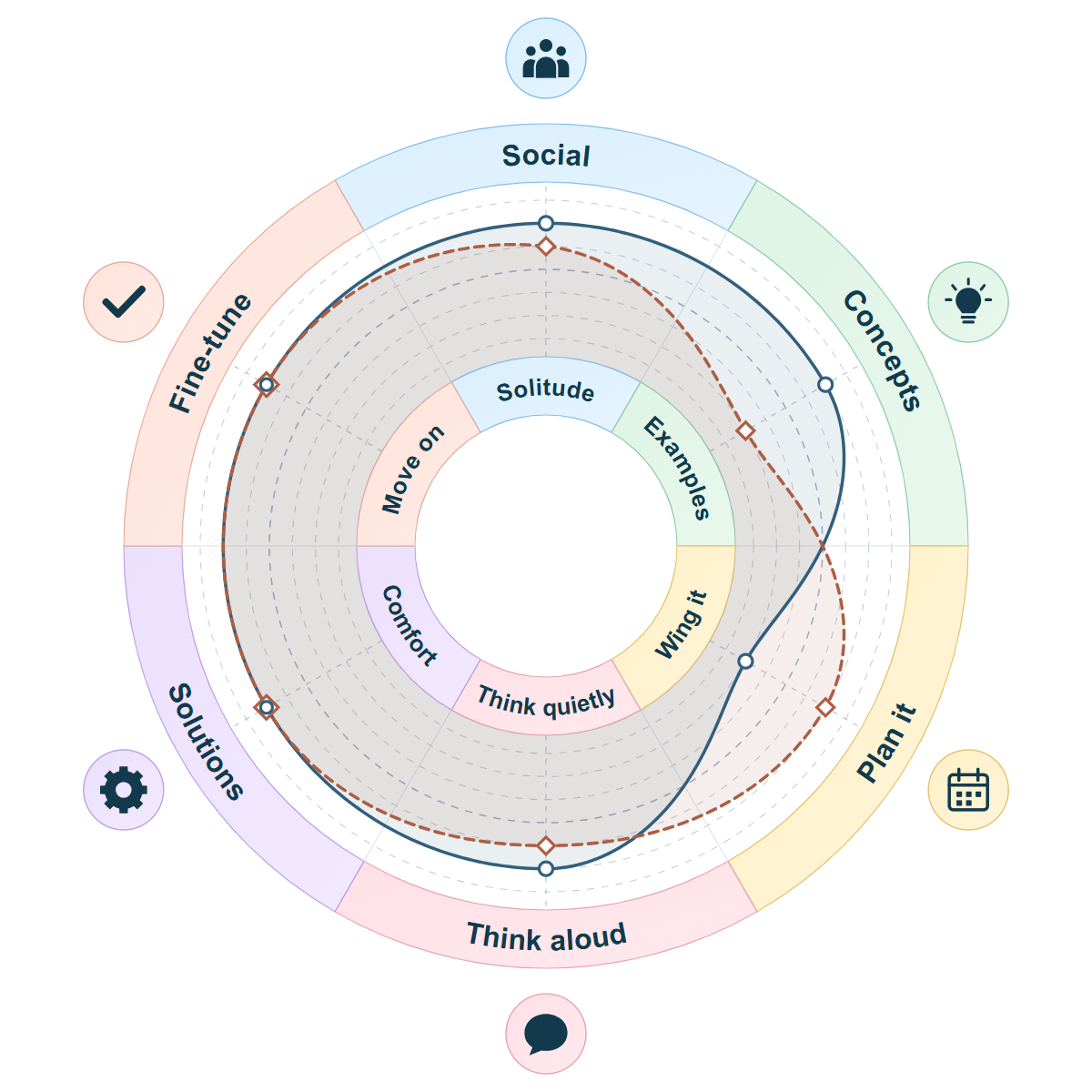
How to read the wheel
Each spoke follows a 1–7 scale. The source illustration has been cropped around the original wheel, without changing its lines or positions.
Recharging
1 = Time alone
7 = Time with people
Barack Obama: 6
Michelle Obama: 5
Learning something new
1 = Start with an example
7 = Start with the big idea
Barack Obama: 6
Michelle Obama: 2
Making plans
1 = Keep options open
7 = Decide ahead
Barack Obama: 2
Michelle Obama: 6
Finding your words
1 = Think before speaking
7 = Think by talking
Barack Obama: 6
Michelle Obama: 5
The support you offer
1 = Hear the feeling
7 = Work on the problem
Barack Obama: 6
Michelle Obama: 6
Knowing when it is done
1 = Good enough for its purpose
7 = Keep refining
Barack Obama: 6
Michelle Obama: 6
When one correction becomes a whole argument
Here is a possible difficulty in that combination that goes beyond one person liking plans and the other liking options.
Imagine a couple making a dinner reservation. One checks the confirmation and says, “That's Thursday. We were talking about Friday.”
The person who booked it starts explaining. The website kept jumping between dates. They were looking at two restaurants. They had the right evening selected before the page refreshed.
The other person repeats that the booking appears to be for Thursday.
Now the explanation gets longer. The person who made the reservation wants it understood that they can handle a simple booking. The person looking at the email wants to know whether they are going to change it.
They are no longer answering the same question.
One is trying to correct the detail. The other is trying to correct what they think the detail says about them. A small practical exchange has become a conversation about whether their partner respects their judgment.
The harder the first person pushes for a straightforward answer, the more accused the second feels. The more the second explains, the more the first feels that the actual issue is being avoided.
That is the loop illustrated below. Applied to these estimates, the correction would come more readily from Michelle's side and the explanation from Barack's. Either role could appear in an ordinary couple's life. We're exploring an imagined exchange, not describing an argument between them.
When a small correction starts feeling personal
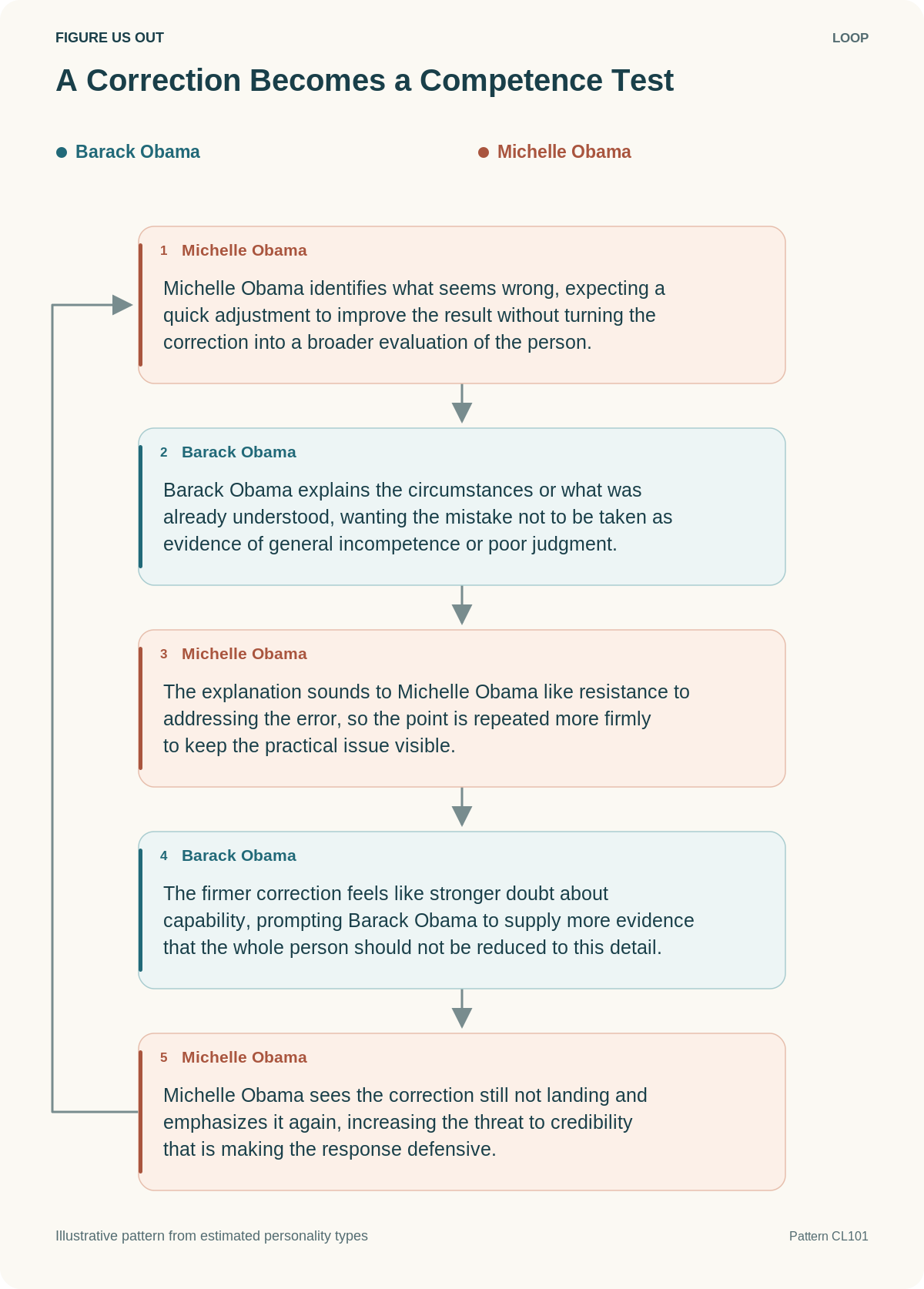
Michelle’s side points out an apparent error and expects a quick check or adjustment.
Barack’s side explains the circumstances so the detail won’t look like poor judgment.
Michelle’s side hears avoidance and repeats the correction more firmly.
Barack’s side feels more doubted and offers a longer defense.
The detail still seems unresolved, so Michelle’s side presses it again.
↻ Step 5 reinforces step 1, so the exchange can repeat.
The opening can stay small: “The email says Thursday. Can we check the date together?”
The answer can stay small too: “You're right, that's the wrong day. I'll change it.” Or, “I think the Friday booking is in a different email. Let's check.”
That last possibility matters. The correction may be mistaken. The goal is to find out what is true, rather than make one person prove that the other was wrong.
Knowing someone's usual competence doesn't require pretending they never make a mistake. Making a mistake doesn't erase all the times they've handled something well.
Your partner shouldn't need a defense lawyer to answer a question
What makes this pattern worth noticing is how quickly it can change the atmosphere of a relationship.
A person may become reluctant to ask about anything because a small question reliably starts a long defense. Their partner may become equally reluctant to take initiative because they expect the result to be picked apart.
Both lose something useful. Questions get postponed. Effort starts feeling risky. A pair of capable people can end up spending more energy explaining themselves than making the next decision.
In a combination with a strong wish to be effective and respected, a little precision helps. Keep the question about the thing in front of you. Leave words like “always” and “never” out of a conversation that only needs to establish which day dinner is booked.
There is also a useful distinction between explaining context and using context to delay an answer. You can acknowledge the mistake first and tell the story afterward. Once your partner knows the practical problem is being handled, they're more likely to hear the explanation as information rather than resistance.
And the person making the correction can notice effort without turning it into a ceremonial compliment. “Thanks for booking it. I think the date needs checking” is often enough.
Respect becomes believable in these small exchanges. It lives in whether a partner can be mistaken, ask a question, or change their mind without the whole person going on trial.
Being challenged can be part of feeling supported
Their public comments also offer a warmer view of what a different perspective can give you.
In a joint PEOPLE interview in June 2026, Barack praised Michelle's character and judgment. Michelle described how he had helped her imagine a broader life and different possibilities for her own work. Both spoke about what being with the other had made possible.
I like that because it gives both people something more interesting to do than keep the other one happy. A partner can help you become braver about one choice and more thoughtful about another.
Their estimated profiles suggest a strength along those lines: generating alternatives together, then finding a way to choose among them.
Imagine discussing whether to take a class, organize a neighborhood project, or finally try something you've talked about for years. One person sees three promising ways to do it. The other asks what would make the effort worthwhile and which option fits the time available.
If they agree on that priority, the practical question gives the ideas somewhere to go. It doesn't have to end the excitement. It can help them choose an idea they will actually enjoy pursuing.
The person generating possibilities still participates in making the chosen one happen. The person asking questions leaves room for an option they wouldn't have invented. Otherwise, “we balance each other” can quietly become one person creating work and the other absorbing it.
You can keep the difference and change the agreement
The familiar timing question offers another place to apply that approach.
For someone who likes an established plan, knowing when they will leave can free their attention for the rest of the day. For someone who likes room to respond, an open schedule can feel like part of the pleasure.
An imaginary couple heading to an event might agree on a departure time and still leave themselves a choice about dinner afterward. They don't need to settle every minute. They do need to mean the same thing by the commitments they make.
The person who prefers flexibility is responsible for the part they've agreed to keep fixed. The person who prefers structure needs to distinguish a necessary agreement from an extra detail they would simply enjoy deciding now.
That is a more useful goal than spending years hoping your partner will start experiencing time exactly as you do.
It also leaves room for affection. You can find someone's habits funny and still ask them to take your time seriously. You can appreciate their planning and still want a little space inside the plan.
Leave room for the people who had that first date
A long relationship can collect so many familiar complaints that they begin to sound like the whole story. The late departure. The extra question. The answer that turns into a speech.
But those are not the only things two people give each other. There is also the conversation you enjoy, the interest they take in your work, the occasion when their confidence helps you try something, and the ordinary evening you are glad to share.
In the estimated Obama pairing, both people could have a strong investment in getting things right. That energy could produce a lot of useful effort. It could also make a minor disagreement feel bigger than it needs to be.
A question to try the next time a correction starts growing:
“Are we checking this detail, or have we started arguing about what it says about me?”
You may still need to fix the reservation. You may also need to make it clear that fixing it won't change your opinion of the person who made it.
The most appealing part of a partnership like this is having someone whose judgment you value, whose company you enjoy, and whose differences can still teach you something. The practical arrangements can improve without requiring either person to stop being recognizable.
And there can still be ice cream afterward.
What could your own pairing show you?
Figure Us Out combines two personal guides, a couples guide, a 12-week workbook, and a downloadable book. Discover where your personalities could make life easier together and where a familiar misunderstanding may need a different response.
A little more to explore
The article follows a few possibilities. These optional graphics show the rest of the supplied strengths and patterns.
Three possible shared strengths
Alternatives With a Way to Choose
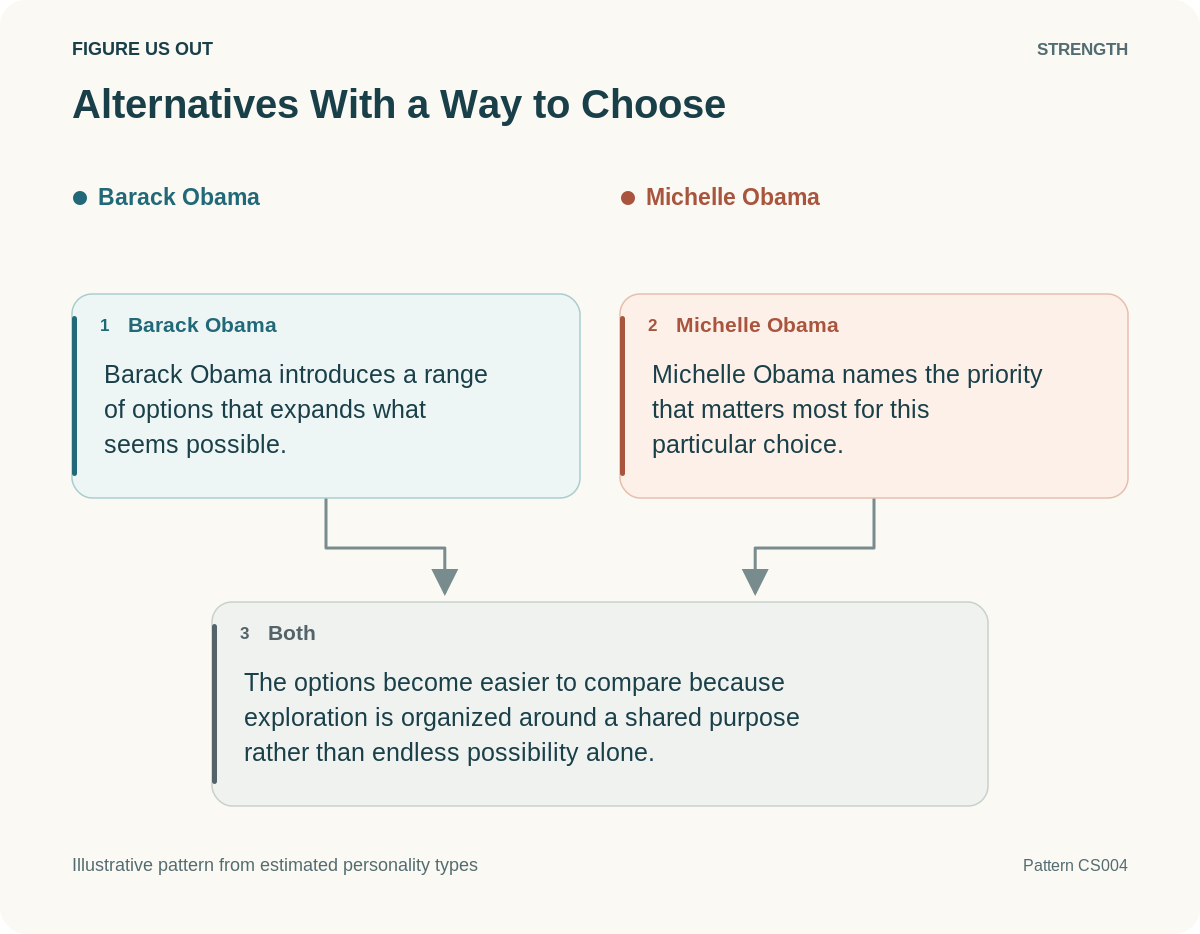
Read the steps
1. Barack Obama introduces a range of options that expands what seems possible.
2. Michelle Obama names the priority that matters most for this particular choice.
3. The options become easier to compare because exploration is organized around a shared purpose rather than endless possibility alone.
Contributions 1 and 2 both feed outcome 3. Neither contribution causes the other.
Try: Generate several genuinely different options, then choose one shared criterion before ranking them.
Calm With a Next Step
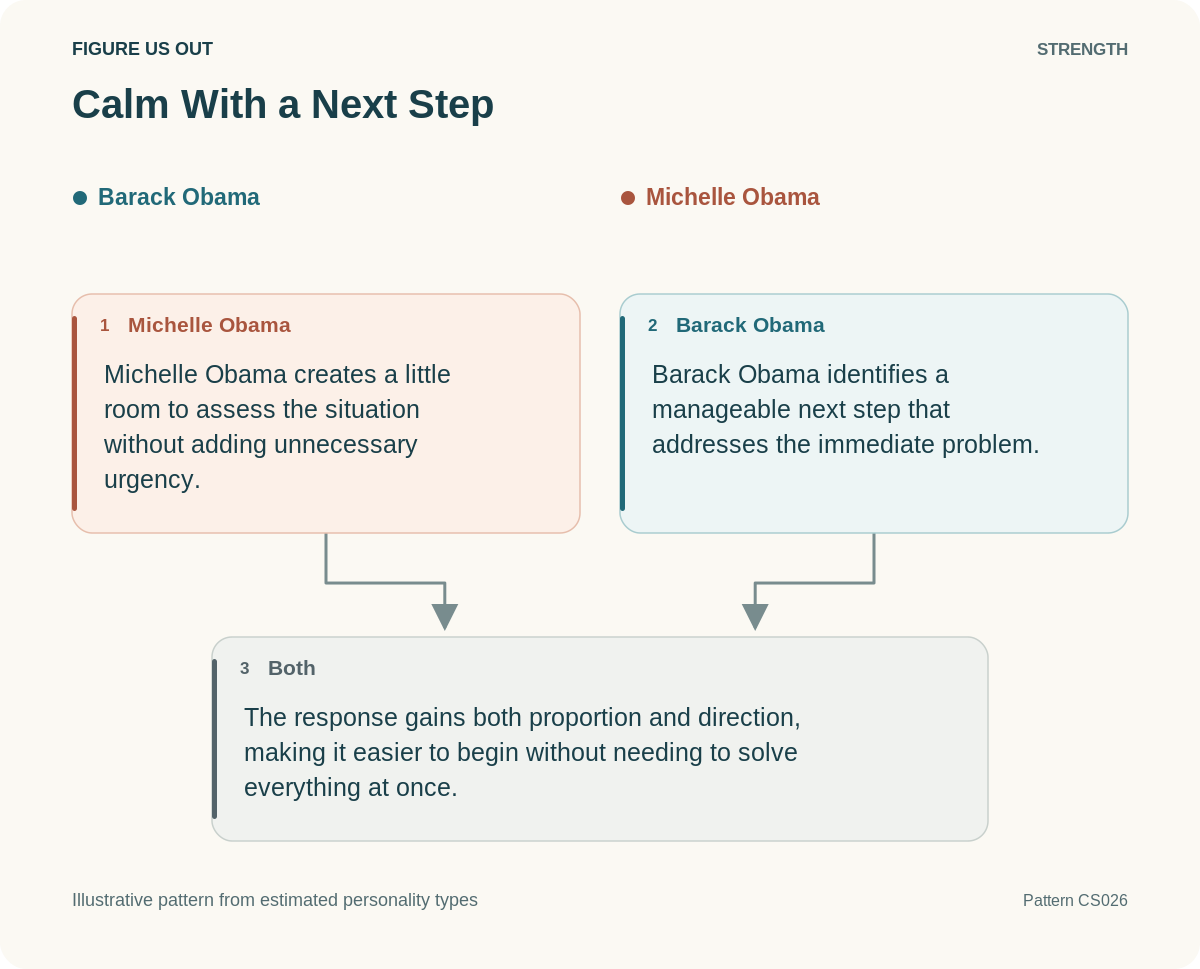
Read the steps
1. Michelle Obama creates a little room to assess the situation without adding unnecessary urgency.
2. Barack Obama identifies a manageable next step that addresses the immediate problem.
3. The response gains both proportion and direction, making it easier to begin without needing to solve everything at once.
Contributions 1 and 2 both feed outcome 3. Neither contribution causes the other.
Try: Name the immediate problem, take a breath-sized pause, and choose the next useful action rather than the entire solution.
Learning Side by Side
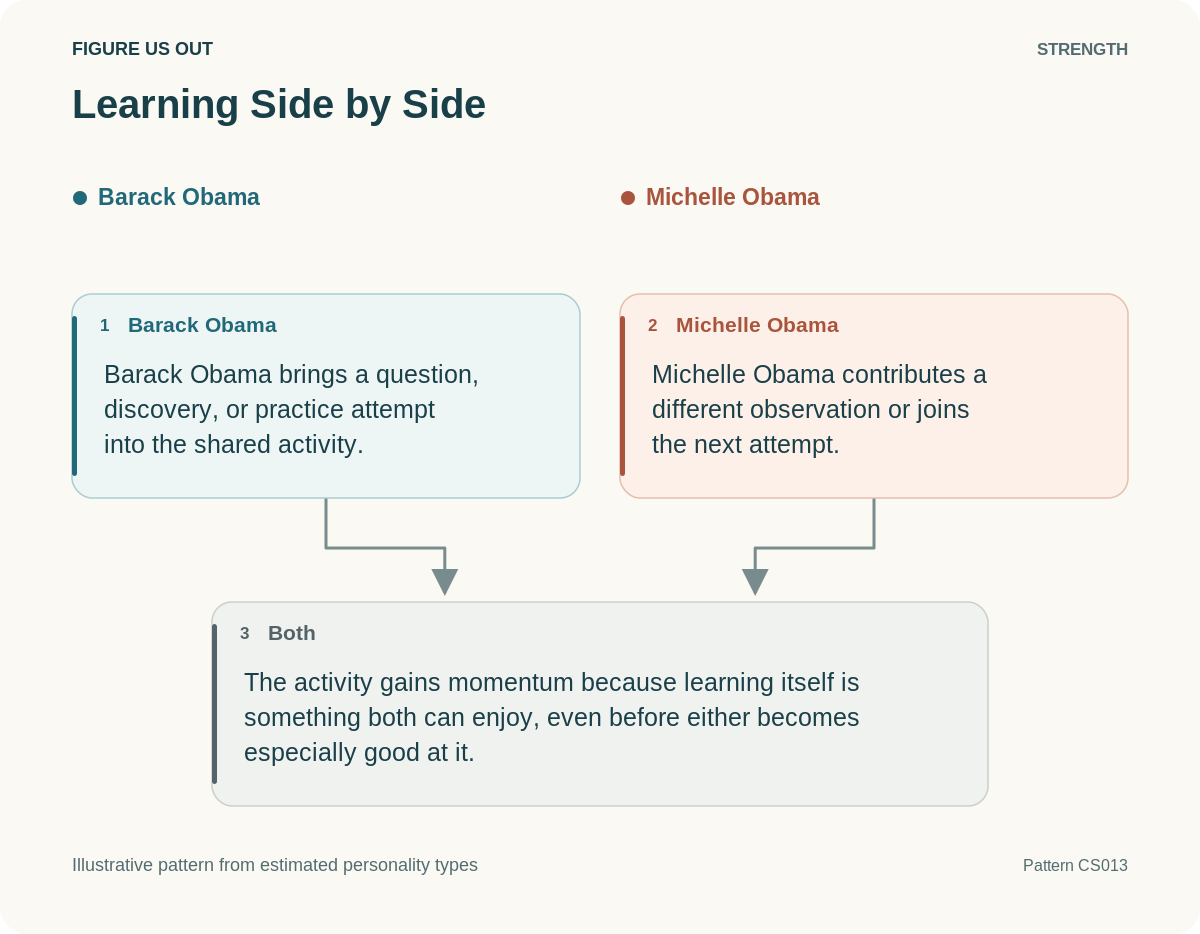
Read the steps
1. Barack Obama brings a question, discovery, or practice attempt into the shared activity.
2. Michelle Obama contributes a different observation or joins the next attempt.
3. The activity gains momentum because learning itself is something both can enjoy, even before either becomes especially good at it.
Contributions 1 and 2 both feed outcome 3. Neither contribution causes the other.
Try: Choose a manageable learning activity and share one discovery each after trying it.
Two other possible recurring patterns
Clear Plans, Open Possibilities
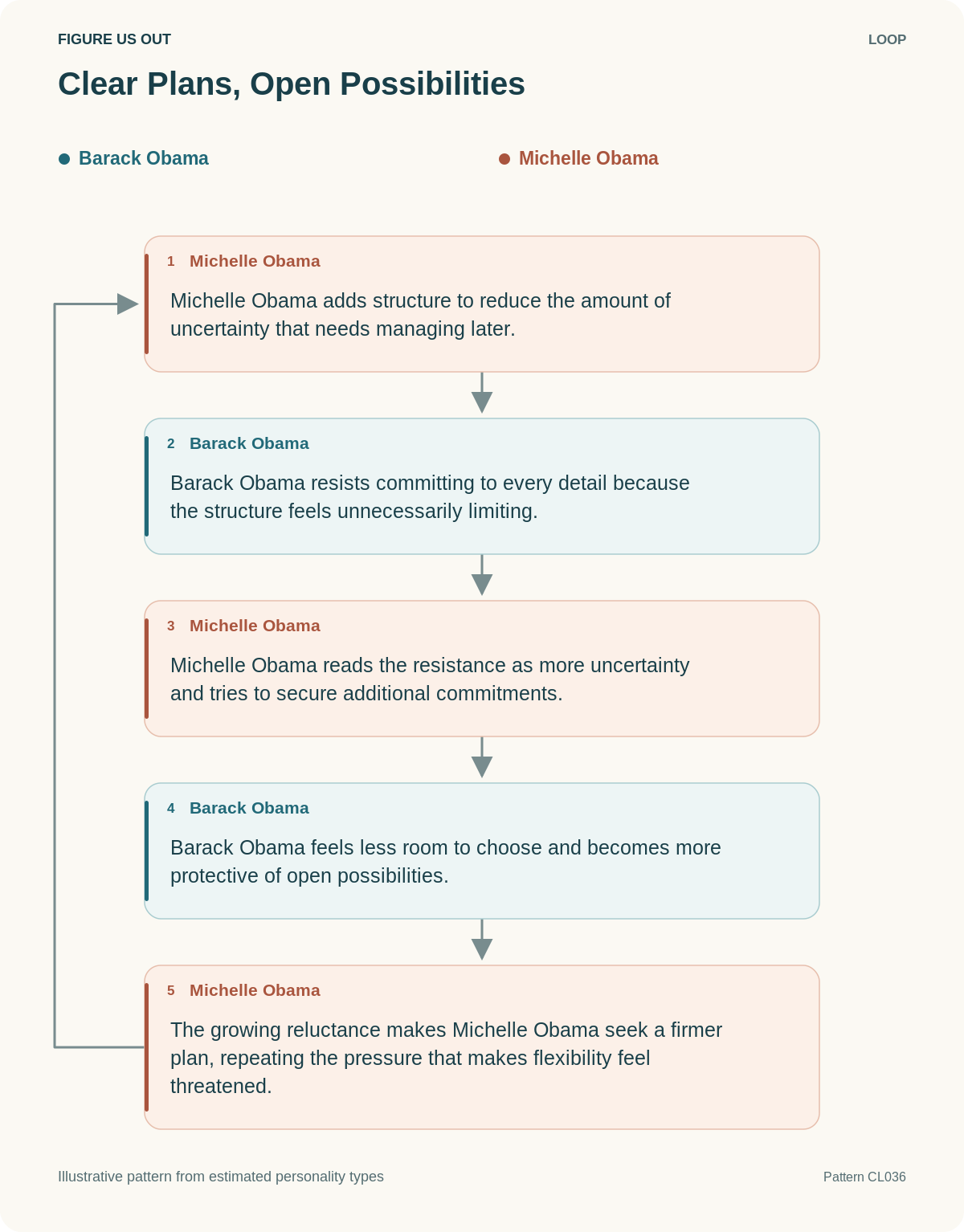
Read the steps
1. Michelle Obama adds structure to reduce the amount of uncertainty that needs managing later.
2. Barack Obama resists committing to every detail because the structure feels unnecessarily limiting.
3. Michelle Obama reads the resistance as more uncertainty and tries to secure additional commitments.
4. Barack Obama feels less room to choose and becomes more protective of open possibilities.
5. The growing reluctance makes Michelle Obama seek a firmer plan, repeating the pressure that makes flexibility feel threatened.
Steps 1 → 2 → 3 → 4 → 5 → 1 form the repeating loop.
Try: Choose a small fixed core and a clearly open remainder.
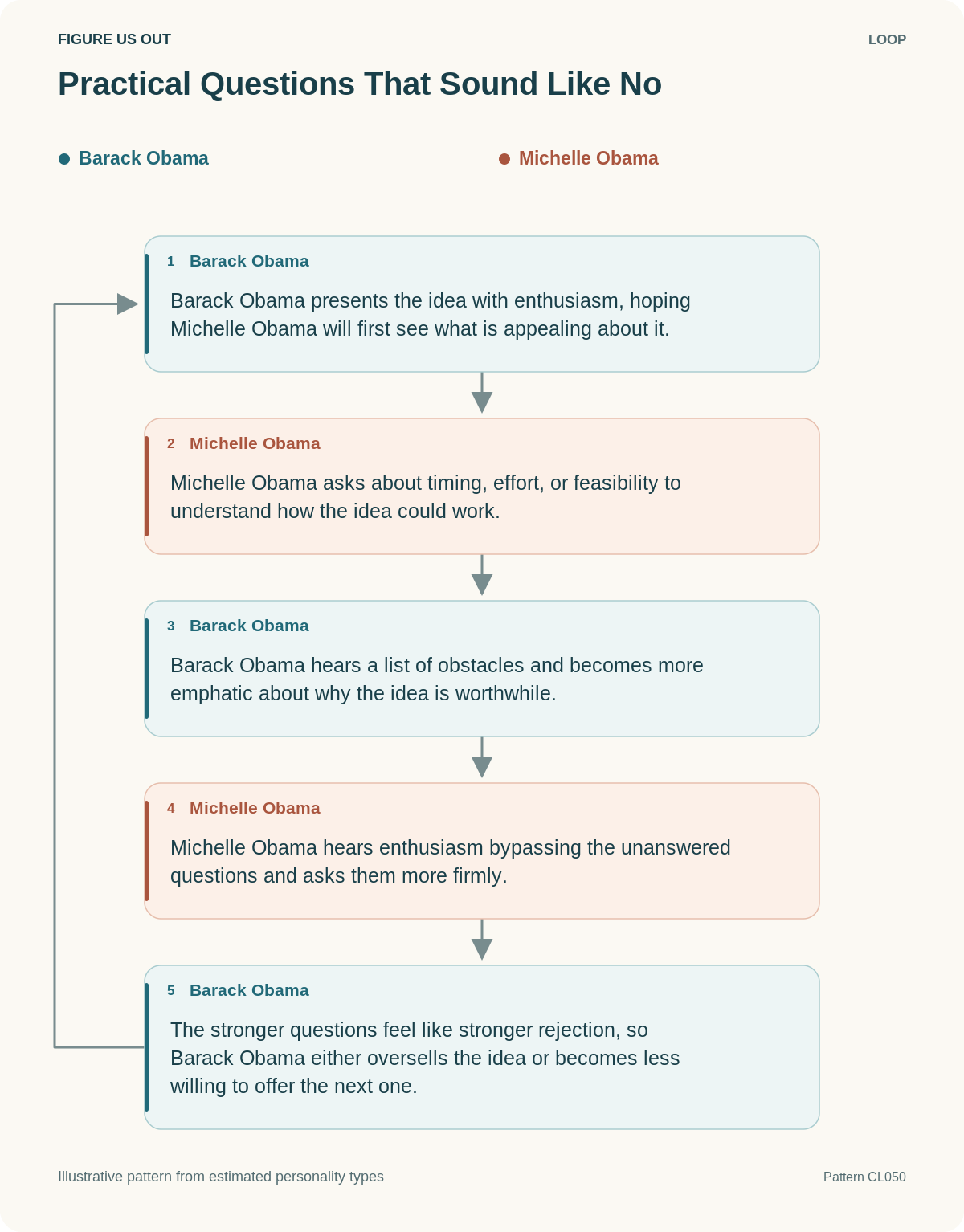
Practical Questions That Sound Like No
Read the steps
1. Barack Obama presents the idea with enthusiasm, hoping Michelle Obama will first see what is appealing about it.
2. Michelle Obama asks about timing, effort, or feasibility to understand how the idea could work.
3. Barack Obama hears a list of obstacles and becomes more emphatic about why the idea is worthwhile.
4. Michelle Obama hears enthusiasm bypassing the unanswered questions and asks them more firmly.
5. The stronger questions feel like stronger rejection, so Barack Obama either oversells the idea or becomes less willing to offer the next one.
Steps 1 → 2 → 3 → 4 → 5 → 1 form the repeating loop.
Try: Give the idea a moment of acknowledgment, then decide together whether to explore or evaluate it.
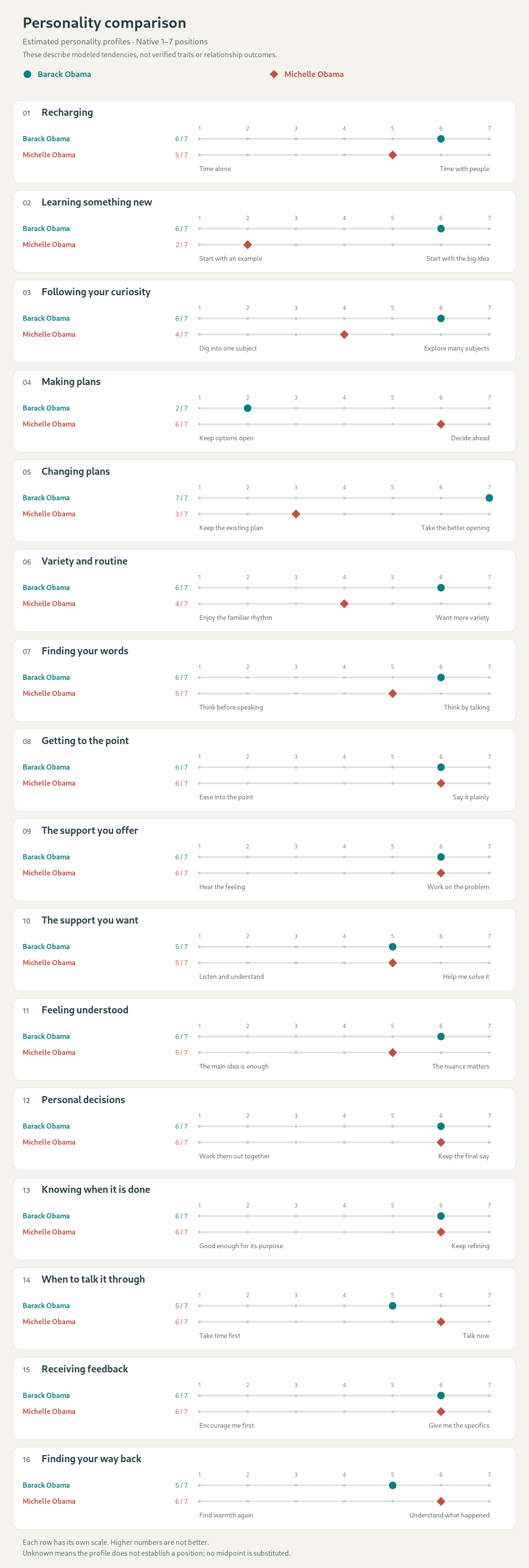
All 16 personality comparisons
Modeled preferences on the source 1–7 scales, not individual measurements. Neither end is better, and differences are not a forecast of relationship success.
Recharging
1 = Time alone7 = Time with people
Barack Obama: 6/7
Michelle Obama: 5/7
Learning something new
1 = Start with an example7 = Start with the big idea
Barack Obama: 6/7
Michelle Obama: 2/7
Following your curiosity
1 = Dig into one subject7 = Explore many subjects
Barack Obama: 6/7
Michelle Obama: 4/7
Making plans
1 = Keep options open7 = Decide ahead
Barack Obama: 2/7
Michelle Obama: 6/7
Changing plans
1 = Keep the existing plan7 = Take the better opening
Barack Obama: 7/7
Michelle Obama: 3/7
Variety and routine
1 = Enjoy the familiar rhythm7 = Want more variety
Barack Obama: 6/7
Michelle Obama: 4/7
Finding your words
1 = Think before speaking7 = Think by talking
Barack Obama: 6/7
Michelle Obama: 5/7
Getting to the point
1 = Ease into the point7 = Say it plainly
Barack Obama: 6/7
Michelle Obama: 6/7
The support you offer
1 = Hear the feeling7 = Work on the problem
Barack Obama: 6/7
Michelle Obama: 6/7
The support you want
1 = Listen and understand7 = Help me solve it
Barack Obama: 5/7
Michelle Obama: 5/7
Feeling understood
1 = The main idea is enough7 = The nuance matters
Barack Obama: 6/7
Michelle Obama: 5/7
Personal decisions
1 = Work them out together7 = Keep the final say
Barack Obama: 6/7
Michelle Obama: 6/7
Knowing when it is done
1 = Good enough for its purpose7 = Keep refining
Barack Obama: 6/7
Michelle Obama: 6/7
When to talk it through
1 = Take time first7 = Talk now
Barack Obama: 5/7
Michelle Obama: 6/7
Receiving feedback
1 = Encourage me first7 = Give me the specifics
Barack Obama: 6/7
Michelle Obama: 6/7
Finding your way back
1 = Find warmth again7 = Understand what happened
Barack Obama: 5/7
Michelle Obama: 6/7
View the original full comparison chart
The full chart scrolls horizontally on smaller screens.