
Taylor Swift and Travis Kelce: When Your Biggest Fan Joins the Show
A friendship bracelet, a top hat, and the fun of loving someone who actually wants to join in.
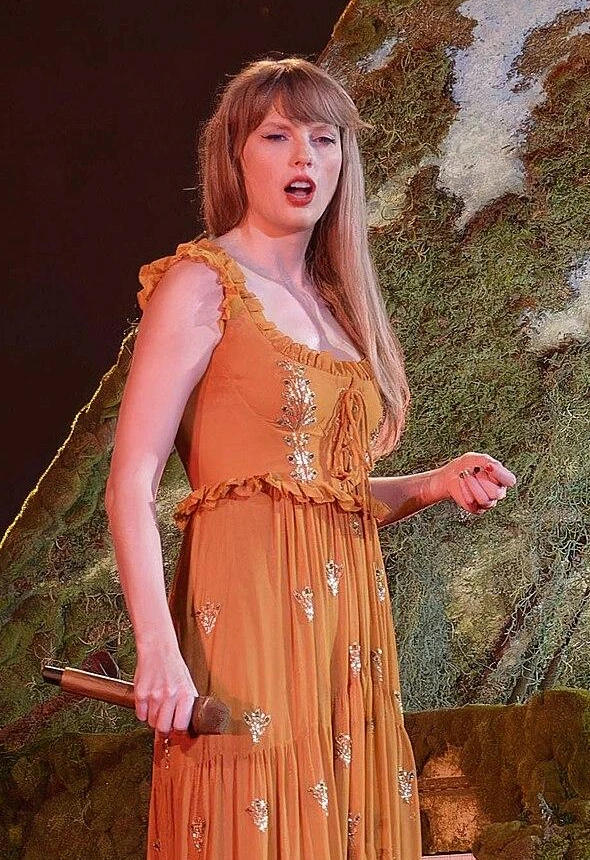

Travis Kelce went to a Taylor Swift concert with a friendship bracelet and a plan. The bracelet had his phone number on it. The plan did not go particularly well.
He didn’t get the chance to give it to her, so he told the story on his New Heights podcast in July 2023. His brother Jason asked whether he meant his jersey number or his phone number. Travis replied, “You know which one.”
As attempts to ask someone out go, announcing yours on a podcast is quite a commitment. Apparently, it helped. Taylor later told TIME that they started spending time together soon afterward. By the time she attended her first Chiefs game, they were already a couple.
An engagement followed in August 2025, and they married in New York on July 3, 2026. But one of the funniest stops along the way involved Travis getting considerably closer to the Eras Tour than the audience.
He was very willing to wear the top hat
At Wembley in June 2024, Travis appeared onstage in a tuxedo and top hat, danced, and carried Taylor over to a sofa as part of the show. His main concern, he explained afterward, was simple: “Do not drop Taylor.”
Fair enough. That would be a difficult thing to explain at dinner.
The part I like is that joining the show had been his idea. He mentioned it, Taylor laughed, and then she asked whether he would seriously be interested. He was. What began as a joke became a part they could enjoy together.
There’s something appealing about that kind of company. You have a thing you love, and the person you’re with finds a way to enjoy it alongside you. You don’t have to spend the whole evening wondering whether they’re bored or counting the minutes until you leave.
Most of us are working with a much smaller audience. But having someone who will join your ridiculous dance in the kitchen can still be a pretty good reason to love them.
Sometimes you’re both up for it
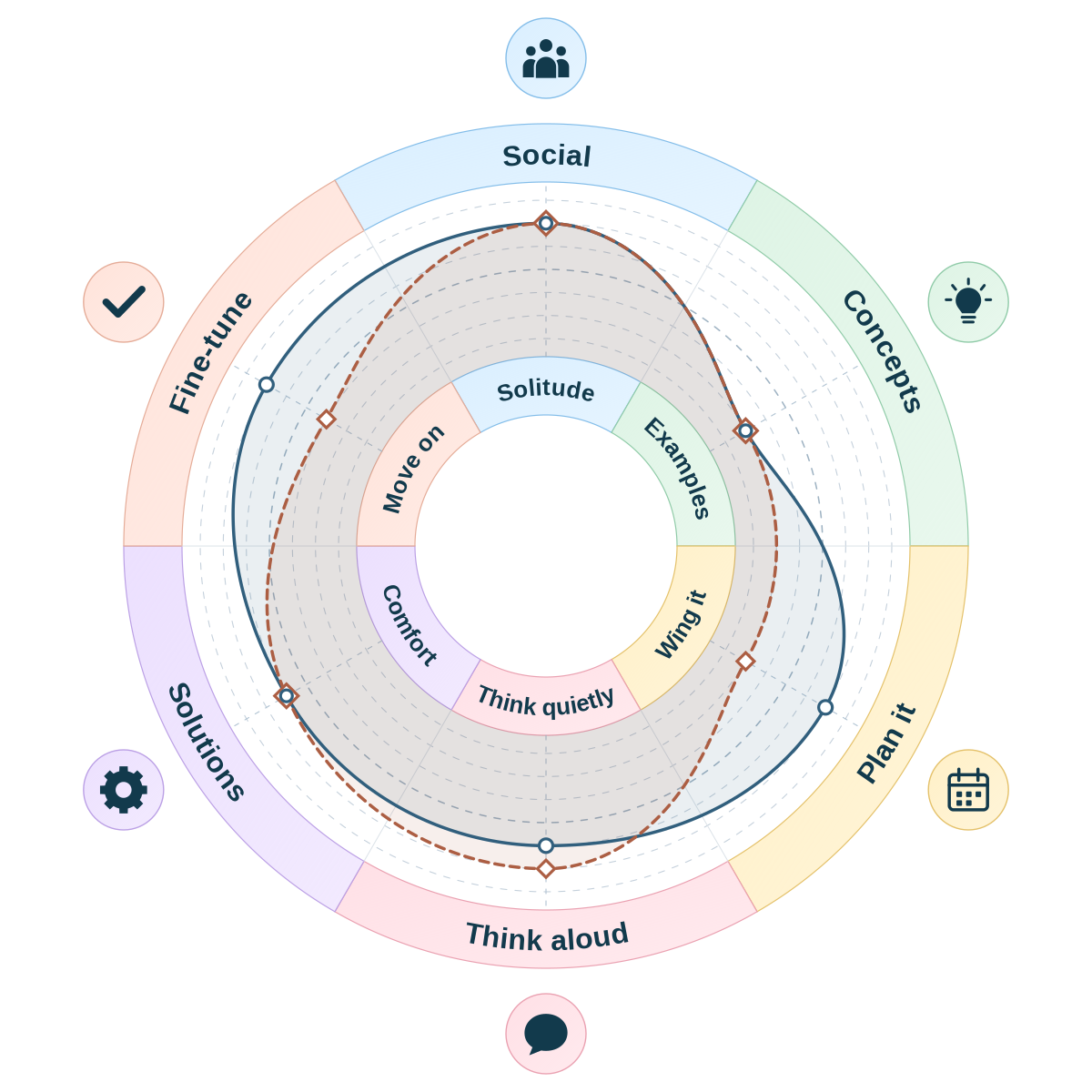
For this Figure Us Out article, we’re exploring Taylor as ESFJ 3w2 and Travis as ESFP 7w6. In everyday language, that suggests two people who enjoy company, get involved, and are often ready to help. Taylor’s combination puts more emphasis on preparing and doing something well; Travis’s leaves more room to try things and see what happens.
A quick note: These types are estimates from public personality discussions, not results Taylor or Travis gave us. Travis’s Enneagram wing is less certain. Their interviews tell us what they’ve shared; the charts and imagined situations below explore possibilities, not private events. Neither has endorsed Figure Us Out.
One of the appealing possibilities here is shared playfulness. A silly suggestion has somewhere to go. One person starts the joke, the other adds to it, and now grocery shopping has become a competition to find the most questionable snack.
There’s room for practical teamwork, too. In this pairing, both profiles lean toward offering useful help and getting things moving. Someone says they want to host dinner, and both can have ideas about how to make it happen. They still need to compare notes before discovering they’ve each invited twelve people.
Being alike in those ways doesn’t mean they would want the same amount of planning or polishing. One might be enjoying the party while the other still sees three things that could make it better. You can share the enthusiasm and have a different answer to when something is good enough.
Their personalities, at a glance
Taylor’s estimated profileTravis’s estimated profile
When a compliment starts turning into homework
That combination of ambition, helpfulness, and enthusiasm brings up a less obvious question: what happens when you’re excited about something your partner could do, but they don’t actually want to do it?
Imagine your partner bakes a wonderful cake. You tell them they could sell these. They laugh and say they just enjoy making them occasionally. But you’re serious. You start suggesting prices, packaging, maybe a stall at the weekend market.
You think you’re helping them see how talented they are. They’re wondering how making dessert turned into running a business.
When they hesitate, you hear a lack of confidence and encourage them harder. They feel less free to say no, so they push back. Now you’re frustrated because you believe in them, and they’re frustrated because you don’t seem to believe their answer.
You can believe someone would be brilliant at something they don’t want to do.
When encouragement starts feeling like pressure
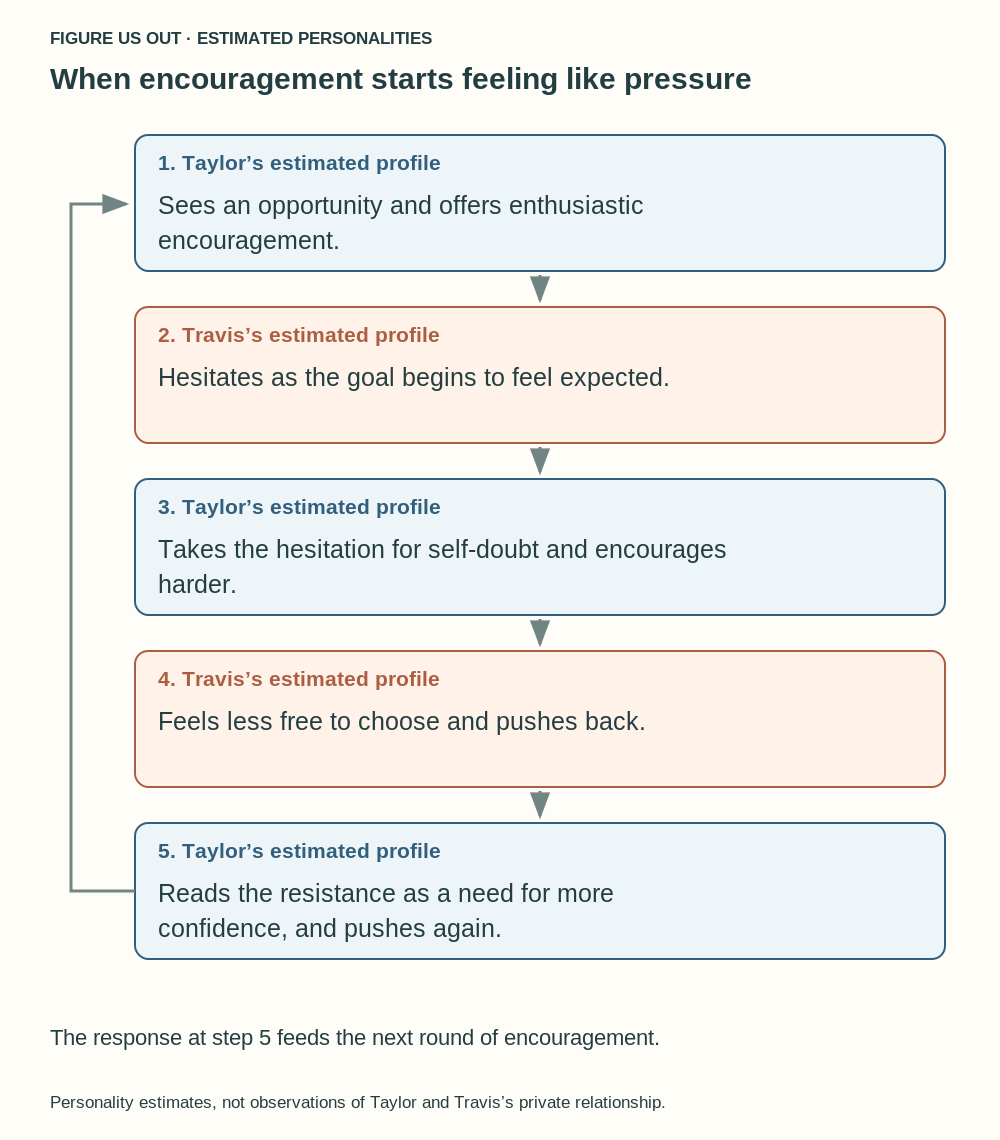
- Taylor’s estimated profile
Sees an opportunity and offers enthusiastic encouragement.
- Travis’s estimated profile
Hesitates as the goal begins to feel expected.
- Taylor’s estimated profile
Takes the hesitation for self-doubt and encourages harder.
- Travis’s estimated profile
Feels less free to choose and pushes back.
- Taylor’s estimated profile
Reads the resistance as a need for more confidence, and pushes again.
↶ The last response feeds the first, and the loop repeats.
That’s a possible loop in Taylor and Travis’s estimated pairing, not a claim that it happens between them. Taylor’s achievement-minded, helpful combination could be quick to see an opportunity; Travis’s more open-ended combination could be more interested in keeping the activity enjoyable and chosen. Neither description tells us how ambitious, capable, or hardworking the actual person is.
The useful question is easy to ask: “Would you enjoy taking this further, or do you like it the way it is?” Then let the answer count. You can keep admiring the cake without putting a price tag on it.
Sometimes being their biggest fan is enough
Taylor shared a smaller, sweeter example of support at the 2024 MTV Video Music Awards. Accepting video of the year for “Fortnight,” she recalled hearing Travis cheer from across the set after a take. She thanked him for bringing “happiness and fun and magic” to the shoot.
I like that the thing she remembered was how much more enjoyable it made the day. There are plenty of ways to support someone besides finding their next opportunity or suggesting how to improve what they’re doing.
You can come along, pay attention, laugh with them, or notice the part they worked hard on. And when you’re on the receiving end, saying what you appreciated helps your partner understand what actually mattered. “I liked having you there” can tell them something an automatic thank-you doesn’t.
The Wembley story has that same useful detail: Taylor checked whether Travis really wanted to join in. Enthusiasm had somewhere to go because it was his enthusiasm, too.
Find the version you both enjoy
A shared life doesn’t require matching excitement about every activity. Your partner can love you and have absolutely no desire to join your running group. They can be proud of your work without wanting to help turn every good idea into a bigger project.
At Figure Us Out, we want understanding each other’s personalities to make those differences easier to live with. Keep the willingness to help. Keep the fun. Just check whether you’re helping with something your partner wants, rather than something you’ve decided would be good for them.
For a couple with these tendencies, one person might appreciate a little more planning while the other wants some room to improvise. That can be worked into what they do together without either becoming the permanent organizer or the person who never follows through.
Taylor and Travis’s public story gives us a particularly entertaining picture of two people joining in. But you don’t need a stadium-sized gesture to borrow something from it. Ask your partner what they would like you to be part of, and listen to the answer.
They might want help. They might want someone to cheer. And occasionally, they might have a spare top hat.
What do your personalities bring out in each other?
You and your partner might share the same sense of fun and have completely different ideas about what comes next. Figure Us Out helps you look at both personalities together, including what feels natural and where you might keep misunderstanding each other.
You each complete your own assessment. The couples package includes a personal guide for each of you, a shared couples guide, and a 12-week workbook, with a downloadable book you can print. One purchase covers both of you, with no subscription.
Enjoy the personality details?
Here are a few more possibilities from the same estimated pairing. Open whichever catches your interest.
A strength: someone to be silly with
One person makes a playful invitation and the other joins in. Both contributions make the moment more enjoyable. It works when the humor is welcome, not when someone feels expected to laugh.
Someone to be silly with
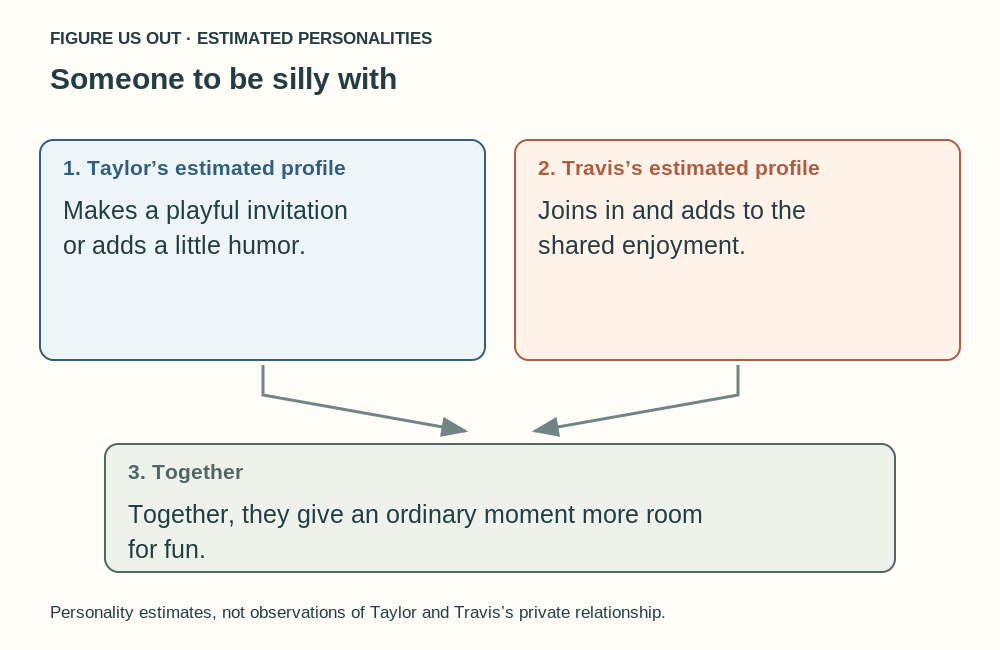
Makes a playful invitation or adds a little humor.
Joins in and adds to the shared enjoyment.
Both contribute ↓
Another loop: how much of the day needs a plan?
One person wants to settle the details so they can relax. The other wants to leave enough room for a good surprise. Agreeing on what needs to be dependable, and what can stay open, gives both something they need.
A plan, with a little room left in it
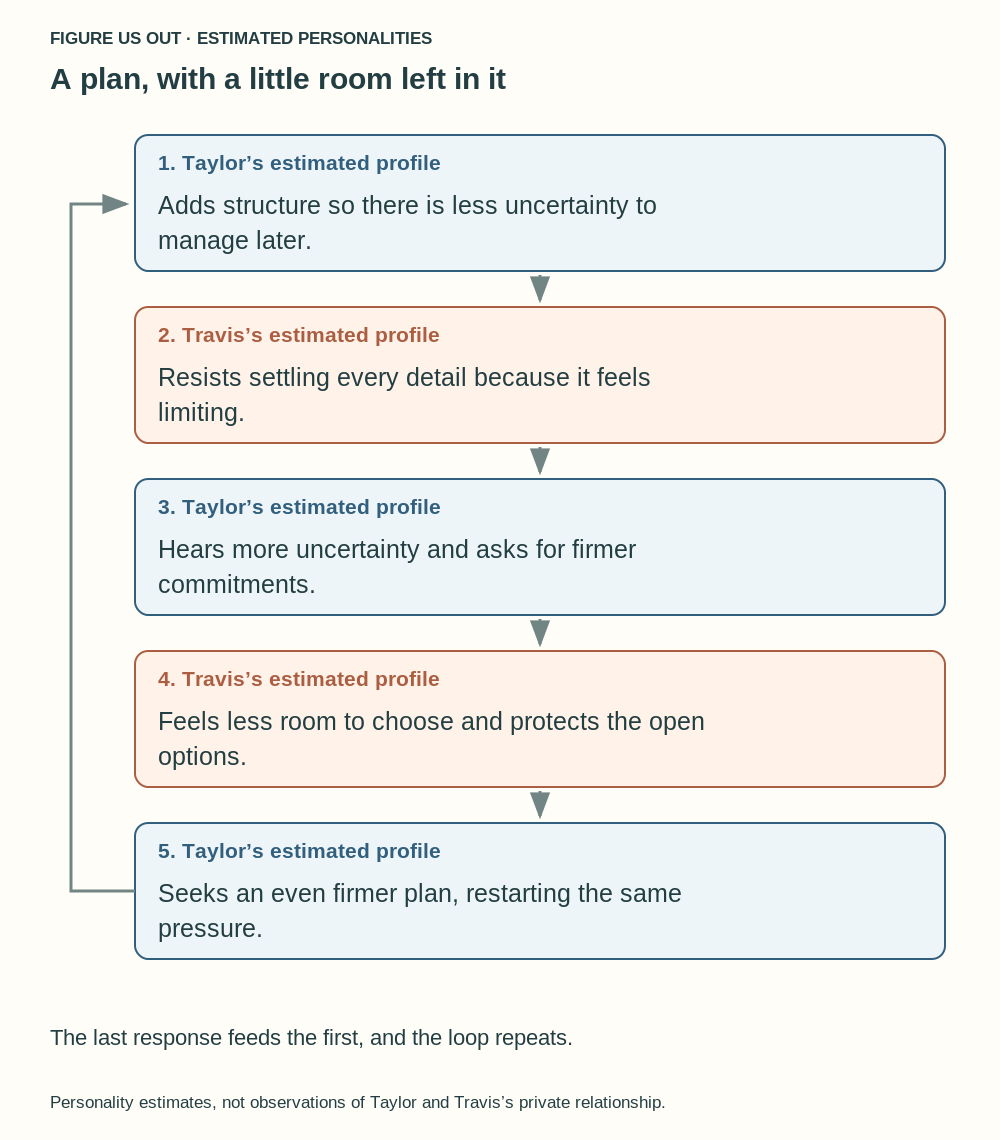
- Taylor’s estimated profile
Adds structure so there is less uncertainty to manage later.
- Travis’s estimated profile
Resists settling every detail because it feels limiting.
- Taylor’s estimated profile
Hears more uncertainty and asks for firmer commitments.
- Travis’s estimated profile
Feels less room to choose and protects the open options.
- Taylor’s estimated profile
Seeks an even firmer plan, restarting the same pressure.
↶ The last response feeds the first, and the loop repeats.
See all 16 everyday comparisons
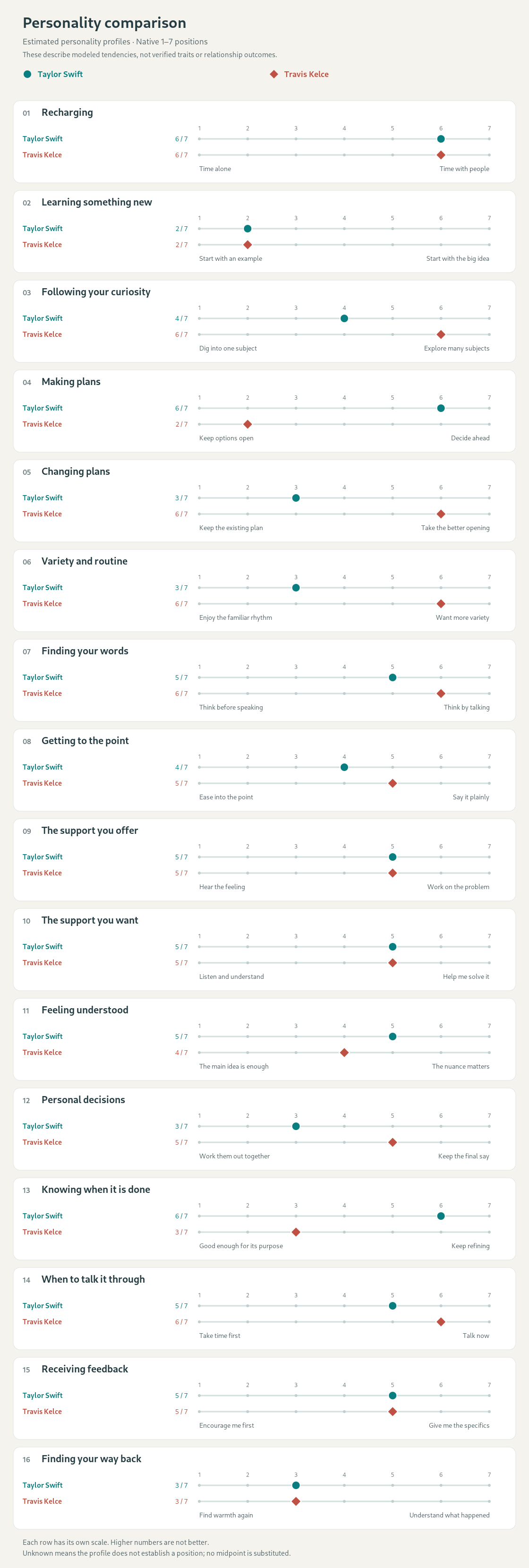
These are type-based estimates on the original 1–7 scales, not measurements taken from either person. A higher number means closer to the right-hand preference. Neither end is better.
Recharging
1 · Time alone7 · Time with people
Taylor: 6/7
Travis: 6/7
Learning something new
1 · Start with an example7 · Start with the big idea
Taylor: 2/7
Travis: 2/7
Following your curiosity
1 · Dig into one subject7 · Explore many subjects
Taylor: 4/7
Travis: 6/7
Making plans
1 · Keep options open7 · Decide ahead
Taylor: 6/7
Travis: 2/7
Changing plans
1 · Keep the existing plan7 · Take the better opening
Taylor: 3/7
Travis: 6/7
Variety and routine
1 · Enjoy the familiar rhythm7 · Want more variety
Taylor: 3/7
Travis: 6/7
Finding your words
1 · Think before speaking7 · Think by talking
Taylor: 5/7
Travis: 6/7
Getting to the point
1 · Ease into the point7 · Say it plainly
Taylor: 4/7
Travis: 5/7
The support you offer
1 · Hear the feeling7 · Work on the problem
Taylor: 5/7
Travis: 5/7
The support you want
1 · Listen and understand7 · Help me solve it
Taylor: 5/7
Travis: 5/7
Feeling understood
1 · The main idea is enough7 · The nuance matters
Taylor: 5/7
Travis: 4/7
Personal decisions
1 · Work them out together7 · Keep the final say
Taylor: 3/7
Travis: 5/7
Knowing when it is done
1 · Good enough for its purpose7 · Keep refining
Taylor: 6/7
Travis: 3/7
When to talk it through
1 · Take time first7 · Talk now
Taylor: 5/7
Travis: 6/7
Receiving feedback
1 · Encourage me first7 · Give me the specifics
Taylor: 5/7
Travis: 5/7
Finding your way back
1 · Find warmth again7 · Understand what happened
Taylor: 3/7
Travis: 3/7
Story sources and the personality estimates
The friendship-bracelet story · Sports Illustrated, July 26, 2023.
Taylor on how they started dating · TIME, December 2023.
Marriage confirmation · Reuters, July 3, 2026 (updated July 4).
Travis on the Wembley cameo · Sky News, July 3, 2024.
Taylor’s 2024 VMAs speech · Good Morning America, September 12, 2024.
Current couples package · Figure Us Out, checked October 15, 2026.
The working types come from Figure Us Out’s October 15, 2026 writer packet, using its saved October 8 typing research. Examples of the community sources are the Taylor discussion at Typology Central and Travis’s GetPersonality listing. These are editorial estimates, not independently verified assessments. Taylor is explored as ESFJ 3w2; Travis as ESFP 7w6, with 7w8 a competing wing estimate.
The comparisons and pattern illustrations use that packet. The cake example is invented to explain a possible interaction. Public anecdotes do not prove the types or establish private relationship patterns.

_(cropped).jpg)
_(cropped).jpg)