Celebrity couples · Figure Us Out
Blake Lively and Ryan Reynolds: The Double Date, the Bad Jokes, and the Art of Being on the Same Team
They fell for each other while out with other people. Their humor is famous, but there may be something even more useful in the way their personalities fit.
Blake Lively and Ryan Reynolds have an origin story that sounds as though somebody in Hollywood wrote it, then decided it was a little too convenient.
They met filming Green Lantern. At first they were friends. Later, when they were both single, they went on a double date. The awkward part was that they weren't each other's dates.
Ryan has described how obvious the chemistry between them became while the other two people sat there. By his telling, there were practically fireworks across the table. It's the sort of dinner story you can laugh about years later, although I imagine the other couple of people had a rather different review of the evening. 1
They started dating in 2011 and married in 2012. Since then, the public has watched them raise a family, work in films, make fun of each other online, and occasionally stop joking long enough to say something surprisingly tender.
And that last part is what I find interesting.
When someone is funny all the time, it's easy to miss what they're doing when they're serious.
Their jokes have a secret advantage
If you've followed Blake and Ryan for a while, you probably know their sense of humor. They've teased each other over birthdays, pictures and even the questionable choice of having pie instead of birthday cake. Once Blake mock-complained online that she couldn't believe they were still married after Ryan's pie-related birthday behavior. 2
The jokes work, at least publicly, because both appear willing to participate. Neither has to be the permanent comedian while the other sits there looking impressed. They pass the playfulness back and forth.
And there is something genuinely nice about being with a person who can turn a mundane afternoon into a shared joke. A grocery store trip is still a grocery store trip. But it can feel a little better when the person beside you finds the same silly thing funny.
Of course, humor has timing. A joke can be affectionate one day and deeply unwelcome another. The invitation matters more than the punch line. A person should be able to say, “I know you're kidding, but I'm serious about this,” and still feel safe being honest.
Two people who like to play, and one difference you might not notice
For this Figure Us Out exploration, we're using Blake as ESFJ 7w6 and Ryan as ENTP 7w8. Those are working estimates based on public personality discussions, not types the couple confirmed or results from our assessment. The examples below are imagined situations suggested by that pairing, not accounts of their private marriage. 3
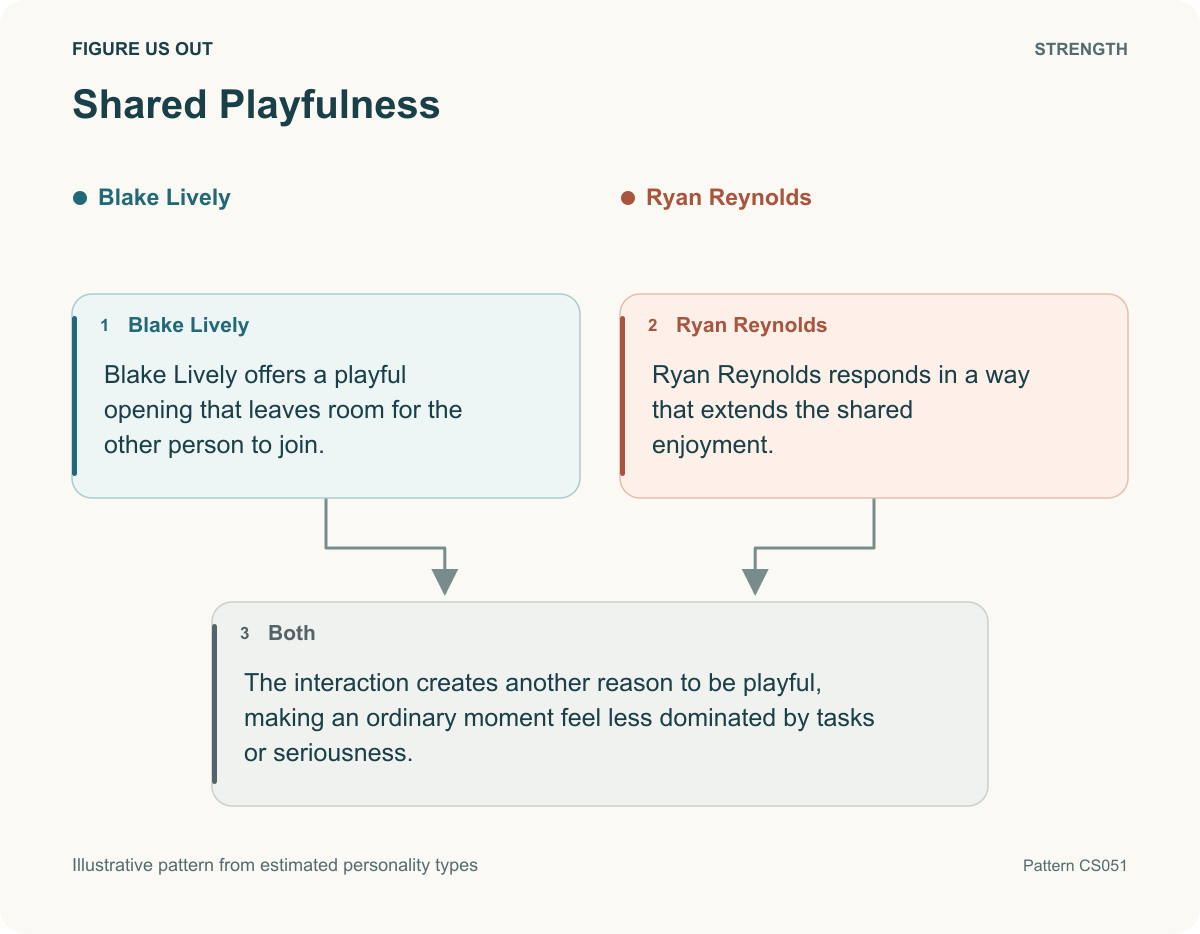
These profiles share quite a bit of social energy, curiosity and openness to having fun. That's consistent with why the source model highlights Shared Playfulness as one possible strength. Both can keep the joke going when the moment is right.
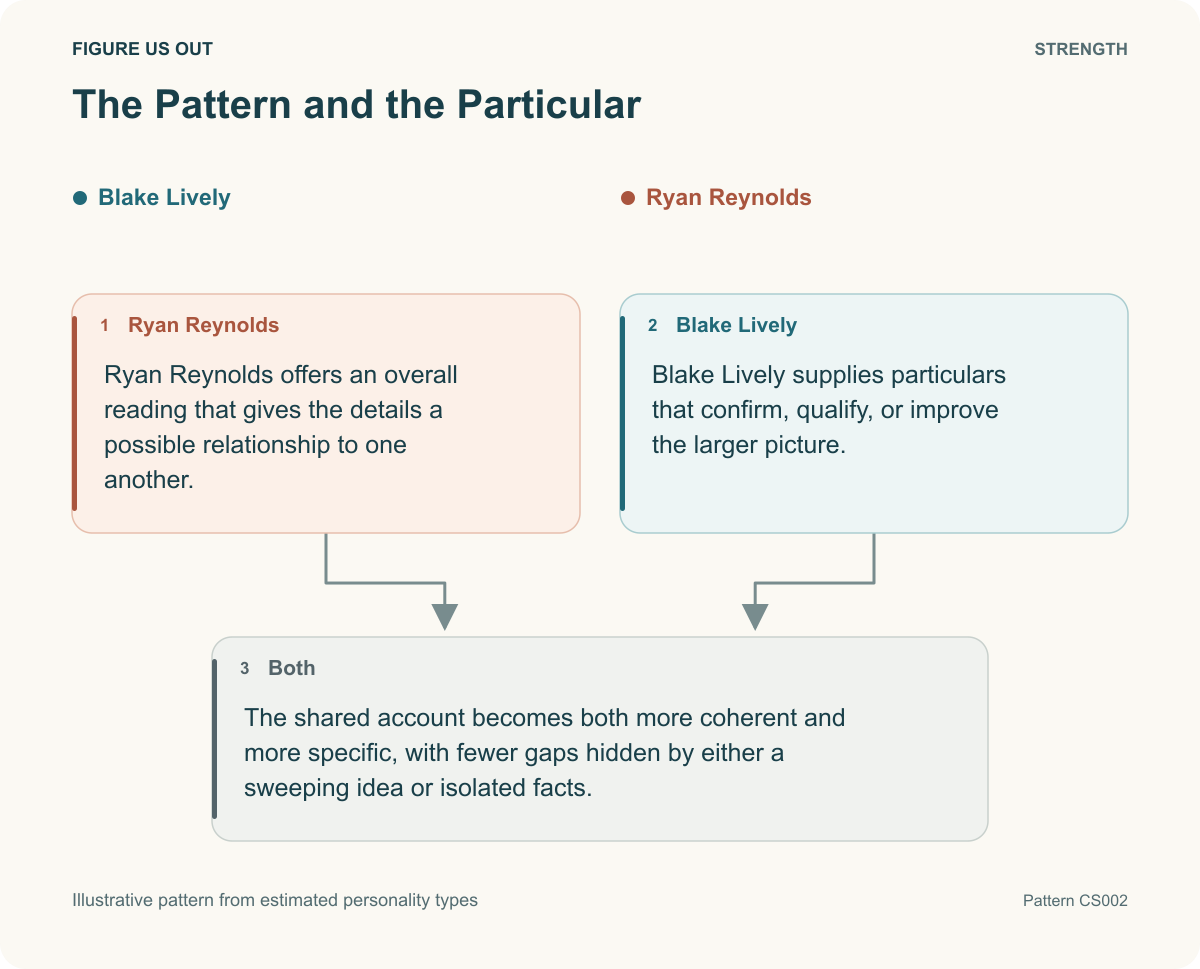
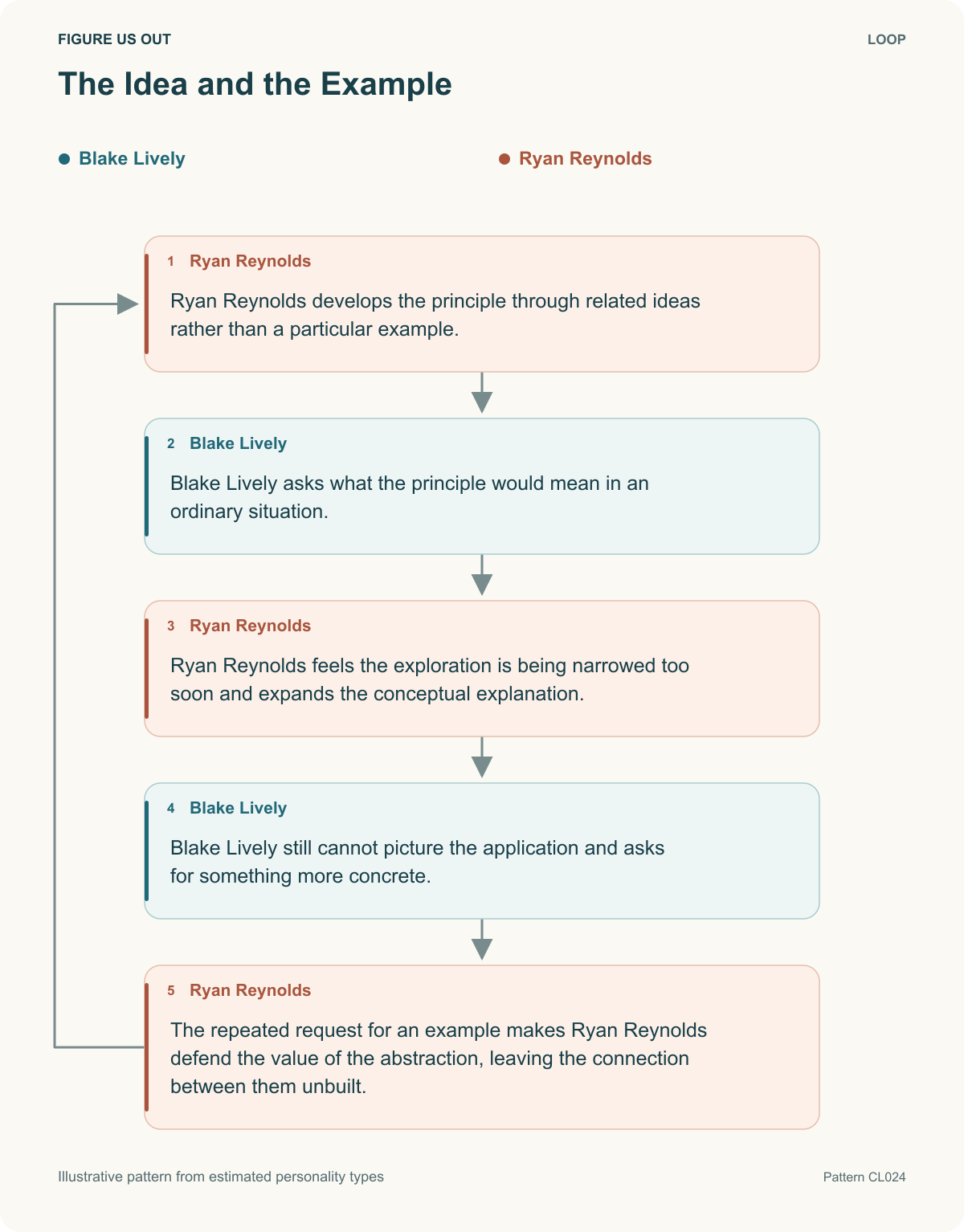
But the model also gives them different starting points for processing information. Blake's estimated profile is more likely to want an actual example, something specific that makes an idea real. Ryan's leans toward the big picture first: the concept, the possibility, the amusing connection.
Those two approaches can be excellent together. Someone says, “Wouldn't it be fun to do a whole themed movie night?” One immediately starts dreaming up the mood. The other remembers the food that made last time a hit or the practical detail that would make everyone comfortable.
They can also misunderstand each other. If you want to know whether the plan is actually good, a big idea can feel like somebody skipped a step. If you're enjoying the concept, detailed questions can sound like objections even when the other person is trying to join in.
Sometimes all you need is to say which conversation you're having: “I'm just playing with an idea,” or “Do you actually want to do this?”
It's amazing how much confusion can be avoided when an unfinished idea is allowed to stay unfinished for a while.
The romantic gesture I like more than the big ones
In 2024, Blake recalled that early in their relationship, Ryan would send her flowers every week. The sweet part wasn't simply the flowers. He included a card recalling a small thing that had happened between them that week. 4
That's a different sort of romance from booking the grandest restaurant or buying the biggest gift. It says, I was paying attention.
Sometimes people spend a fortune trying to make someone feel loved while overlooking the ordinary details that would have done it better. A single remembered sentence can mean more than an expensive surprise if it shows that your partner has been noticing your shared life.
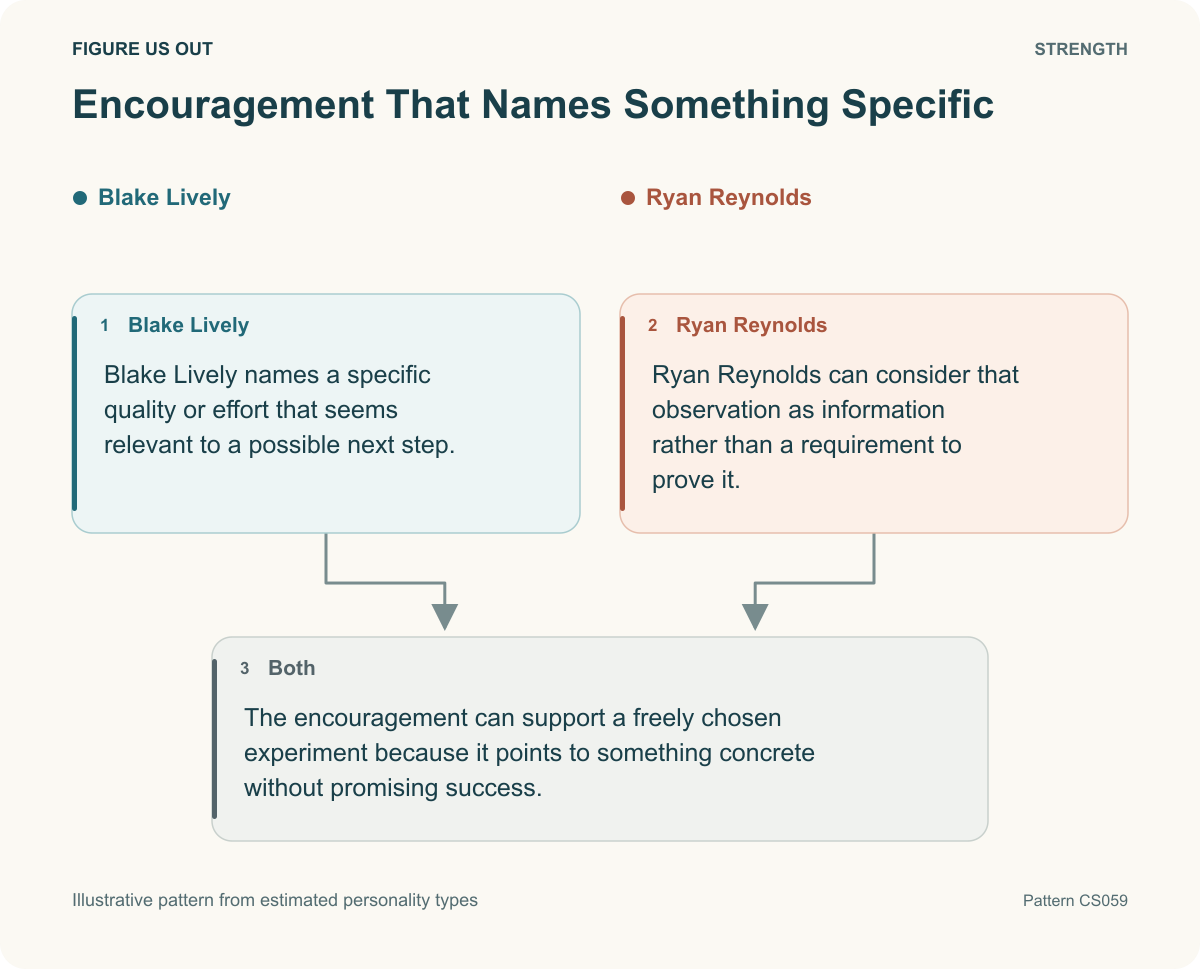
And the source model has a strength that fits this general idea: Encouragement That Names Something Specific. It's the difference between “You're amazing!” and “I saw how patiently you handled that conversation, and I admire it.”
Both are kind. One lets the person know exactly what you saw.
It's worth noticing how this fits alongside the teasing. Being playful together doesn't mean you can't be deeply attentive. Sometimes the person making fun of your birthday pie is also the person who remembers what you said on an ordinary Tuesday.
Can too much encouragement become pressure?
Here is a wrinkle that makes this estimated pairing more interesting than simply calling them two fun-loving people.
The selected model includes a possible pattern called “Encouragement That Stops Feeling Chosen.” One person sees potential in the other and starts offering more encouragement, suggestions or opportunities. The intention is good. But the other person can start hearing those invitations as a set of expectations. 3
Think of a partner who has started painting again. They make something beautiful and show it to you. You're delighted. You tell them they should sell prints, start an account, make a website, maybe take commissions.
Meanwhile, they were hoping you'd simply enjoy the painting.
The next time they pick up a brush, the hobby suddenly feels a little like an assignment. They paint less. You notice the hesitation and encourage them even more, because you don't want them to waste their talent.
Both of you might be trying to protect something valuable. One wants the person they love to know how capable they are. The other wants to keep enjoying an activity without having to justify what it might become.
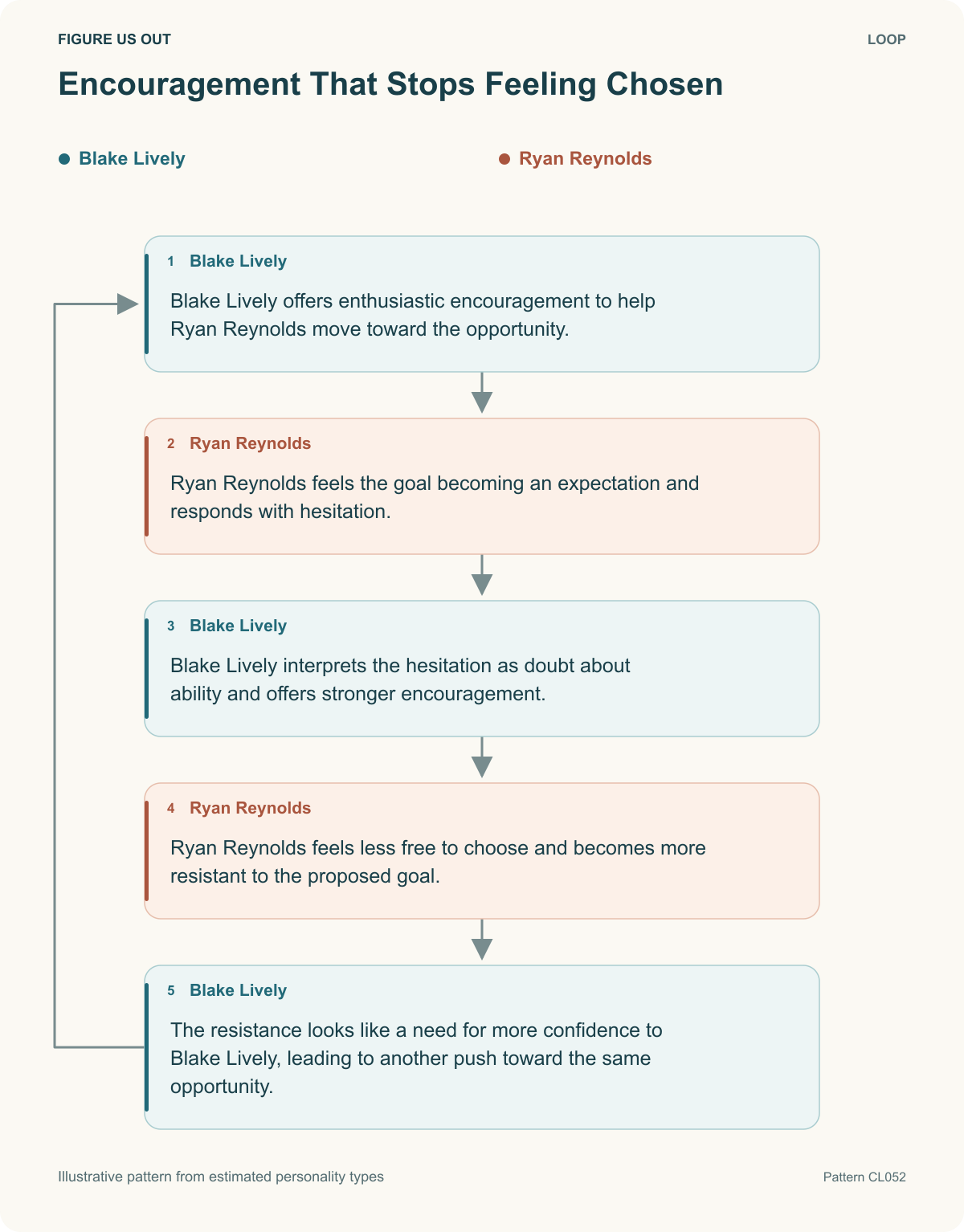
Encouragement That Stops Feeling Chosen
Blake Lively offers enthusiastic encouragement to help Ryan Reynolds move toward the opportunity.
Ryan Reynolds feels the goal becoming an expectation and responds with hesitation.
Blake Lively interprets the hesitation as doubt about ability and offers stronger encouragement.
Ryan Reynolds feels less free to choose and becomes more resistant to the proposed goal.
The resistance looks like a need for more confidence to Blake Lively, leading to another push toward the same opportunity.
↺ How this loops: the final response encourages more of the original reaction.
The important distinction is this: believing in someone's potential is not the same as deciding what they should do with it.
You can admire a gift without turning it into a business plan. You can cheer for an ambition while leaving the ambition in its owner's hands.
A question such as “Do you want ideas, or do you just want me to enjoy this with you?” isn't taking your enthusiasm away. It's making sure your encouragement lands as support rather than another demand.
A rule they made before life got complicated
There is one publicly described decision that I think says something more substantial about being a team than a perfect red-carpet photo.
In a 2024 conversation, Blake said she and Ryan made an agreement early in their relationship that they wouldn't work at the same time. The intention was to keep their home life from always coming second to two demanding entertainment careers. 5
That's a real decision with a cost. An opportunity can arrive at an inconvenient moment. Someone may need to say no or wait. A good-sounding idea meets the reality of a household with a calendar, responsibilities and other people who matter.
I'm not claiming we know every exception or how that agreement has worked over the years. Public interviews are only a window. But the intention behind it is easy to recognize: they wanted their work decisions to take their shared life into account.
In the personality pairing, that kind of agreement matters because one person may be more inclined to settle the key parts of a plan while the other is more comfortable keeping options open. Neither is wrong. But a family cannot live indefinitely on a collection of interesting possibilities.
Sometimes the loving thing is a firm plan. Sometimes it's room to change that plan. The two people involved need to know which parts they can count on.
There's also a nice balance between choosing to encourage your partner and leaving them freedom to make their own decisions. An agreement works best when both people genuinely own it.
Friendship gets to be part of the marriage
Blake has said that friendship mattered enormously in deciding she wanted to marry Ryan. She admired having someone she could genuinely like as well as love. 6
I think that's a beautiful distinction. Romantic attraction is wonderful, but a life together contains an awful lot of uneventful Tuesdays. Someone has to pick up milk. Someone forgot a phone charger. Someone's joke is terrible and somehow you laugh anyway.
The public story of this marriage includes much more complicated material than a few cheerful social-media posts, and there's no reason to pretend we know its private reality. Still, the friendship they have described is a meaningful part of the story they're choosing to share.
For readers, the useful question isn't whether you and your partner are equally funny or spontaneous. It's whether the fun you offer is fun for both of you, and whether the encouragement you give leaves the other person free to be themselves.
At Figure Us Out, we work from the belief that core personality differences are things to understand, not flaws to erase. You can become more thoughtful about when to joke, when to listen, when to offer an idea and when to put the whole idea away.
The next time your partner shows you something they're proud of, maybe ask yourself: “Am I celebrating what they enjoyed, or am I already planning what they should do next?”
There's room for a wonderful relationship in that little pause.
What do you and your partner bring out in each other?
Figure Us Out helps two people explore where their personalities naturally fit, where everyday misunderstandings can begin, and how to be more considerate without becoming the same person. The couples package includes both personal guides, a shared relationship guidebook and a 12-week workbook, together in a book you can download and print. One payment covers both of you, with no subscription.
Explore your own relationship at Figure Us Out
Explore more relationship strengths and loops
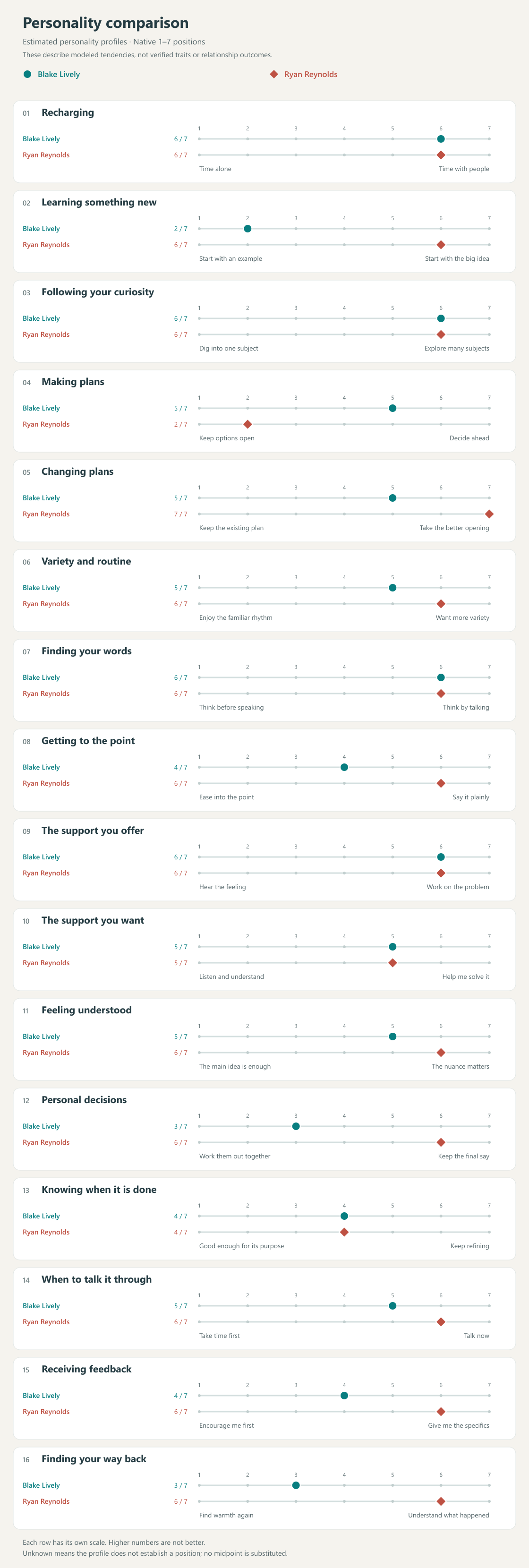
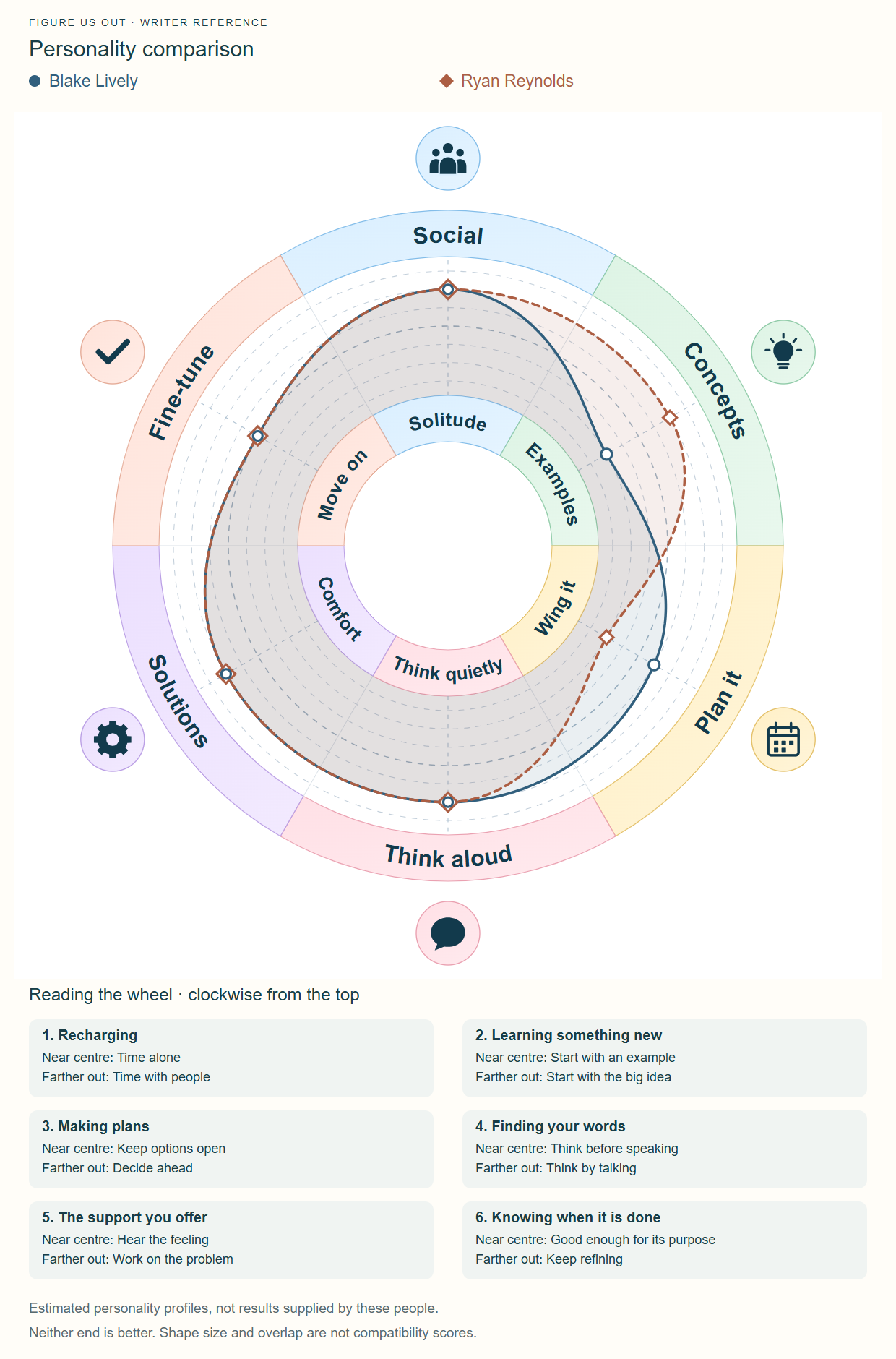
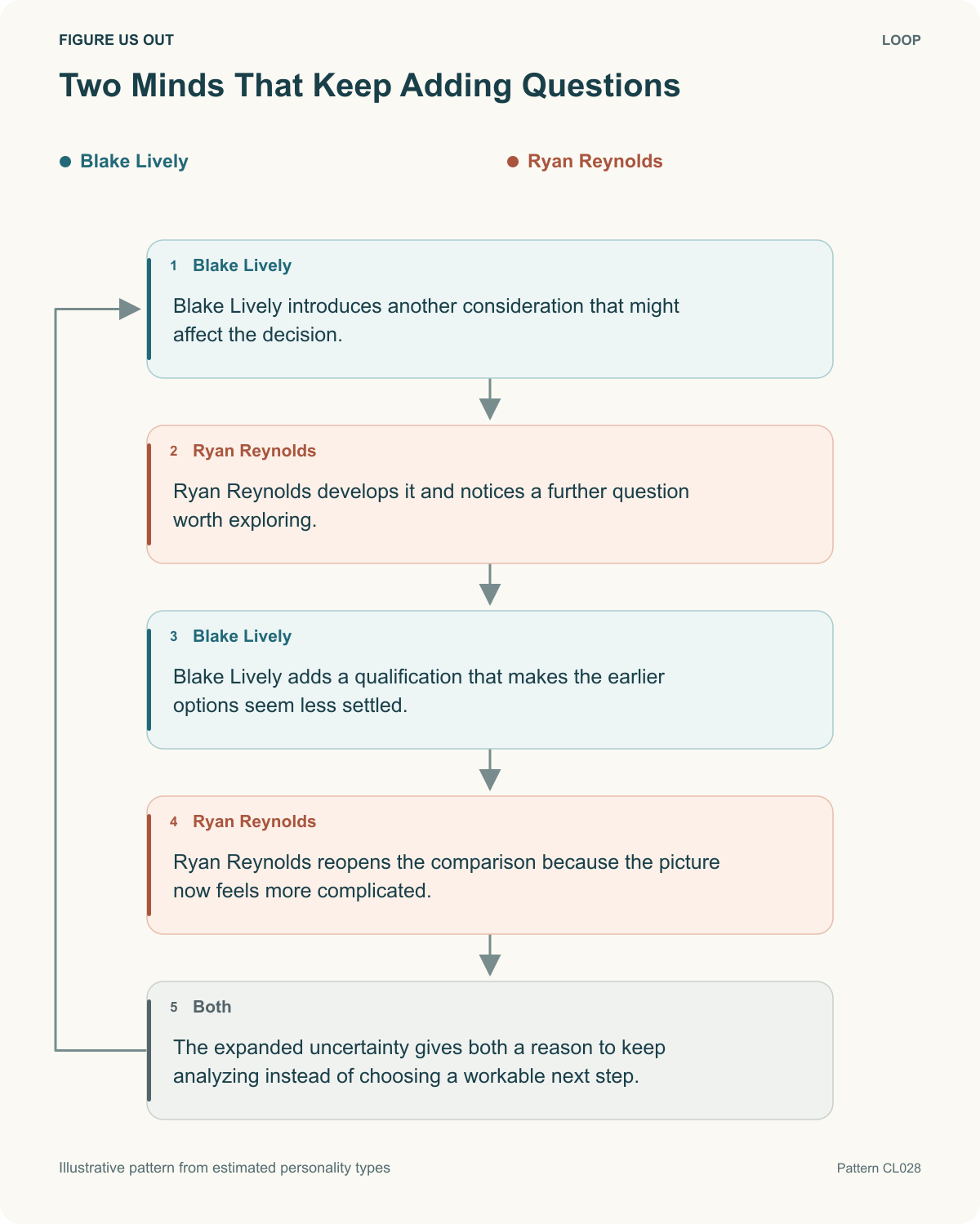
These optional diagrams come from the same prepared pairing and represent possible tendencies. They do not establish what the couple actually does.
See all 16 modeled personality comparisons
Each position is a type-based estimate on the original 1–7 scale. These are not measurements of these public figures, compatibility ratings, or relationship-success probabilities.
Blake Lively: 6/7 Ryan Reynolds: 6/7
Time alone ↔ Time with peopleBlake Lively: 2/7 Ryan Reynolds: 6/7
Start with an example ↔ Start with the big ideaBlake Lively: 6/7 Ryan Reynolds: 6/7
Dig into one subject ↔ Explore many subjectsBlake Lively: 5/7 Ryan Reynolds: 2/7
Keep options open ↔ Decide aheadBlake Lively: 5/7 Ryan Reynolds: 7/7
Keep the existing plan ↔ Take the better openingBlake Lively: 5/7 Ryan Reynolds: 6/7
Enjoy the familiar rhythm ↔ Want more varietyBlake Lively: 6/7 Ryan Reynolds: 6/7
Think before speaking ↔ Think by talkingBlake Lively: 4/7 Ryan Reynolds: 6/7
Ease into the point ↔ Say it plainlyBlake Lively: 6/7 Ryan Reynolds: 6/7
Hear the feeling ↔ Work on the problemBlake Lively: 5/7 Ryan Reynolds: 5/7
Listen and understand ↔ Help me solve itBlake Lively: 5/7 Ryan Reynolds: 6/7
The main idea is enough ↔ The nuance mattersBlake Lively: 3/7 Ryan Reynolds: 6/7
Work them out together ↔ Keep the final sayBlake Lively: 4/7 Ryan Reynolds: 4/7
Good enough for its purpose ↔ Keep refiningBlake Lively: 5/7 Ryan Reynolds: 6/7
Take time first ↔ Talk nowBlake Lively: 4/7 Ryan Reynolds: 6/7
Encourage me first ↔ Give me the specificsBlake Lively: 3/7 Ryan Reynolds: 6/7
Find warmth again ↔ Understand what happened