Celebrity couples · Figure Us Out
Chip and Joanna Gaines: He Was Late, Had No Plan, and Somehow Got a Second Date
The Fixer Upper couple's unlikely beginning says a lot about why two very different approaches can make a pretty good team.
Imagine getting ready for a first date. You've picked out what to wear. You've told your roommates where you're going. You've probably rehearsed a few things to say. Then your date doesn't arrive.
Ten minutes pass. Half an hour. More than an hour.
That was the beginning of Chip and Joanna Gaines' romance.
In a 2026 conversation with Hoda Kotb, Joanna recalled that Chip showed up more than an hour late to their first date in 2001. She had warned her roommates that if he didn't appear in the next few minutes, she wasn't opening the door. He arrived just in time. 1
If you've watched five minutes of Fixer Upper, you can probably imagine Chip arriving with an enormous grin and a story to tell.
The way they met was memorable too. Joanna worked at her father's automotive shop in Waco, Texas. Chip had noticed her in the shop's commercials and found a reason to come by. They talked, he asked her out, and the rest eventually became one of television's best-known husband-and-wife businesses. 12
Eventually is doing a little work in that sentence. On their first date, Joanna wasn't particularly impressed that he was so talkative and interested in taking risks. She had generally pictured herself with someone quieter. 3
And yet they married in 2003, built a family, renovated houses together, and created an entire world around the name Magnolia.
I'm not saying showing up late is a good dating strategy. I'm saying that sometimes the person who seems nothing like what you expected turns out to be worth getting to know.
The funny thing about two people with completely different rhythms
On Fixer Upper, the contrast is part of the entertainment. Chip gets excited, goes big, acts goofy and seems happy to start. Joanna takes a longer look at how the finished thing ought to feel and what it will take to get there.
Obviously a television show is edited to make a good story. Their private life is more complicated than the personalities viewers see on screen. But Joanna herself has described how Chip's willingness to take risks was one of the things she noticed early on, and how their different skills became part of working together. 34
Chip was already buying and renovating houses when they were dating. Joanna gradually became interested in the design side, and their skills developed alongside the business. In an interview about working together, Joanna described herself as stronger at choosing materials and finishes, while Chip was good at figuring out how to do things they couldn't afford to hire someone else to do. 4
There's something very appealing about the combination. One person sees an opportunity before the whole route is clear. Another notices the details that will make it something people actually want to live with.
But every strength like that has a point where it can start causing trouble.
“What about the budget?” can sound like “What a terrible idea”
For this Figure Us Out article we're exploring Chip as ENFP 7w6 and Joanna as ISTJ 1w9. These are tentative outside personality estimates, not results they personally supplied. The research behind both typings is divided, particularly the wings. The examples below are invented to illustrate possibilities from that pairing, not reports of their actual arguments. 5
In this model, Chip's side is drawn toward possibilities and enjoys working an idea out by talking. Joanna's side likes knowing the practical details and wants a decision that can be followed through reliably.
Imagine a couple looking at their backyard. One says, “We should put in a little outdoor kitchen.” They start imagining pizza nights and friends coming over. They haven't chosen an appliance or figured out whether the idea makes any sense. Right now they're having fun picturing it.
The other person asks where it would go, how much it would cost, and whether there's already a water line nearby.
Those are reasonable questions. They're also surprisingly easy to hear as a refusal.
The excited partner says, “I was just talking about it.” The practical partner says, “I know, I'm trying to see whether we could actually do it.”
Now one feels discouraged. The other feels criticized for paying attention.
The more questions that come, the more enthusiastically the first person defends the idea. The more passionately they defend it, the more it can sound as though a decision has already been made. So the second person asks even more questions.
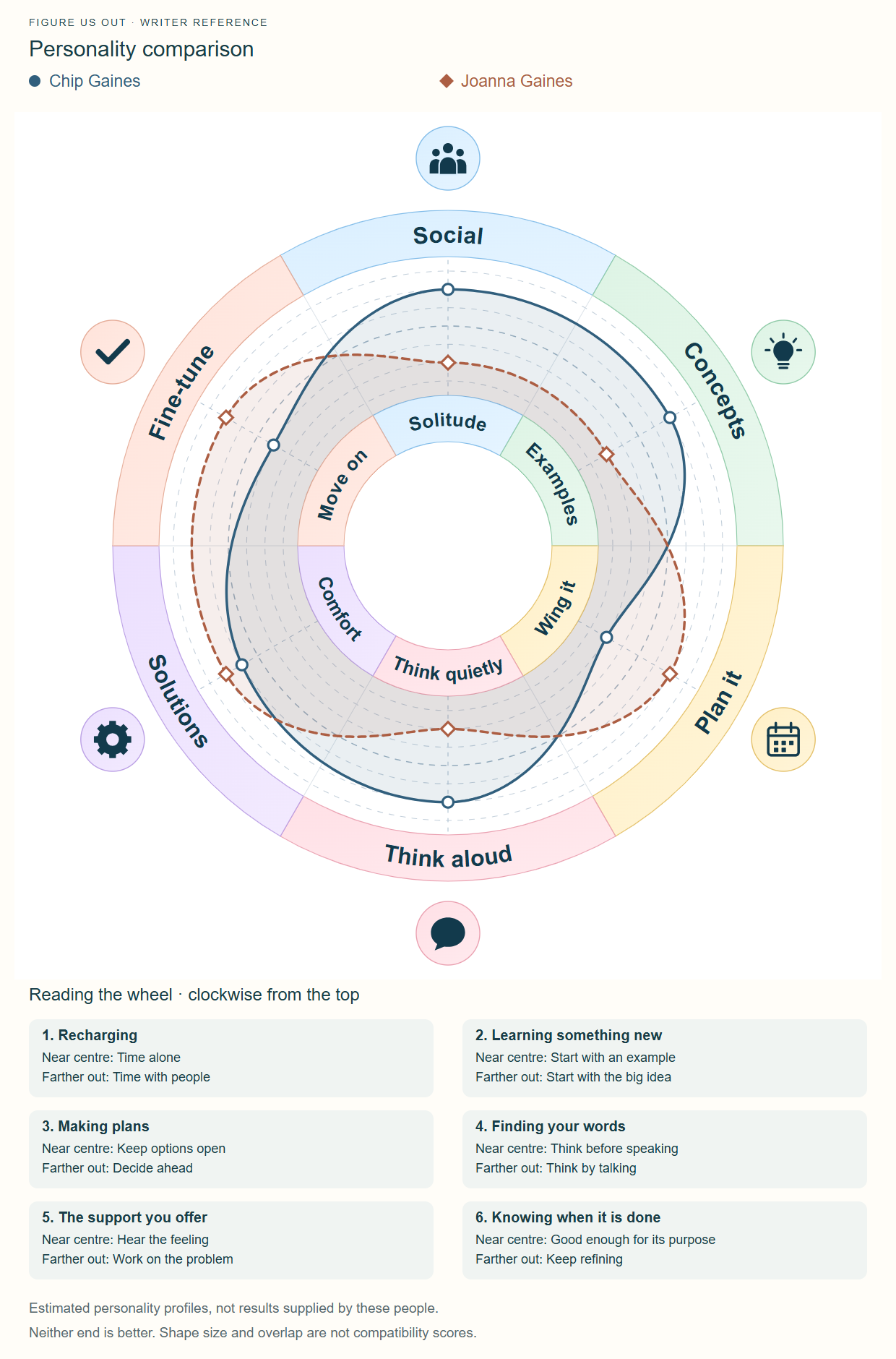
That is the kind of recurring exchange behind the packet's “Practical Questions That Sound Like No” loop. The questions may be an attempt to participate. The enthusiasm may be an invitation to imagine. Without knowing that, each can mishear the other's response. 5
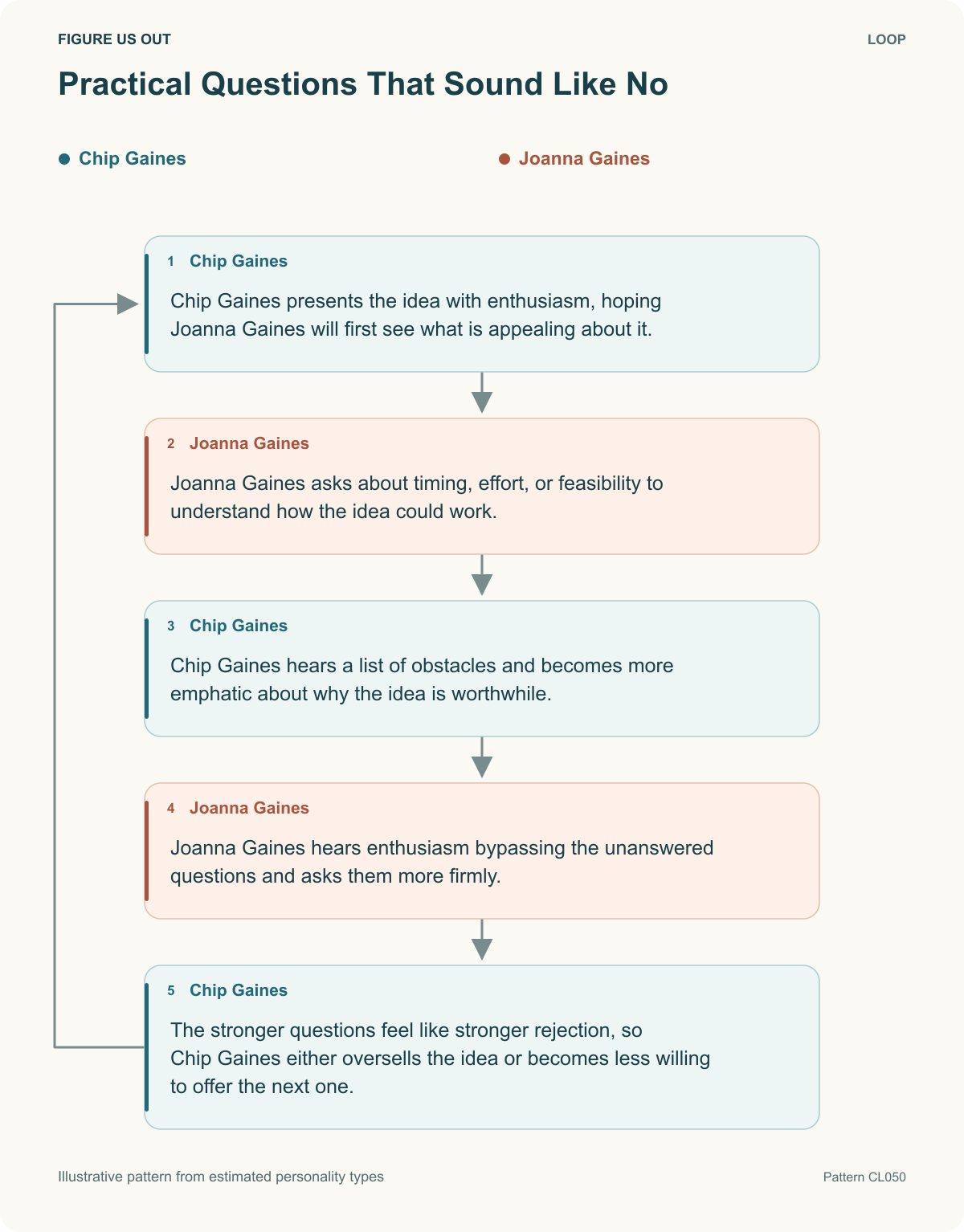
Practical Questions That Sound Like No
Chip Gaines presents the idea with enthusiasm, hoping Joanna Gaines will first see what is appealing about it.
Joanna Gaines asks about timing, effort, or feasibility to understand how the idea could work.
Chip Gaines hears a list of obstacles and becomes more emphatic about why the idea is worthwhile.
Joanna Gaines hears enthusiasm bypassing the unanswered questions and asks them more firmly.
The stronger questions feel like stronger rejection, so Chip Gaines either oversells the idea or becomes less willing to offer the next one.
↺ How this loops: the final response encourages more of the original reaction.
The simplest way through it might be asking, “Are we dreaming about this, or are we actually deciding?”
If you're dreaming, you can enjoy the idea without immediately becoming responsible for the plumbing. If you're deciding, the practical questions belong in the conversation. Both people get a chance to participate in the stage they're actually in.
Hope is better when somebody can tell you why it might work
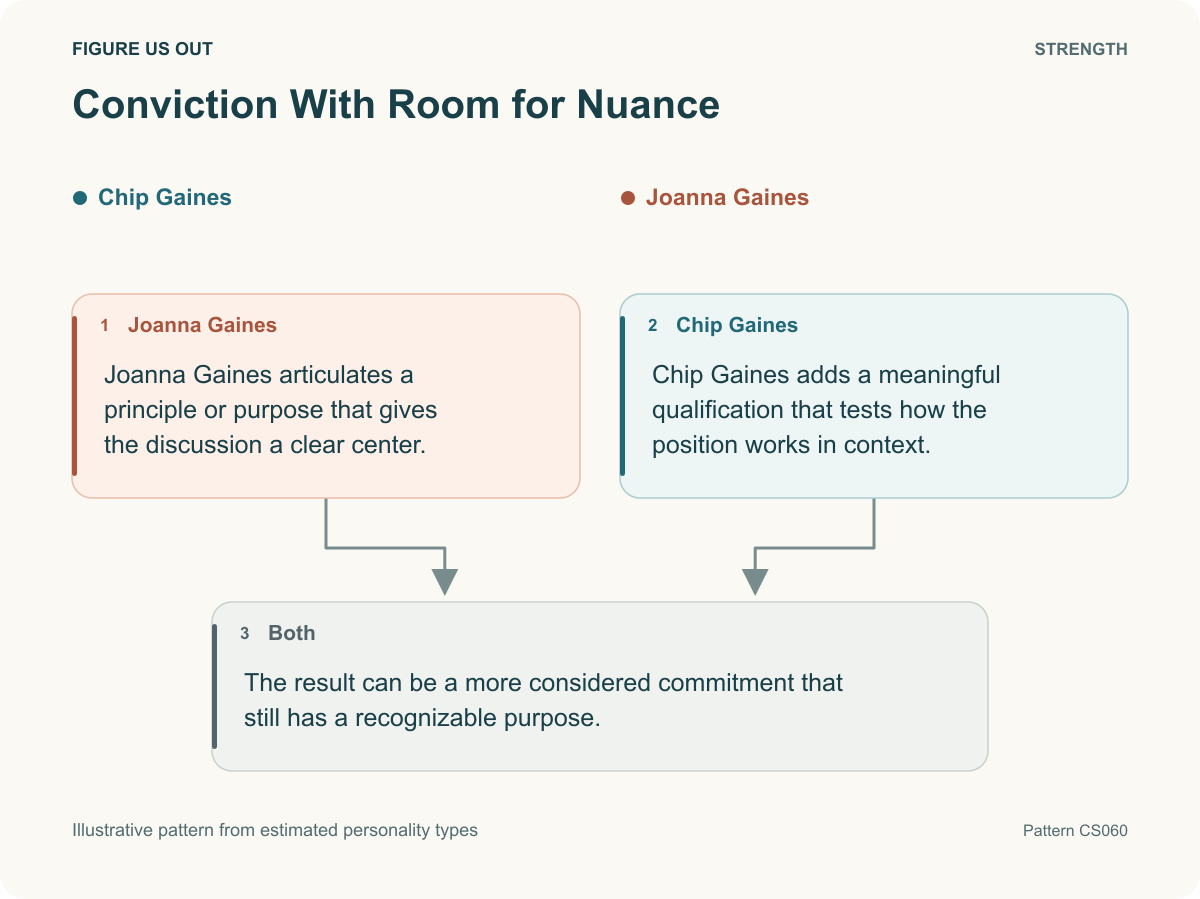
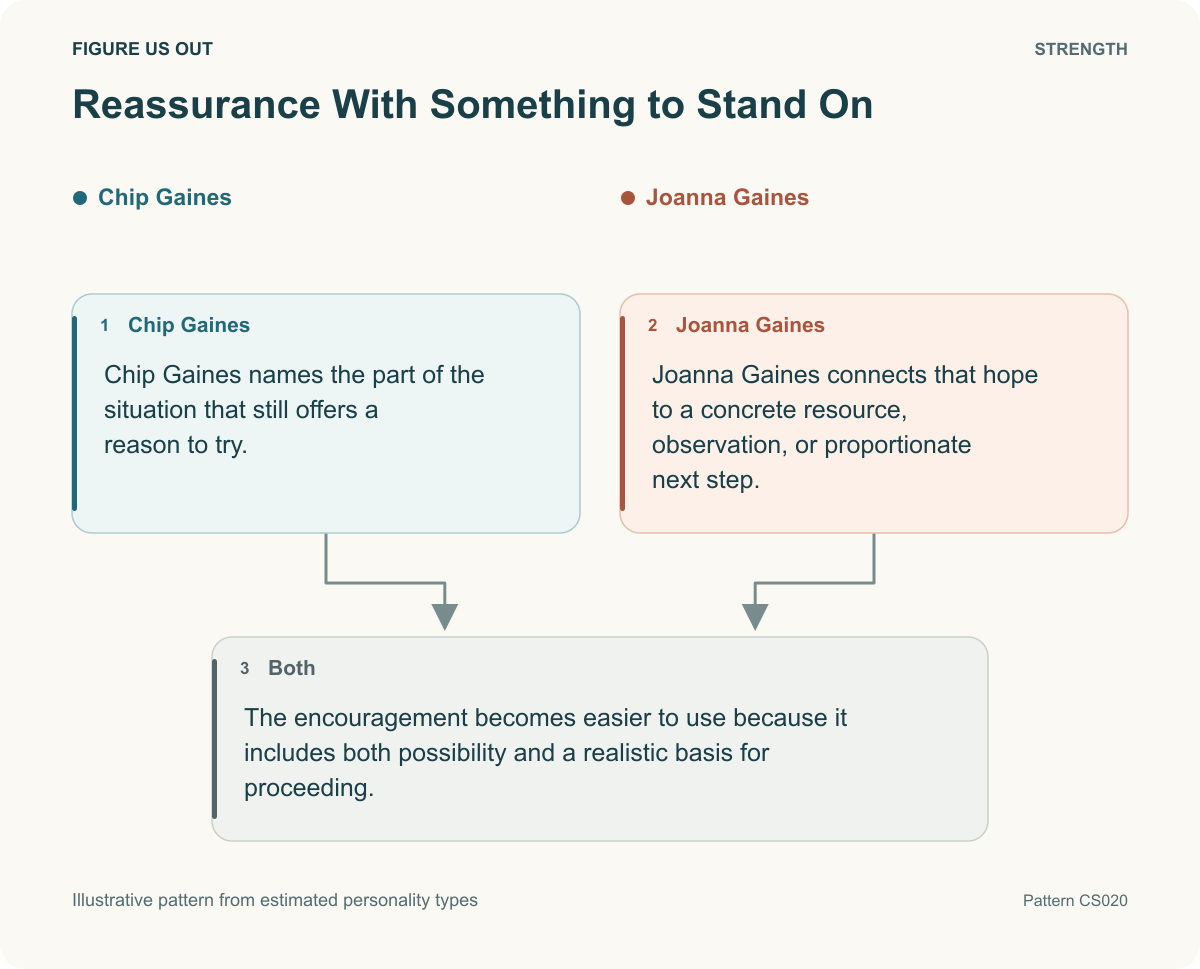
I especially like one of the strengths in this pair's prepared relationship library. It is called “Reassurance With Something to Stand On.” 5
It's about the difference between someone saying, “It'll be fine!” and someone being able to say, “It might work, and here's the first thing we can try.”
Think about a couple considering something new: a business idea, a trip, a move, a family project. One person is excited about the possibilities. The other has useful information about what the first step would cost or require.
If the excited person treats every concern as negativity, their partner stops wanting to participate. If the practical person uses questions only to shut ideas down, the first person stops wanting to share them.
But when hope and practical knowledge actually meet, they can do something neither would do alone. The idea gets a fair chance to become real.
You can start small. Try the inexpensive version. See what happens. Adjust before investing the whole savings account or ripping out an otherwise perfectly good wall.
Neither partner has to be permanently assigned the job of dreaming or doing all the difficult work. A good question improves the idea. A good idea gives the practical work a purpose.
I can see why this is a satisfying theme for a couple whose public work has involved imagining what an old house could become and then figuring out how to make it stand up.
Sometimes the deadline is the whole argument
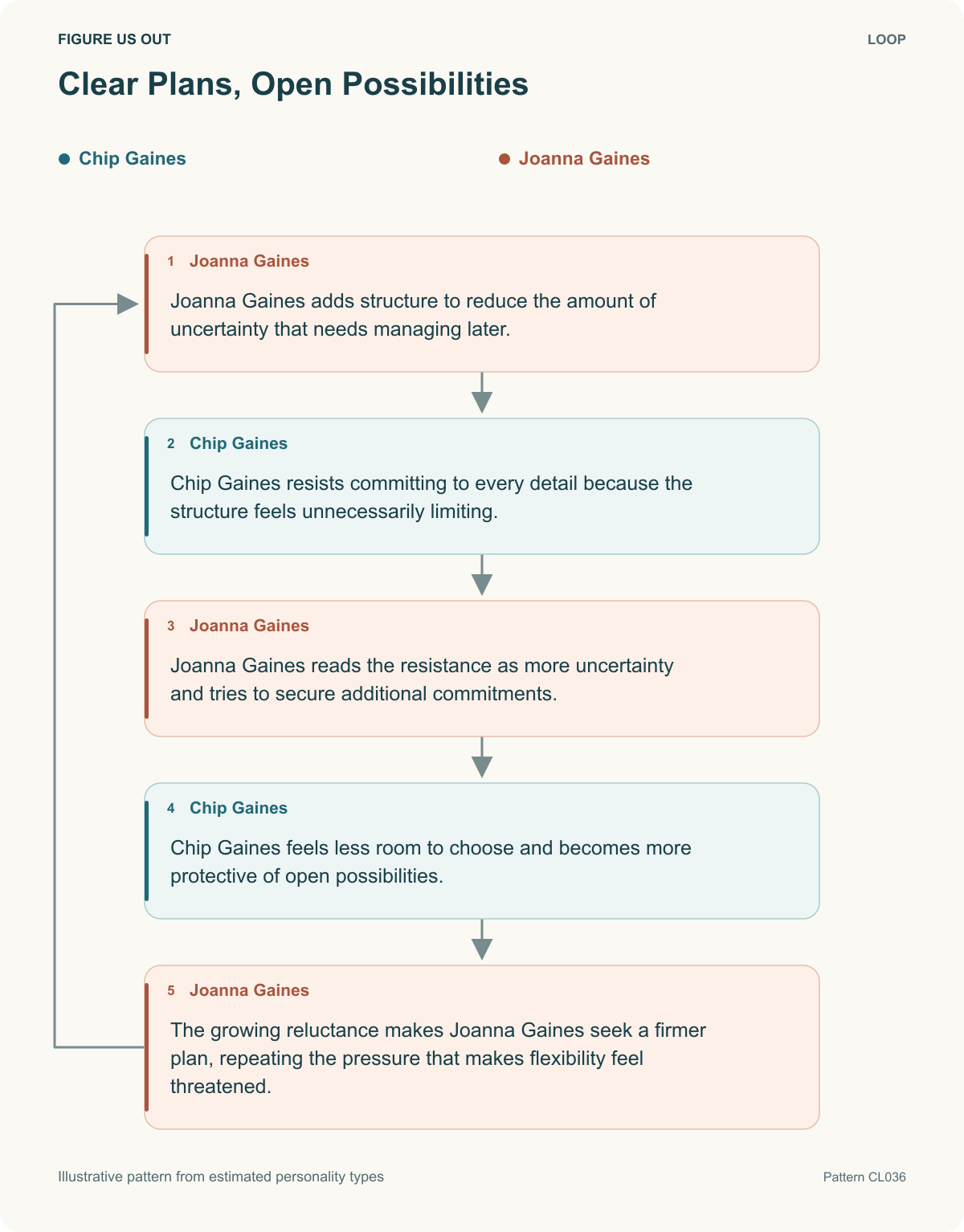
Their estimated profiles also differ around plans. Joanna's leans toward deciding the important things in advance. Chip's leans toward leaving room to change direction when something promising comes along.
For anyone who has watched them together, it's tempting to make that a joke about the sensible wife and the wild husband. But that wouldn't be fair to either person. The problem isn't that one person is grown-up and the other isn't. It's that they can be trying to protect different things with their preferred approach.
A plan lets one person relax because they know what to count on. Flexibility lets the other relax because the day hasn't been decided for them.
Picture a Saturday when there are three things to get done. One person wants to agree on the order at breakfast. The other wants to start with the first task and see where the day goes. An unexpected invitation arrives at noon. Suddenly, one sees a fun opportunity and the other sees two promises being pushed aside.
A good compromise isn't always “half a plan.” Sometimes it's agreeing which commitments can't move and which can. If there's a real deadline, say it. If something can wait, let it wait without turning it into a character flaw.
That distinction also keeps the mental work from falling entirely on the person who worries about the schedule. Anyone who suggests changing a plan can help figure out how the change affects the rest of the day.
The work isn't the whole relationship
In an interview about their early projects, Joanna said they had to deliberately set aside time at home when they wouldn't talk about work. 4
I think that might be one of the most relatable admissions from two people who built their careers together. When your partner is also the person you brainstorm with, solve problems with, and make decisions with, it's easy for every quiet evening to become another meeting.
You might be wonderful business partners and still need to put the business away for a while. It doesn't mean you dislike what you're building. It means the person across from you matters apart from what the two of you produce.
In a 2024 interview around Fixer Upper: The Lakehouse, Joanna talked about the pleasure she still finds in renovating with Chip after more than two decades of marriage. 6
The lasting appeal probably isn't just that one has good ideas and the other knows where to put the tile. A shared life needs room to enjoy what they've created and to keep learning how to do it together.
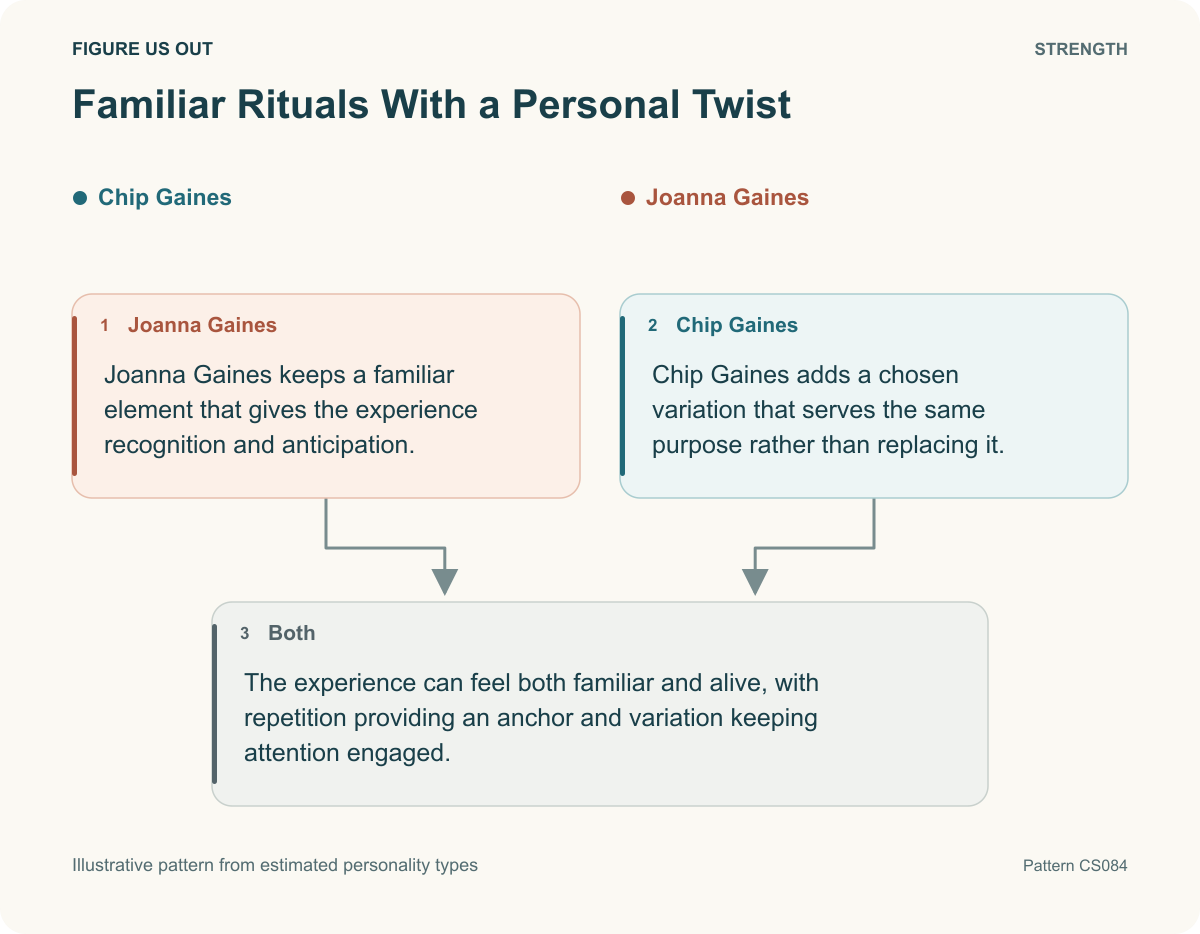
One partner can like a familiar rhythm while the other brings a new twist to it. You can go back to the same breakfast place and take a different route home. You can keep a tradition while letting the details change. Familiar doesn't have to mean boring, and new doesn't have to mean disruptive.
The dating story is funnier once you know the rest
I keep coming back to Chip arriving late for that first date. At the time, Joanna had every reason to wonder whether the evening would be worth it. She later described how Chip's attention to other people could make him lose track of time. That doesn't erase the inconvenience. It does give the behavior a meaning she didn't necessarily have on the first night. 1
A lot of relationship understanding works that way. You learn what a behavior means to your partner, and you still get to talk about how it affects you.
Knowing why someone is spontaneous doesn't mean you have to enjoy waiting around. Appreciating someone who is organized doesn't mean every hour of your weekend needs an itinerary.
At Figure Us Out, we're interested in exactly that middle ground. Core personalities may stay recognizable, while the way you respond to each other becomes more thoughtful. You can learn to appreciate what your partner naturally brings without making them the one person who is always responsible for that contribution.
If an idea turns into an argument at your house, try asking “Are you inviting me to imagine this with you, or are you asking me to help decide?”
It might turn a frustrating five minutes into a much better conversation.
What would the two of you build differently together?
Figure Us Out helps you and your partner explore your individual personalities, how they meet, the strengths worth enjoying, and the patterns that might keep resurfacing. Your full package includes both personal guides, a shared couples guidebook, and a 12-week workbook in a downloadable, print-ready book. One payment covers both of you, with no subscription.
Explore your own relationship at Figure Us Out
Explore more relationship strengths and loops
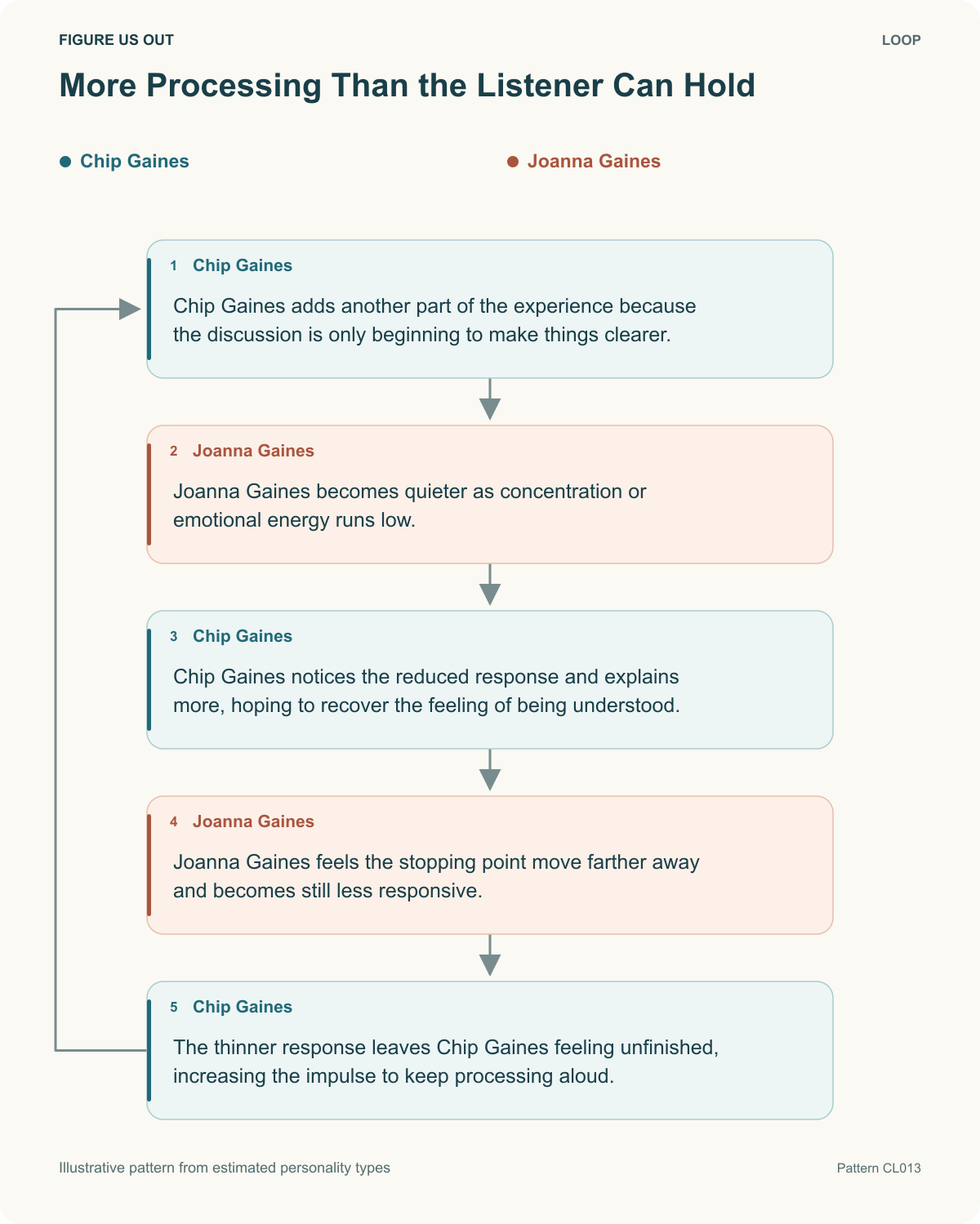
These optional diagrams come from the same prepared pairing and represent possible tendencies. They do not establish what the couple actually does.
See all 16 modeled personality comparisons
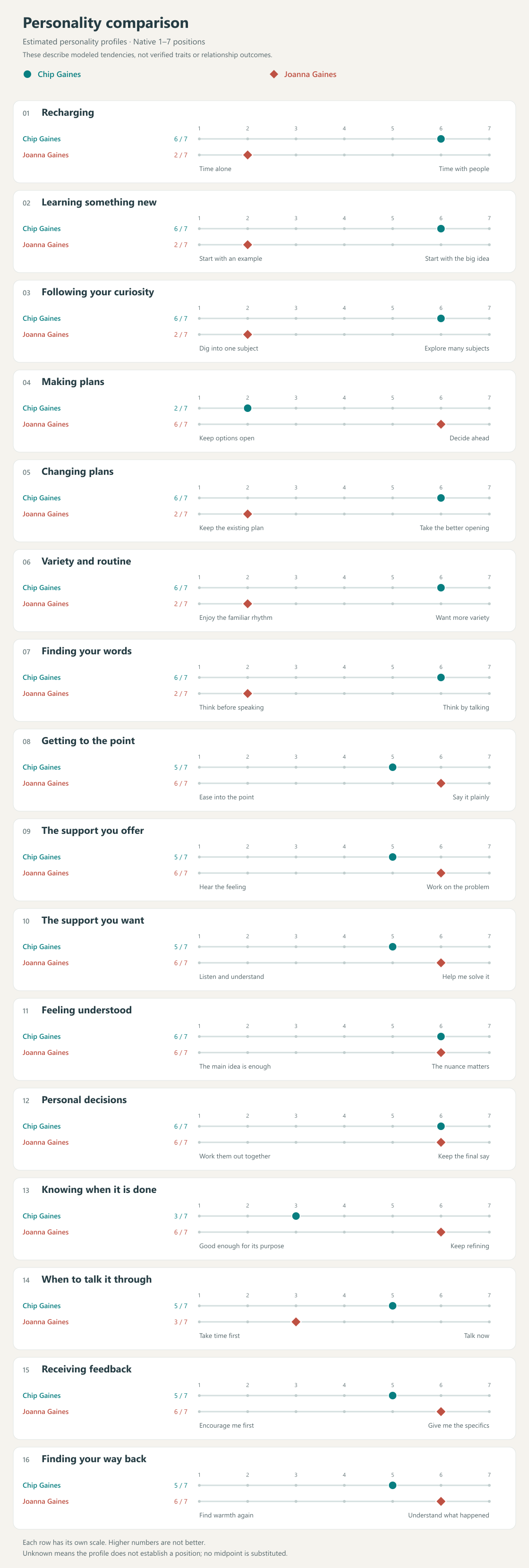
Each position is a type-based estimate on the original 1–7 scale. These are not measurements of these public figures, compatibility ratings, or relationship-success probabilities.
Chip Gaines: 6/7 Joanna Gaines: 2/7
Time alone ↔ Time with peopleChip Gaines: 6/7 Joanna Gaines: 2/7
Start with an example ↔ Start with the big ideaChip Gaines: 6/7 Joanna Gaines: 2/7
Dig into one subject ↔ Explore many subjectsChip Gaines: 2/7 Joanna Gaines: 6/7
Keep options open ↔ Decide aheadChip Gaines: 6/7 Joanna Gaines: 2/7
Keep the existing plan ↔ Take the better openingChip Gaines: 6/7 Joanna Gaines: 2/7
Enjoy the familiar rhythm ↔ Want more varietyChip Gaines: 6/7 Joanna Gaines: 2/7
Think before speaking ↔ Think by talkingChip Gaines: 5/7 Joanna Gaines: 6/7
Ease into the point ↔ Say it plainlyChip Gaines: 5/7 Joanna Gaines: 6/7
Hear the feeling ↔ Work on the problemChip Gaines: 5/7 Joanna Gaines: 6/7
Listen and understand ↔ Help me solve itChip Gaines: 6/7 Joanna Gaines: 6/7
The main idea is enough ↔ The nuance mattersChip Gaines: 6/7 Joanna Gaines: 6/7
Work them out together ↔ Keep the final sayChip Gaines: 3/7 Joanna Gaines: 6/7
Good enough for its purpose ↔ Keep refiningChip Gaines: 5/7 Joanna Gaines: 3/7
Take time first ↔ Talk nowChip Gaines: 5/7 Joanna Gaines: 6/7
Encourage me first ↔ Give me the specificsChip Gaines: 5/7 Joanna Gaines: 6/7
Find warmth again ↔ Understand what happened