Celebrity couples · Figure Us Out
David and Victoria Beckham: From Secret Car-Park Dates to 27 Years of Doing Life Their Way
They started out hiding in a car just to talk. These days, their different ways of caring might be the most interesting part of the story.
David and Victoria Beckham have worn some extraordinary things over the years. There was the purple wedding reception outfit. There were the matching leather ensembles. There was Posh Spice, David's football haircuts, and a wedding so elaborate that it practically needed its own postcode.
But according to Victoria, some of their earliest dates involved a very ordinary setting: a car park.
In an October 2026 interview, Victoria recalled how difficult it was for two famous young people to have a quiet date. Her mother would drop her off, and she and David would sit talking in his car, away from the cameras. She joked that a discreet car park was a useful place to get to know somebody. 1
It's a surprisingly lovely picture. Before the international moves, the businesses, the fashion shows and the documentaries, there were two people making time to sit together and talk.
They met in 1997, when David was playing for Manchester United and Victoria was a Spice Girl. David has recalled spotting her on television and telling a teammate he was going to marry her. Victoria, meanwhile, has admitted that her visits to football matches had rather a lot to do with the handsome player on the field. They married in 1999. 2
And after all those years, they're still giving us things to laugh about. Especially when David insists that Victoria be a little more accurate about her upbringing.

The most famous two-word interruption
You may remember the moment from Netflix's BECKHAM documentary when Victoria was talking about coming from a working-class family. David appeared in the doorway and asked her to be honest about the car her father drove her to school in. Eventually, the answer was a Rolls-Royce. 2
It's a funny exchange partly because of how comfortable they seem interrupting each other's carefully arranged version of a story. David notices a detail he thinks matters. Victoria is trying to explain a larger point. Suddenly, they're having two conversations at once.
I wouldn't try to turn that into a psychological assessment. We saw a few minutes of a documentary, not the private workings of their marriage. Still, it gives us a useful way into a very ordinary relationship question: when your partner adds a correction, do you hear helpful information or someone pulling apart what you meant?
Sometimes they're doing one while you hear the other.
They're both more private than you'd expect
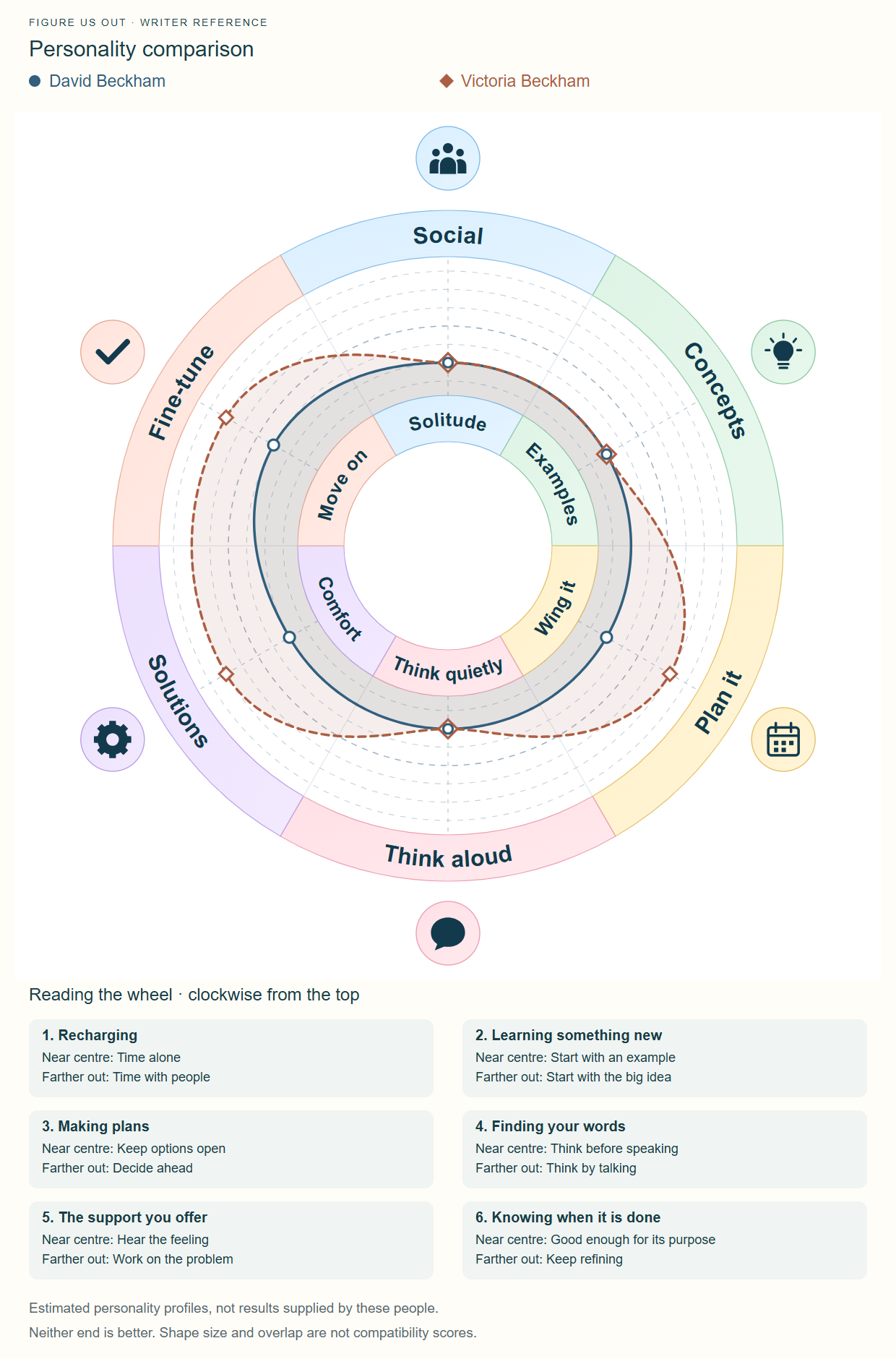
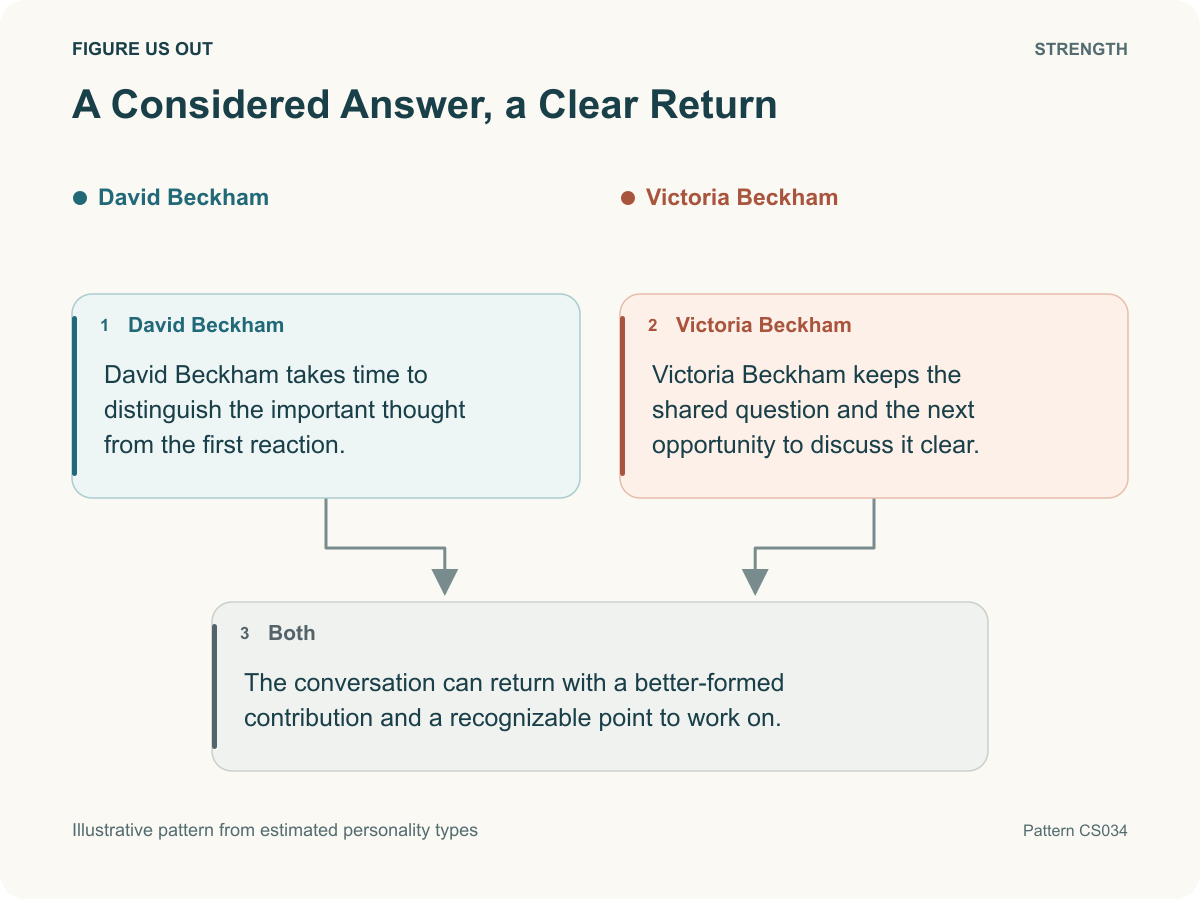
For this Figure Us Out exploration, we're using estimated personality types of David as ISFP 9w8 and Victoria as ISTJ 3w4. These are outside estimates, not assessments they took for us. The public sources supporting these choices vary in confidence, and the examples that follow are illustrations of how those combinations could interact, not stories about arguments they've had. 3
People tend to picture the football star and the Spice Girl as two people who must love constant attention. Their public careers certainly required plenty of it. But the source profiles we're exploring share a preference for quieter time and thinking before speaking.
That makes the car-park story rather fitting, even if it tells us nothing definite about their personality types. Two people can have enormous public lives and still enjoy having a small part of the day where nobody needs anything from them.
It also means you can't guess how a couple communicates just by looking at who seems louder in public. Two privately minded people can be wonderfully comfortable together. They may also both need a little time before they've figured out exactly what they want to say.
When help arrives in the wrong form
Here's one of the more interesting differences in the source pairing. David's estimated profile leans toward wanting his feelings understood before anyone starts fixing the situation. Victoria's leans toward looking for a practical way forward when someone is having a hard time.
Both responses can be loving. They simply don't always feel the same to the person receiving them.
Imagine a couple sitting in the kitchen after a difficult day. One starts telling a story about something frustrating that happened. The other can already see a sensible next step: make a call, move the appointment, send the email, change the arrangement.
The advice is probably useful. But the person telling the story isn't ready for it. They're still trying to explain why the whole thing bothered them.
They say more, hoping their partner will understand. Their partner responds with more solutions, thinking the first suggestion must not have helped. Before long, one feels rushed and the other feels as though their help isn't wanted.
It's easy to see why neither understands what went wrong. One thought, I listened and tried to help. The other thought, I barely got to finish telling you how I felt.
In the prepared Figure Us Out model, that is the possible “Help That Misses the Feeling” loop for this pairing. It doesn't mean Victoria ignores David's feelings, or that David rejects sensible advice. It's simply a way these different preferences can miss one another if the timing isn't right. 3
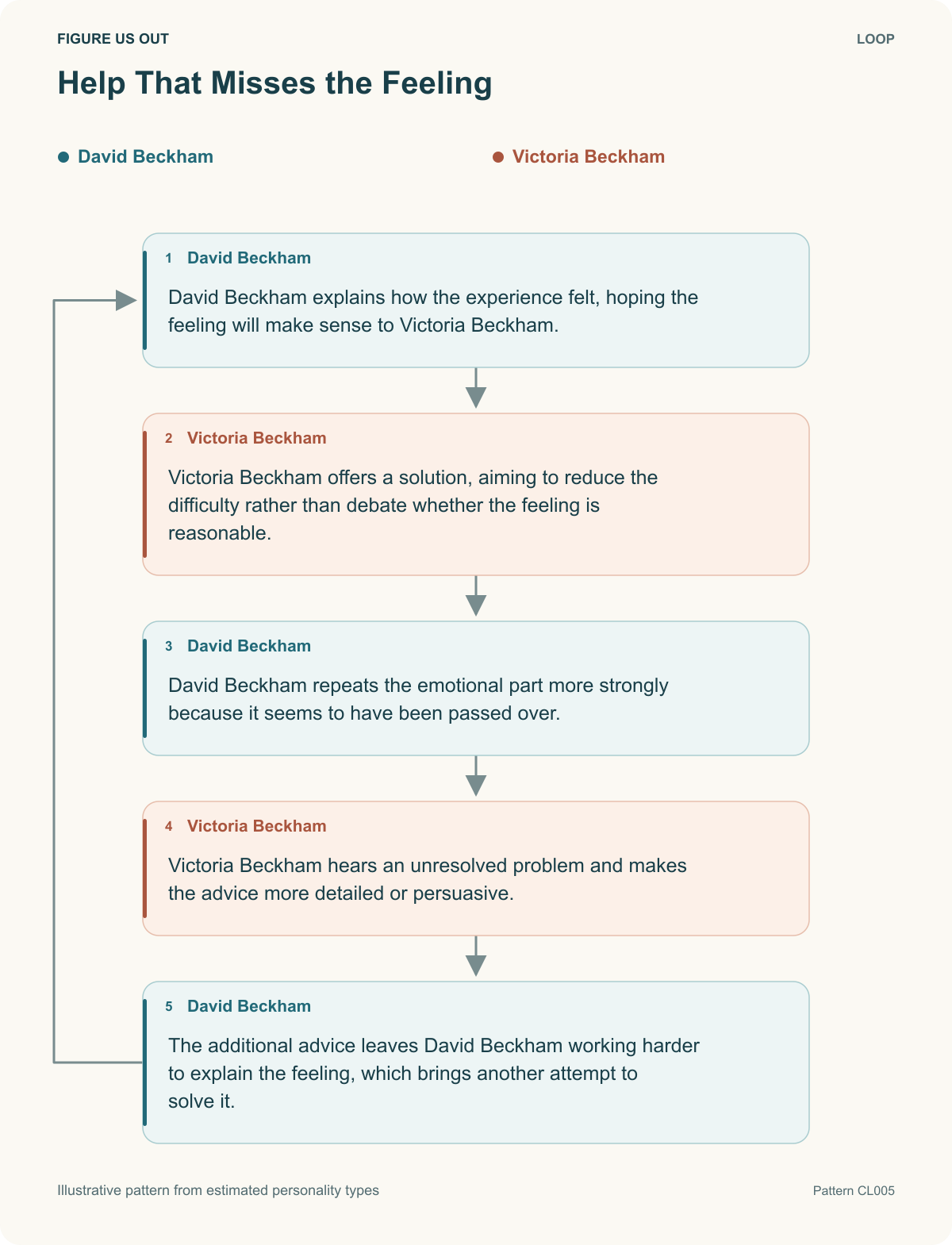
Help That Misses the Feeling
David Beckham explains how the experience felt, hoping the feeling will make sense to Victoria Beckham.
Victoria Beckham offers a solution, aiming to reduce the difficulty rather than debate whether the feeling is reasonable.
David Beckham repeats the emotional part more strongly because it seems to have been passed over.
Victoria Beckham hears an unresolved problem and makes the advice more detailed or persuasive.
The additional advice leaves David Beckham working harder to explain the feeling, which brings another attempt to solve it.
↺ How this loops: the final response encourages more of the original reaction.
I like the simple question that comes out of this: “Do you want me to listen for a minute, or are we figuring out what to do?”
Either answer is fine. What matters is not assuming that the kind of help you naturally give will always be the kind your partner needs first.
Being thoughtful can look very different
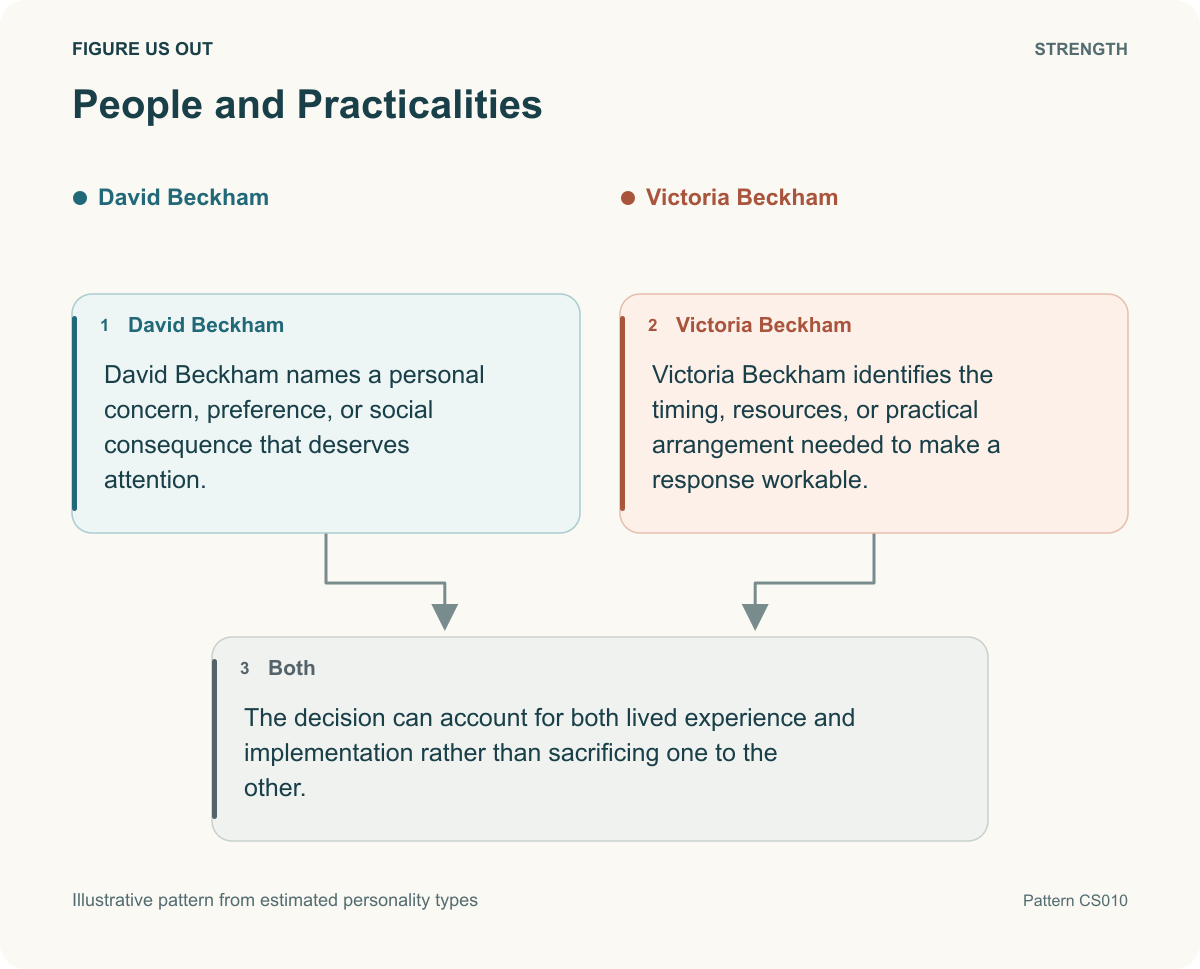
The same personality pairing also offers a genuine strength. One person may be quicker to notice how a decision will affect somebody. The other may be quicker to see the actual arrangements needed to make it work.
Say a couple is planning a family gathering. Someone thinks about the person who might feel left out or overwhelmed. Someone else checks that the timing, seating and transport will actually make the gathering comfortable. Those are useful contributions to the same goal.
The arrangement doesn't become better because one person owns the feelings and the other owns the checklist. It becomes better because both kinds of attention are included.
There's something affectionate about learning to recognize care in a form you wouldn't have thought to offer yourself. An organized answer can be an act of consideration. So can a person who notices that everybody seems happy with the plan except the quiet one at the edge of the room.
The other argument waiting in almost every house
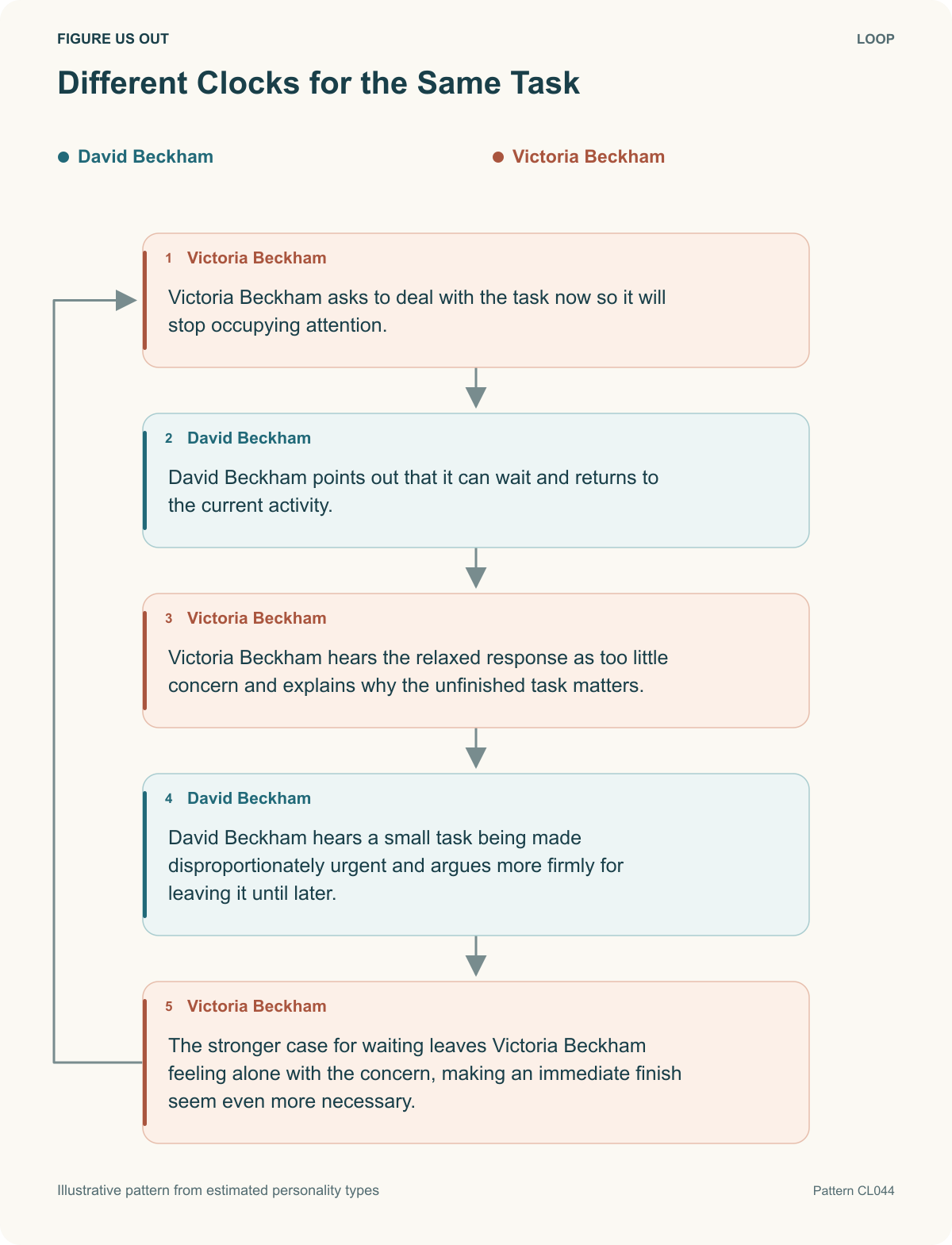
Their estimated profiles differ more sharply around planning. Victoria's leans toward setting important decisions ahead of time, while David's allows more freedom to decide as a day unfolds.
Imagine agreeing that a small household job will be finished this weekend. One person is already imagining when it will get done so they can stop thinking about it. The other also means to do it, but isn't worried about starting at a particular hour.
By lunchtime, the first person asks about the job. The question feels like pressure to the second person, who had every intention of doing it. A vague reassurance feels less reassuring to the person who has been mentally keeping the task open.
The problem may be less about effort than about two different clocks for the same responsibility. “I'll take care of it” can sound like “I'll do it before we go out” to one person and “it's on my list for sometime today” to another.
You don't fix that by convincing someone that their preferred clock is wrong. You agree on what actually matters. “Before dinner” is clearer than “soon.” If the time is flexible, say so. If someone else is relying on it, say that too.
When an ordinary task keeps causing tension, it is worth checking whether you ever agreed on the same deadline in the first place.
The man who wants to enjoy it and the woman building what's next
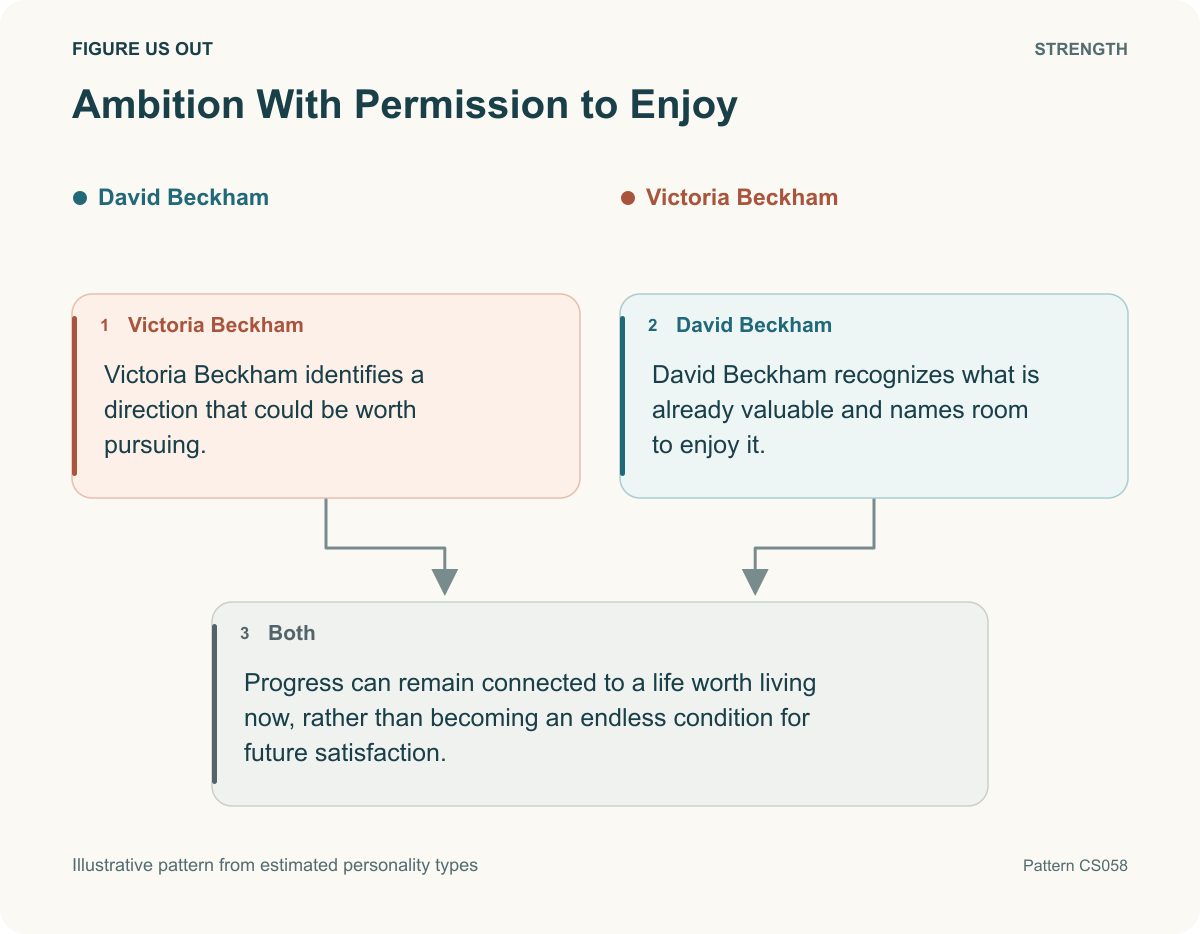
There is one more possible strength worth mentioning, especially with these two. Their estimated combination can put drive and achievement beside an appreciation of the life that's already happening.
Victoria's career has moved from pop music into fashion and beauty, with years of work to establish her own place in those industries. David's life has also been full of ambition, but his documentary gave viewers some charmingly ordinary pleasures: caring for his bees, fussing over household details, and finding joy in things far removed from a stadium. In one scene he and Victoria even disagree about what his honey should be called. 24
That's a good reminder that successful people are still allowed to enjoy something small and slightly ridiculous. The next achievement matters. So does the thing you worked so hard to have in the first place.
The personality strength in the packet is called “Ambition With Permission to Enjoy.” The idea is that an eye for the next goal and a willingness to enjoy the present can help each other, provided nobody becomes responsible for managing the other's ambition or relaxation. 3
I think plenty of ordinary couples know that tension. You finish a big project, and before the dishes are cleared, someone starts talking about the next one. The other wants to sit down and enjoy having finished something.
Both are seeing a real part of life. A good partnership can leave room for both.
What 27 years can teach us without telling us everything
David and Victoria have lived through an extraordinary amount of public scrutiny. We should be careful about treating a documentary moment or an interview as a complete picture of a marriage.
What their story does give us is a funny, human reminder that even a very glamorous relationship is built out of ordinary interactions. Someone corrects a detail. Someone needs time to talk. Someone wants the task done now. Someone wants a moment to enjoy what they've built.
At Figure Us Out, we're interested in the personalities people bring into those moments. Our belief is that understanding your partner shouldn't be about slowly turning them into someone who approaches everything the way you do. It's about seeing the differences more clearly and getting better at living with them.
If you've been together a long time, here's something worth asking each other: “When I'm trying to help, what do I usually do first, and does it actually feel helpful to you?”
A useful answer might save you more arguments than a perfect plan.
Curious what your own personalities look like together?
Your relationship probably has its own version of the car-park conversations, the interrupted stories and the two different clocks. Figure Us Out helps you and your partner explore your individual personalities and what happens when you put them together. The full couples package includes a personal guide for each of you, your couples guidebook and a 12-week workbook, all in a downloadable book. One payment covers both of you, with no subscription.
Explore your own relationship at Figure Us Out
Explore more relationship strengths and loops
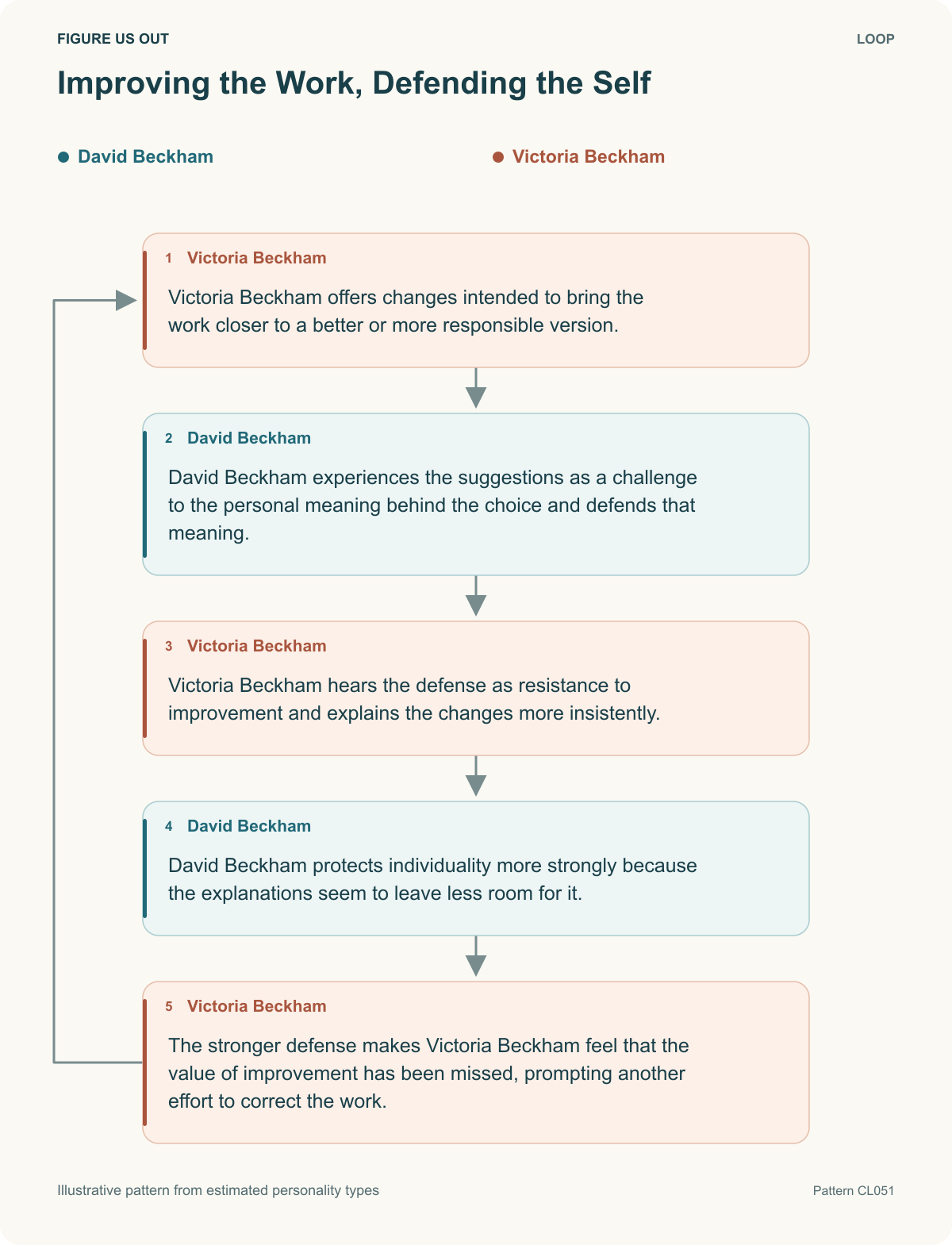
These optional diagrams come from the same prepared pairing and represent possible tendencies. They do not establish what the couple actually does.
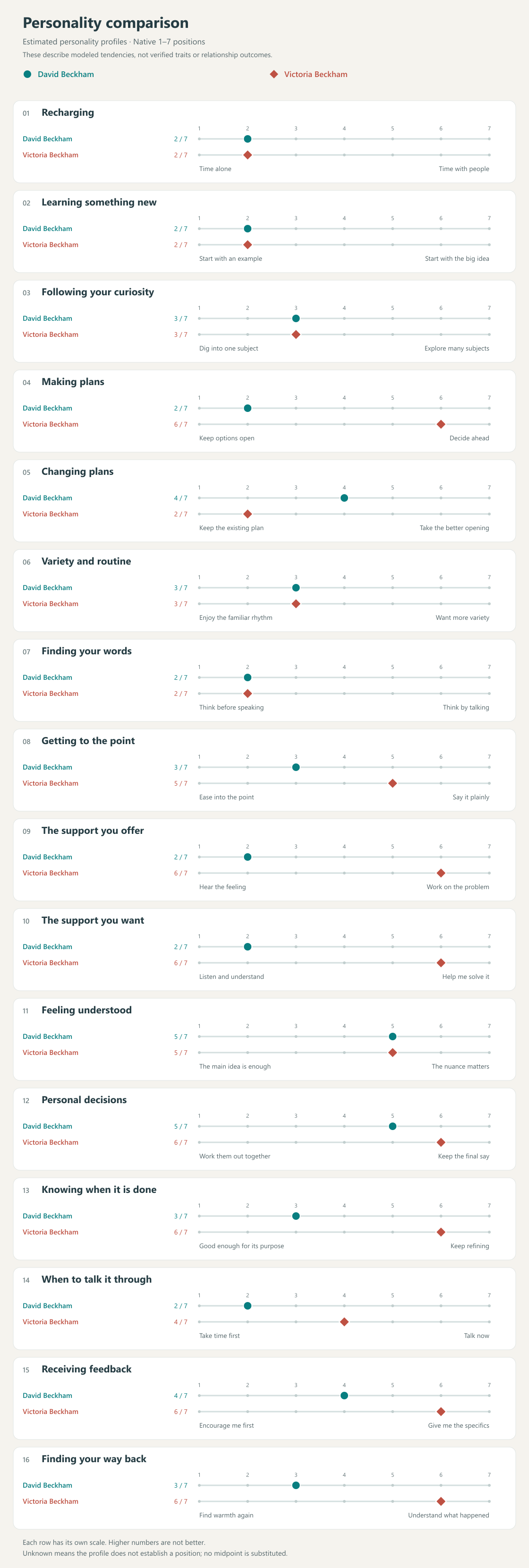
See all 16 modeled personality comparisons
Each position is a type-based estimate on the original 1–7 scale. These are not measurements of these public figures, compatibility ratings, or relationship-success probabilities.
David Beckham: 2/7 Victoria Beckham: 2/7
Time alone ↔ Time with peopleDavid Beckham: 2/7 Victoria Beckham: 2/7
Start with an example ↔ Start with the big ideaDavid Beckham: 3/7 Victoria Beckham: 3/7
Dig into one subject ↔ Explore many subjectsDavid Beckham: 2/7 Victoria Beckham: 6/7
Keep options open ↔ Decide aheadDavid Beckham: 4/7 Victoria Beckham: 2/7
Keep the existing plan ↔ Take the better openingDavid Beckham: 3/7 Victoria Beckham: 3/7
Enjoy the familiar rhythm ↔ Want more varietyDavid Beckham: 2/7 Victoria Beckham: 2/7
Think before speaking ↔ Think by talkingDavid Beckham: 3/7 Victoria Beckham: 5/7
Ease into the point ↔ Say it plainlyDavid Beckham: 2/7 Victoria Beckham: 6/7
Hear the feeling ↔ Work on the problemDavid Beckham: 2/7 Victoria Beckham: 6/7
Listen and understand ↔ Help me solve itDavid Beckham: 5/7 Victoria Beckham: 5/7
The main idea is enough ↔ The nuance mattersDavid Beckham: 5/7 Victoria Beckham: 6/7
Work them out together ↔ Keep the final sayDavid Beckham: 3/7 Victoria Beckham: 6/7
Good enough for its purpose ↔ Keep refiningDavid Beckham: 2/7 Victoria Beckham: 4/7
Take time first ↔ Talk nowDavid Beckham: 4/7 Victoria Beckham: 6/7
Encourage me first ↔ Give me the specificsDavid Beckham: 3/7 Victoria Beckham: 6/7
Find warmth again ↔ Understand what happened