Figure Us Out · Celebrity Couples
Goldie Hawn and Kurt Russell: A Fake Proposal and a Very Real Partnership
An Oscars joke, a memorable first date, and the pleasure of loving someone who is just as happy to wing it as you are.
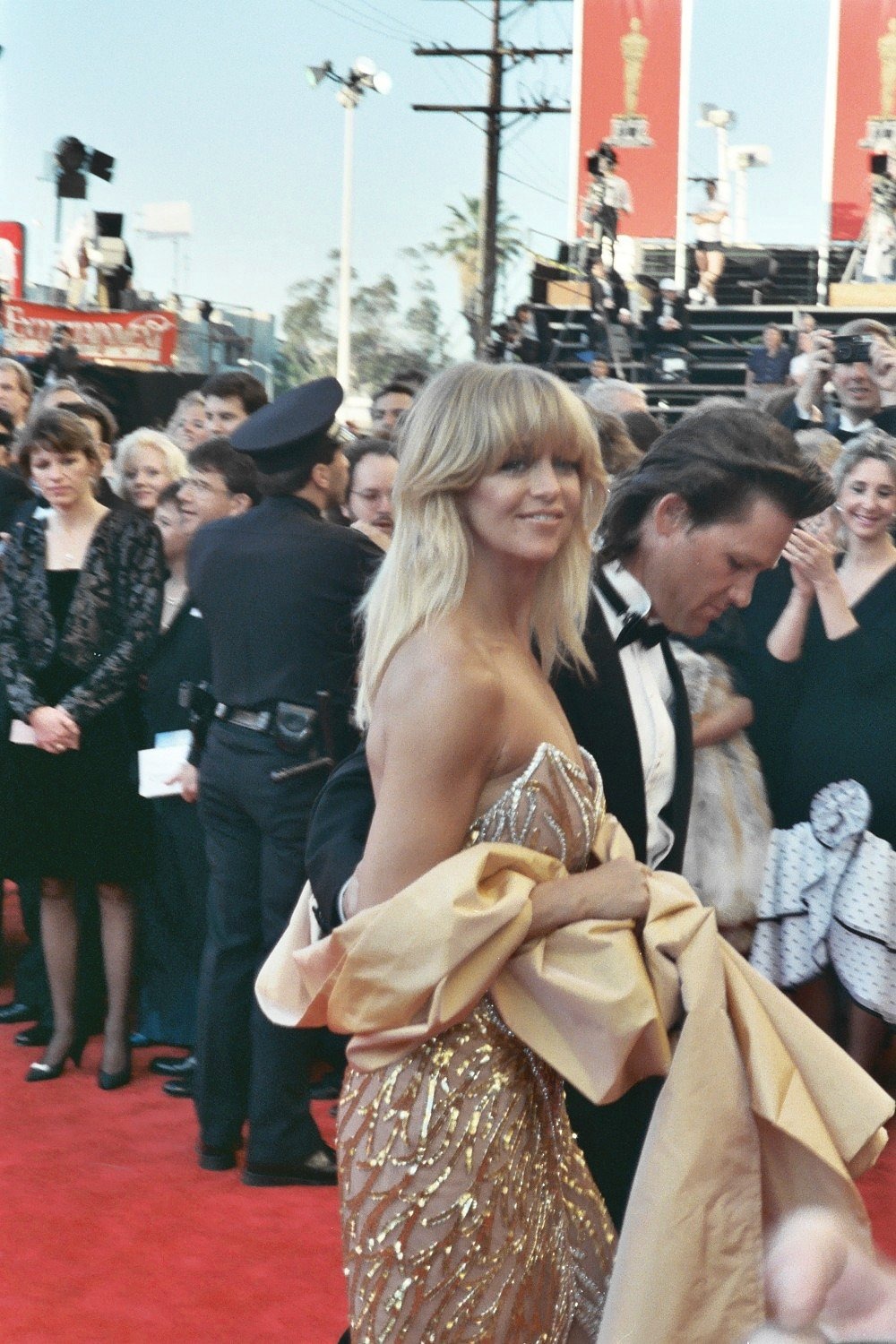
Goldie Hawn and Kurt Russell at the Academy Awards in 1989. Photo: Alan Light. Source · CC BY 2.0.
Resized for this article. Archival event photograph, not an illustration of the imagined relationship scenes. No endorsement is implied.
At the 1989 Oscars, Goldie Hawn and Kurt Russell made an audience wonder whether he was proposing. He wasn't. They were presenting an award, and the awkward pause was part of their joke.
Kurt told Entertainment Weekly in 2026 that they'd invented the routine in the shower before the ceremony, replacing a script they didn't like. They hadn't warned the organizers.
You have to appreciate a couple who can make a joke that big together. One person sets it up, the other knows where to take it, and suddenly the rest of us are watching to see what happens.
Their actual beginning was hardly short on material, either.
The first date wasn't exactly uneventful
They first crossed paths making The One and Only, Genuine, Original Family Band, released in 1968. The romance came years later, when they reunited for Swing Shift. During a SiriusXM conversation with Andy Cohen, Goldie remembered using the movie's dancing as a reason for them to go out together. There was a jitterbug to learn.
Kurt's account of the evening, told on Harry and reported by Vanity Fair, included dancing, a visit to a house Goldie was renovating, and the discovery that she didn't have the key. They got inside anyway. The police eventually arrived.
Most people hope a first date gives them something to talk about. This one seems to have covered that.
But the moment Goldie described falling in love was much quieter. She told Cohen about seeing Kurt with her sleeping children, his attention and tenderness toward them. That was what stayed with her.
I like having both stories in view. There is the evening you could retell at a dinner party, and there is the small moment that tells you something about the person you might want beside you.
What happens when neither person needs a detailed itinerary?
For this Figure Us Out article, we're exploring Goldie as ENFP 7w6 and Kurt as ESFP 9w8. These are public personality estimates, not results they supplied. Kurt's estimate is especially tentative, with substantial disagreement about his type. The charts and imagined examples explore this particular pairing; they don't reveal private events or imply endorsement.
Within that pairing, the surprising thing is how much they could enjoy the same approach to a day. Both profiles favor company, flexibility, and a little room to see what happens. We don't have a designated fun person paired with someone whose only contribution is checking the calendar.
Goldie's estimated combination is drawn to possibilities: an idea, a connection, something else worth trying. Kurt's is more likely to start with the experience in front of him: what looks inviting, what people are doing, what would make the moment enjoyable.
Together, that could feel wonderfully easy. An afternoon can change direction without requiring a defense. You can suggest a detour and have someone who genuinely likes the sound of it, rather than someone reluctantly granting permission.
That kind of companionship has value. Being with a person who enjoys your pace can make you feel welcome before either of you has done anything particularly impressive.
A look at the two estimated profiles
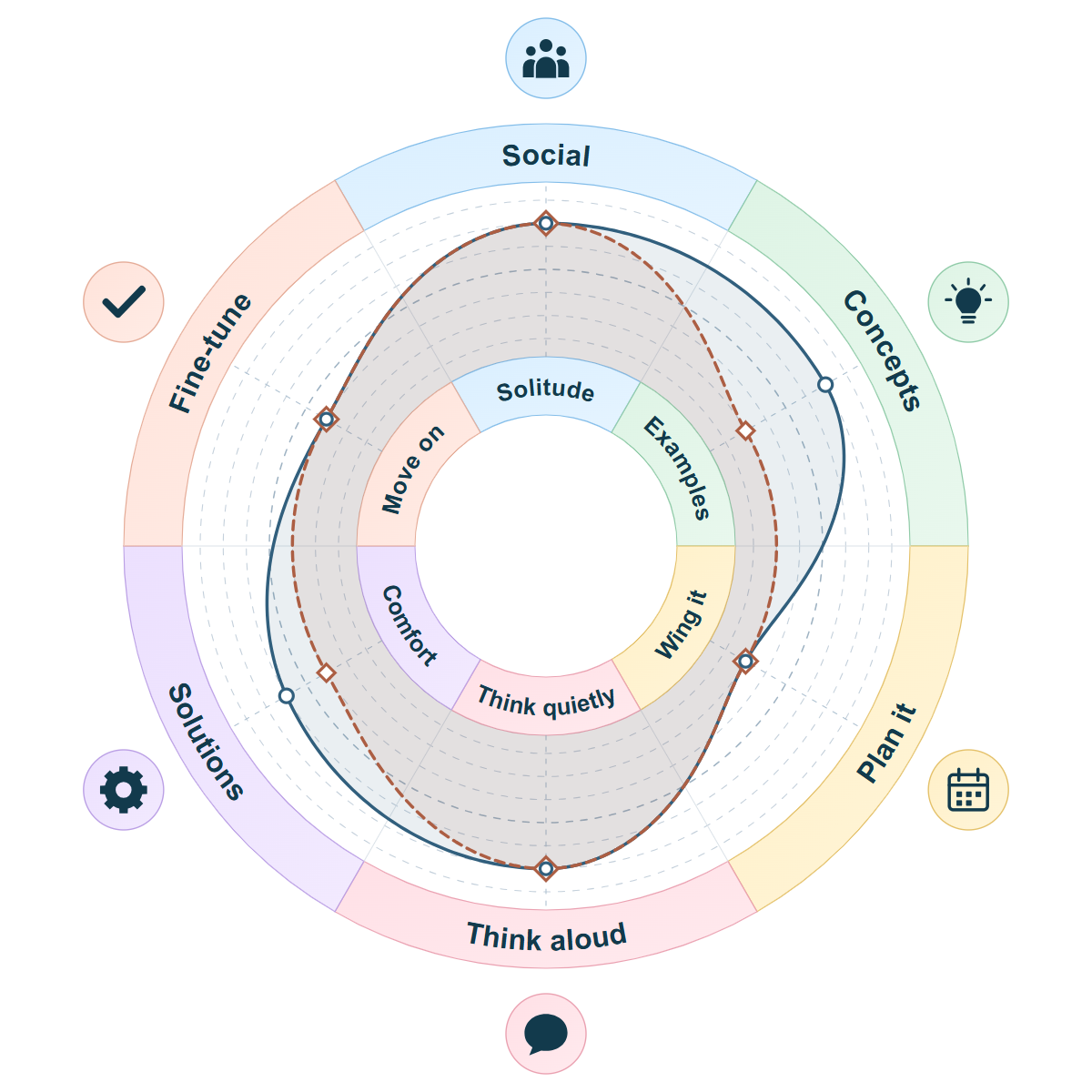
How to read the wheel
Each spoke follows a 1–7 scale. The source illustration has been cropped around the original wheel, without changing its lines or positions.
Recharging
1 = Time alone
7 = Time with people
Goldie Hawn: 6
Kurt Russell: 6
Learning something new
1 = Start with an example
7 = Start with the big idea
Goldie Hawn: 6
Kurt Russell: 2
Making plans
1 = Keep options open
7 = Decide ahead
Goldie Hawn: 2
Kurt Russell: 2
Finding your words
1 = Think before speaking
7 = Think by talking
Goldie Hawn: 6
Kurt Russell: 6
The support you offer
1 = Hear the feeling
7 = Work on the problem
Goldie Hawn: 5
Kurt Russell: 3
Knowing when it is done
1 = Good enough for its purpose
7 = Keep refining
Goldie Hawn: 3
Kurt Russell: 3
The reservation neither person made
Of course, sharing a preference doesn't mean it can never cause trouble. Sometimes you both leave exactly the same thing undone.
Imagine a couple planning a casual weekend away. They know the town they want to visit. There are a few restaurants they might try, and someone mentioned a boat tour. Neither wants to turn two days off into a complicated project.
One says they can choose the tour when they get there. The other agrees. Nobody is being overruled. They are enjoying how relaxed this feels.
By Saturday morning, the tour is full. They drive farther to another departure point, find an afternoon opening, and squeeze lunch in around it. They get on the boat, have a lovely time, and spend the ride home laughing about the scramble.
It worked out. It also took more driving, more waiting, and a much later lunch than either had wanted.
Here is the part worth noticing: the enjoyable ending can hide the unnecessary work that came before it. The memory becomes proof that they always find a way. Next time, leaving the booking until later feels just as reasonable.
We call this possible loop “Two Improvisers, One Missing Plan.” Both people help keep the detail unsettled. Both can also mistake a successful rescue for evidence that nothing needed changing.
When both people leave it until later
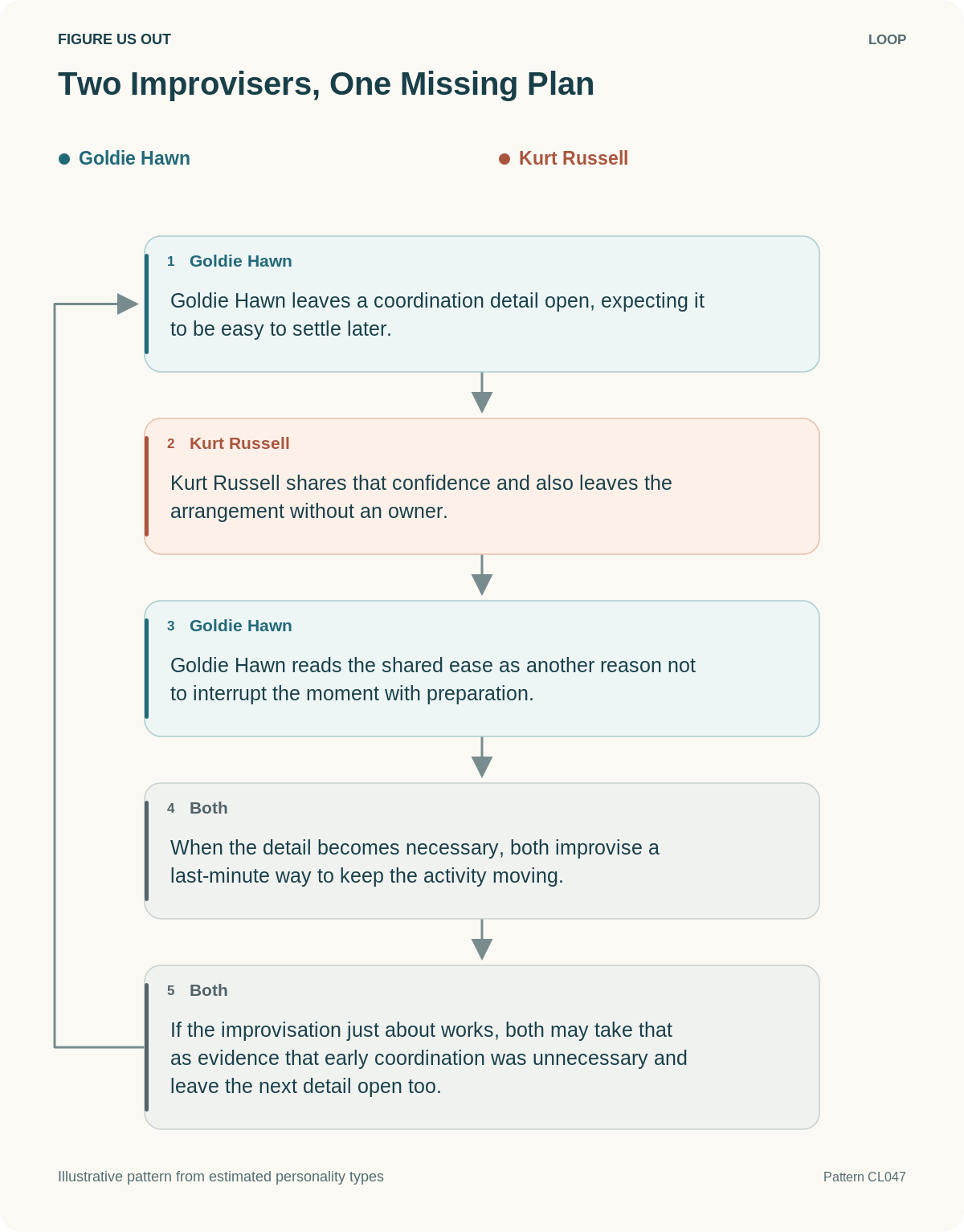
Goldie’s side leaves the details open, expecting to work them out later.
Kurt’s side also leaves them open. Neither person takes on the booking.
The easy agreement gives Goldie’s side another reason to put off preparing.
The deadline arrives and they scramble together to make it work.
When it works out, the rescue makes leaving things open seem sensible again.
↻ Step 5 reinforces step 1, so the exchange can repeat.
The answer doesn't have to be that one of them becomes the household travel agent. That would give a shared preference a very uneven price.
They could simply agree that anything with a limited number of spaces gets booked. One handles the boat, the other checks the place they're staying. Breakfast, the route home, and the shop they happen to pass can remain wonderfully undecided.
A little preparation protects the part they actually enjoy. They still get the freedom to wander. They just don't have to spend half the morning finding out whether they're allowed on the boat.
Being good together doesn't mean one of you notices everything
There is another useful possibility in these profiles. Goldie's side may see how the pieces connect or where an idea could lead. Kurt's may notice a particular detail that changes what is possible right now.
Imagine friends suggesting a big reunion. One person immediately pictures everyone together again, including people who haven't seen each other for years. Their partner notices that the proposed place has nowhere for an older guest to sit comfortably.
That detail can improve the idea. The reunion still matters, and now it has a better chance of being enjoyable for the people actually attending it.
The exchange goes differently when each contribution gets treated as an interruption. An excited person may hear the seating question as an attempt to shrink the occasion. The practical person may think the beautiful vision is skipping over someone who will struggle to be there.
It helps to connect the detail to the intention: “I want everyone to be able to stay and enjoy this. Let's find somewhere with seats and shade.” Now the observation serves the idea rather than seeming to compete with it.
Neither person has a monopoly on useful observations. Either can have the better overall picture, or notice the small thing that changes it.
For readers with a similar difference, the useful habit is giving your partner's contribution a chance to change your own. The vision might need adjusting. The practical objection might have a simple answer. You find out more when neither arrives as the final verdict.
Laughter still needs a willing audience
There is another pleasure worth considering here: shared playfulness. A person who catches your joke and adds to it gives you a pleasure that isn't quite the same as being admired from a distance.
You get to participate together. An ordinary comment becomes a running joke. A dull errand becomes a story you will both tell differently, and probably interrupt each other while telling.
That doesn't mean a couple should joke their way out of every uncomfortable moment. Imagine the boat-tour partner discovering that all the good departures are sold out. If they're hungry and disappointed, a joke about their famously terrible planning may land badly, even if the same joke would be funny two hours later.
The question is whether both are still playing. Someone saying, “I know we'll laugh about this, but can we find lunch first?” hasn't rejected the relationship's sense of humor. They've told their partner what would make it easier to join in again.
It also works the other way. A shared laugh after a mistake needn't mean the practical problem has been dismissed. You can enjoy the ridiculous part and still decide who is making the reservation next time.
Humor becomes a more generous strength when either person is allowed to step out of the joke without becoming the person who spoiled everything.
There is room to enjoy it and still want something different
For Kurt's estimated Nine pattern, keeping the experience easy can sit alongside a real wish to have his own say. That is worth remembering even in a pairing that appears comfortable making decisions as it goes.
Someone can happily agree to the next activity, then realize they've had enough moving around. They might want to stay where they are, finish a conversation, or simply enjoy the place they already chose. The more possibility-minded person may still be seeing what else they could fit in.
A clear preference helps before mild agreement turns into an unexpectedly firm refusal. “I'd like to stay here another hour” gives the other person something to consider. It doesn't require an argument about whether one of them is boring or the other can ever be satisfied.
This is where understanding a partner becomes more useful than assigning them a permanent role. A person who usually likes spontaneity can want something settled today. An easygoing person can have a strong preference. Being familiar with someone should make those moments easier to hear, not easier to dismiss.
You don't have to turn the fun into a job
Goldie and Kurt's public stories give us plenty to enjoy without pretending we know the whole relationship. There is wit, attraction, family tenderness, and the pleasure of remembering an evening that did not go according to plan.
The practical question for a couple like the one we've imagined is how to preserve that ease without repeatedly paying for the same avoidable scramble.
Think of the last time the two of you said, “We'll figure it out when we get there.” Did that give you a better experience? Or did someone quietly spend the day figuring it out while the other enjoyed the freedom?
The answer might be that it genuinely worked beautifully. Keep that. When it didn't, choose the one detail that deserved attention sooner. You don't need a new personality or a binder full of schedules.
At Figure Us Out, the aim is to understand the person you love well enough to make those choices together. Some differences need an agreement. Some similarities do, too.
After all, improvising with someone can be a lot of fun. It is even more fun when you both get to enjoy the afternoon you came for.
What does your own pairing bring out?
Figure Us Out combines two personal guides, a couples guide, a 12-week workbook, and a downloadable book. Explore the strengths and misunderstandings your own personalities could create, with ideas for understanding each other better.
A little more to explore
The article follows a few possibilities. These optional graphics show the rest of the supplied strengths and patterns.
Three possible shared strengths
The Pattern and the Particular
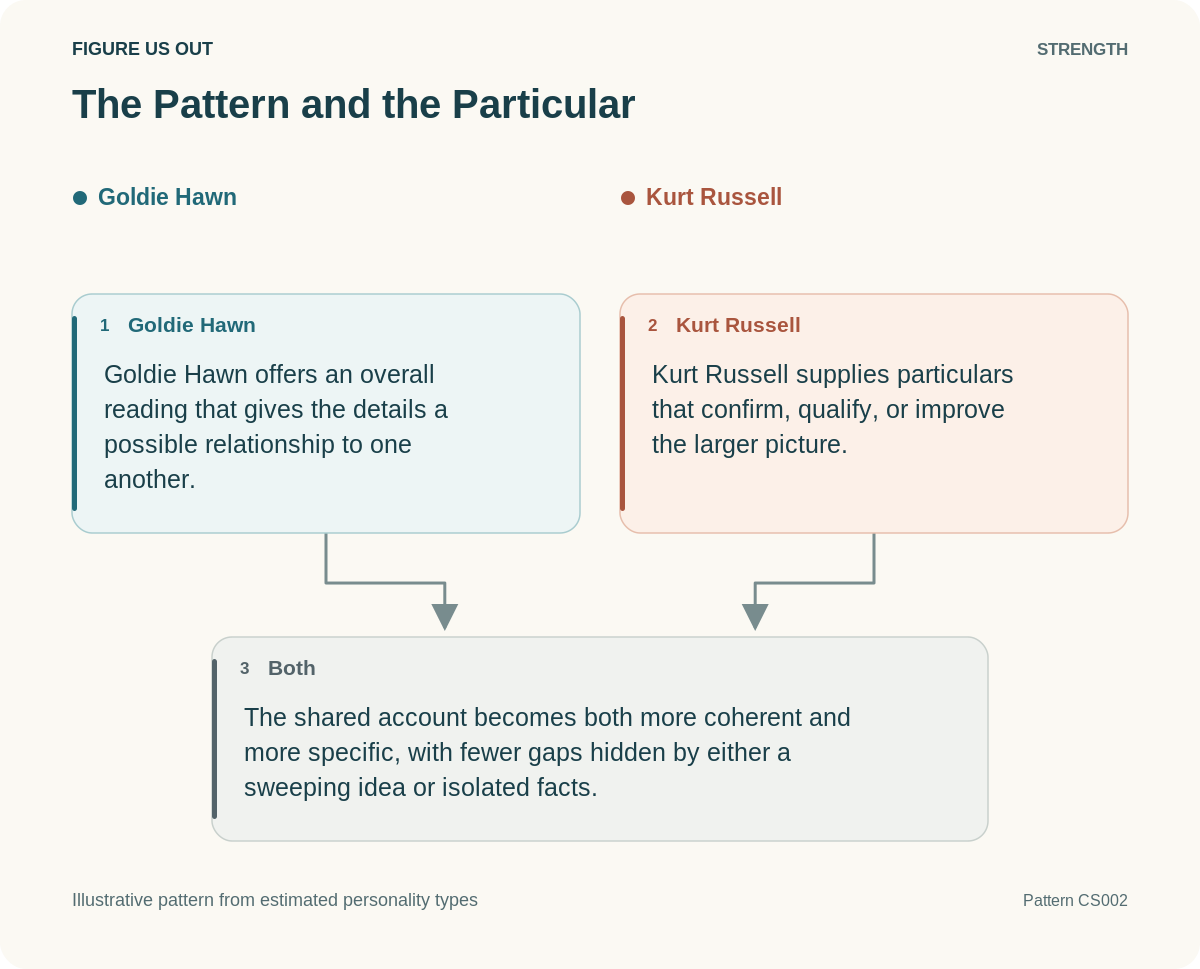
Read the steps
1. Goldie Hawn offers an overall reading that gives the details a possible relationship to one another.
2. Kurt Russell supplies particulars that confirm, qualify, or improve the larger picture.
3. The shared account becomes both more coherent and more specific, with fewer gaps hidden by either a sweeping idea or isolated facts.
Contributions 1 and 2 both feed outcome 3. Neither contribution causes the other.
Try: Ask one person for the overall picture and the other for the detail most likely to change it, then revise the picture together.
Present Needs, Future Consequences
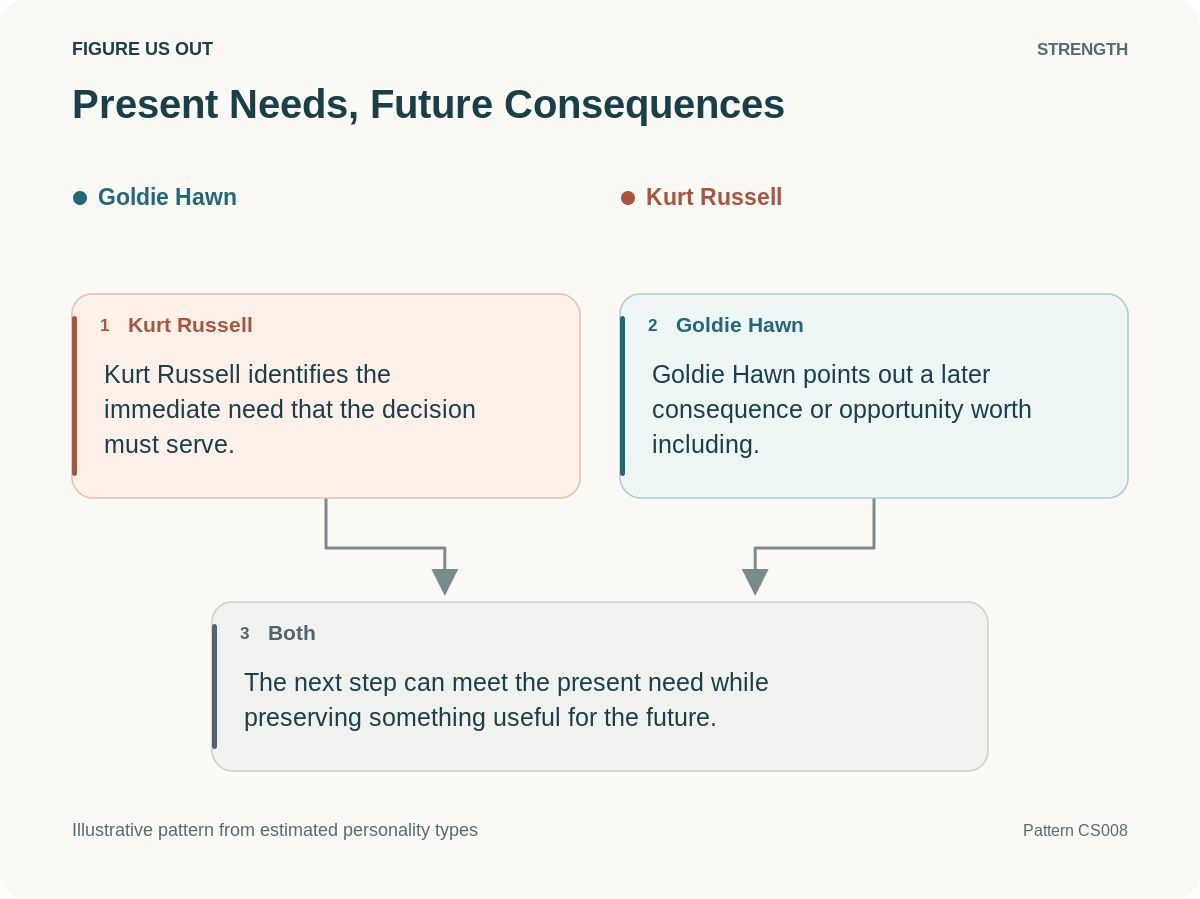
Read the steps
1. Kurt Russell identifies the immediate need that the decision must serve.
2. Goldie Hawn points out a later consequence or opportunity worth including.
3. The next step can meet the present need while preserving something useful for the future.
Contributions 1 and 2 both feed outcome 3. Neither contribution causes the other.
Try: Ask what needs to work now and what one consequence is worth considering next.
Shared Playfulness
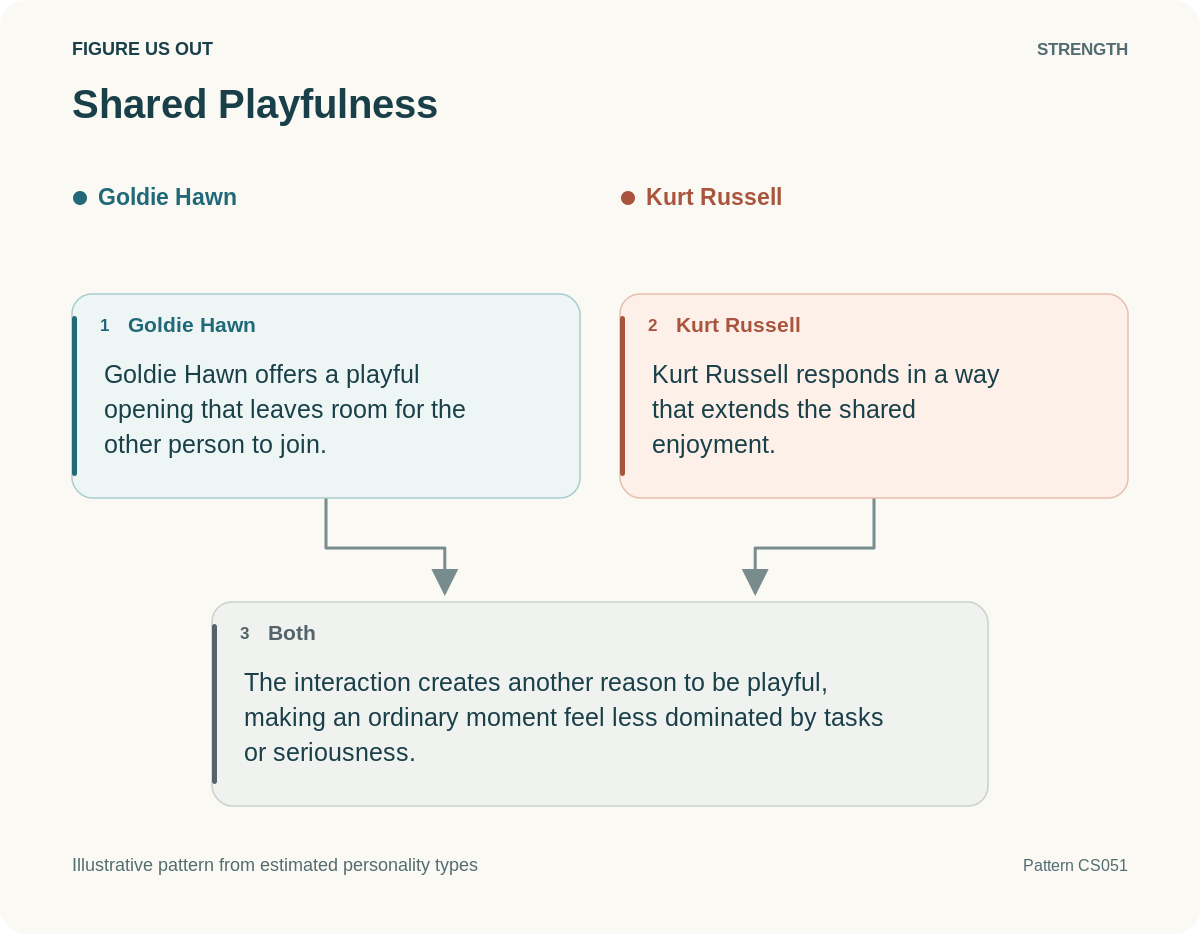
Read the steps
1. Goldie Hawn offers a playful opening that leaves room for the other person to join.
2. Kurt Russell responds in a way that extends the shared enjoyment.
3. The interaction creates another reason to be playful, making an ordinary moment feel less dominated by tasks or seriousness.
Contributions 1 and 2 both feed outcome 3. Neither contribution causes the other.
Try: Offer a small playful invitation and follow the other person's actual response rather than assuming they must join.
Two other possible recurring patterns
The Idea and the Example
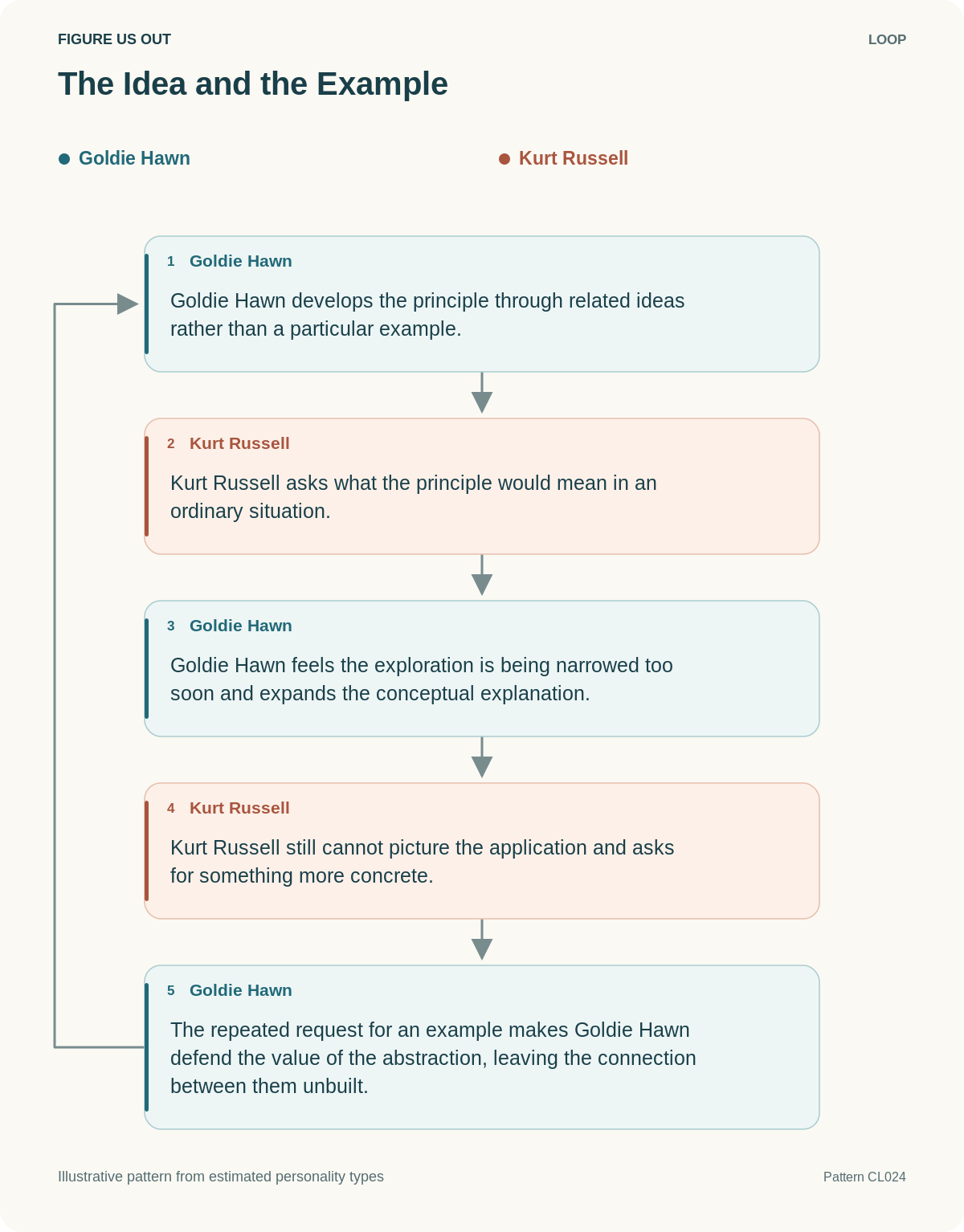
Read the steps
1. Goldie Hawn develops the principle through related ideas rather than a particular example.
2. Kurt Russell asks what the principle would mean in an ordinary situation.
3. Goldie Hawn feels the exploration is being narrowed too soon and expands the conceptual explanation.
4. Kurt Russell still cannot picture the application and asks for something more concrete.
5. The repeated request for an example makes Goldie Hawn defend the value of the abstraction, leaving the connection between them unbuilt.
Steps 1 → 2 → 3 → 4 → 5 → 1 form the repeating loop.
Try: Move from idea to example and back once before deciding that you disagree.
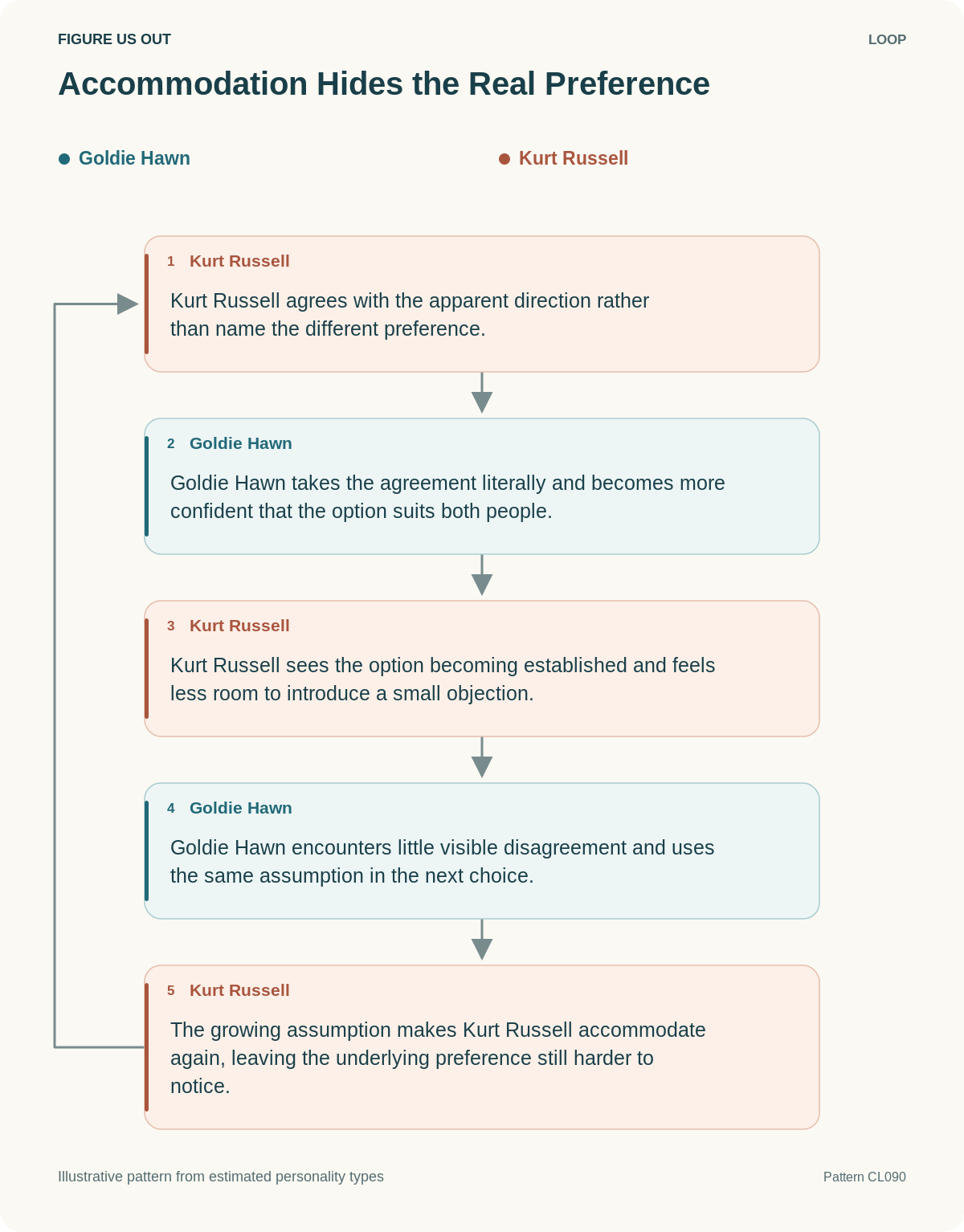
Accommodation Hides the Real Preference
Read the steps
1. Kurt Russell agrees with the apparent direction rather than name the different preference.
2. Goldie Hawn takes the agreement literally and becomes more confident that the option suits both people.
3. Kurt Russell sees the option becoming established and feels less room to introduce a small objection.
4. Goldie Hawn encounters little visible disagreement and uses the same assumption in the next choice.
5. The growing assumption makes Kurt Russell accommodate again, leaving the underlying preference still harder to notice.
Steps 1 → 2 → 3 → 4 → 5 → 1 form the repeating loop.
Try: Let each person name a first choice, then make a separate decision about compromise.
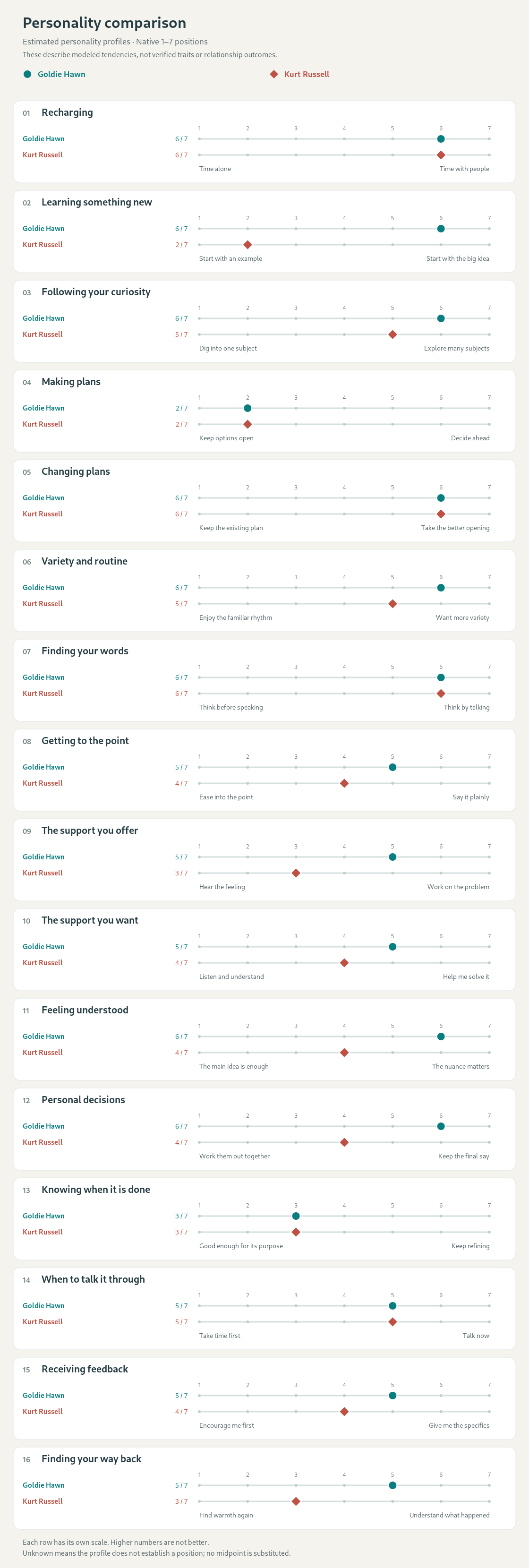
All 16 personality comparisons
Modeled preferences on the source 1–7 scales, not individual measurements. Neither end is better, and differences are not a forecast of relationship success.
Recharging
1 = Time alone7 = Time with people
Goldie Hawn: 6/7
Kurt Russell: 6/7
Learning something new
1 = Start with an example7 = Start with the big idea
Goldie Hawn: 6/7
Kurt Russell: 2/7
Following your curiosity
1 = Dig into one subject7 = Explore many subjects
Goldie Hawn: 6/7
Kurt Russell: 5/7
Making plans
1 = Keep options open7 = Decide ahead
Goldie Hawn: 2/7
Kurt Russell: 2/7
Changing plans
1 = Keep the existing plan7 = Take the better opening
Goldie Hawn: 6/7
Kurt Russell: 6/7
Variety and routine
1 = Enjoy the familiar rhythm7 = Want more variety
Goldie Hawn: 6/7
Kurt Russell: 5/7
Finding your words
1 = Think before speaking7 = Think by talking
Goldie Hawn: 6/7
Kurt Russell: 6/7
Getting to the point
1 = Ease into the point7 = Say it plainly
Goldie Hawn: 5/7
Kurt Russell: 4/7
The support you offer
1 = Hear the feeling7 = Work on the problem
Goldie Hawn: 5/7
Kurt Russell: 3/7
The support you want
1 = Listen and understand7 = Help me solve it
Goldie Hawn: 5/7
Kurt Russell: 4/7
Feeling understood
1 = The main idea is enough7 = The nuance matters
Goldie Hawn: 6/7
Kurt Russell: 4/7
Personal decisions
1 = Work them out together7 = Keep the final say
Goldie Hawn: 6/7
Kurt Russell: 4/7
Knowing when it is done
1 = Good enough for its purpose7 = Keep refining
Goldie Hawn: 3/7
Kurt Russell: 3/7
When to talk it through
1 = Take time first7 = Talk now
Goldie Hawn: 5/7
Kurt Russell: 5/7
Receiving feedback
1 = Encourage me first7 = Give me the specifics
Goldie Hawn: 5/7
Kurt Russell: 4/7
Finding your way back
1 = Find warmth again7 = Understand what happened
Goldie Hawn: 5/7
Kurt Russell: 3/7
View the original full comparison chart
The full chart scrolls horizontally on smaller screens.