Figure Us Out · Celebrity Couples
Gwen Stefani and Blake Shelton: The Pop Star Has Her Own Tractor
A garden, a wedding song, and what happens when “this means something to me” meets “okay, but how would we do it?”

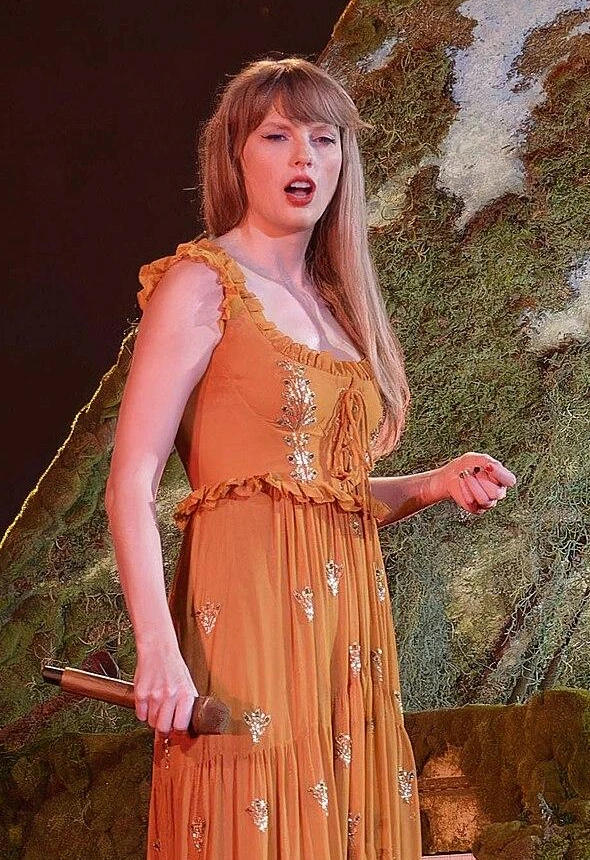
Blake Shelton and Gwen Stefani performing at the U.S.–Italy state dinner on October 18, 2016. Photo: Pete Souza / The White House. Source · U.S. federal government public domain.
Resized for this article. Archival event photograph, not an illustration of the imagined relationship scenes. No endorsement is implied.
Gwen Stefani has her own tractor. Blake Shelton confirmed it in a 2024 NYLON interview, which is a detail worth enjoying for a moment.
You might picture the two of them in very different settings. Then you find out they're gardening together, and the picture gets a little more interesting. In NYLON's cover story, Gwen described their pandemic project of moving irises so they could watch them grow. Blake's interests included bigger crops; hers included the smaller plants that need more attention.
That sounds like a much better starting point for understanding a couple than simply deciding that a pop star and a country singer must be opposites.
There is a world of difference between having different tastes and having nothing to enjoy together.
They found more than a duet
Gwen and Blake met as coaches on The Voice in 2014. They married on July 3, 2021, and celebrated five years of marriage in 2026. Their wedding took place on his Oklahoma ranch, in a chapel that made the location very much part of the occasion.
The wedding also gave Blake a fairly intimidating assignment: say something heartfelt after Gwen had already done it beautifully.
According to Carson Daly's account, reported by Entertainment Tonight, he encouraged them to write their own vows. Gwen delivered hers, and Blake brought out a guitar. He had written her a song, later released as “We Can Reach the Stars.” Daly remembered Blake singing it through tears.
You have to give him credit. A song you wrote for the person standing in front of you is a pretty good answer to the question of how to make your vows personal.
It also complicates the easy story about a practical country guy and an expressive woman. Practical people can care deeply about meaning. Expressive people can learn how to drive the tractor.
Different ways of getting excited about the same thing
For this Figure Us Out exploration, we're using Gwen as ENFP 4w3 and Blake as ESTP 6w7. Both are tentative public personality estimates, with competing interpretations, not results either person supplied. Our charts and imagined examples explore those profiles; they don't establish what happens in their private relationship or imply endorsement.
Gwen's estimated combination pays particular attention to what makes something personal. An idea becomes exciting because of the feeling, story, or possibility behind it. Making it look fine on paper may not be enough if the part that makes it hers has disappeared.
Blake's estimated combination is quicker to engage with what can be tried, built, changed, or tested. The Six part adds an interest in whether people and arrangements can be relied on. Keeping options open doesn't mean wanting everything to be uncertain.
There could be a lot to enjoy in that pairing. One person helps you picture something you hadn't considered. The other starts finding a way to give it a real place in your life.
Imagine mentioning an idea for an outdoor dinner. You're describing lights, music, and the feeling you want the evening to have. Your partner starts checking where the table could go and whether there's an outlet nearby.
Those questions can be an expression of interest. They've started imagining people actually sitting there.
And the person picturing the atmosphere contributes something practical too. Knowing what the evening is meant to feel like helps you decide whether any of those arrangements are worth making.
A look at the two estimated profiles
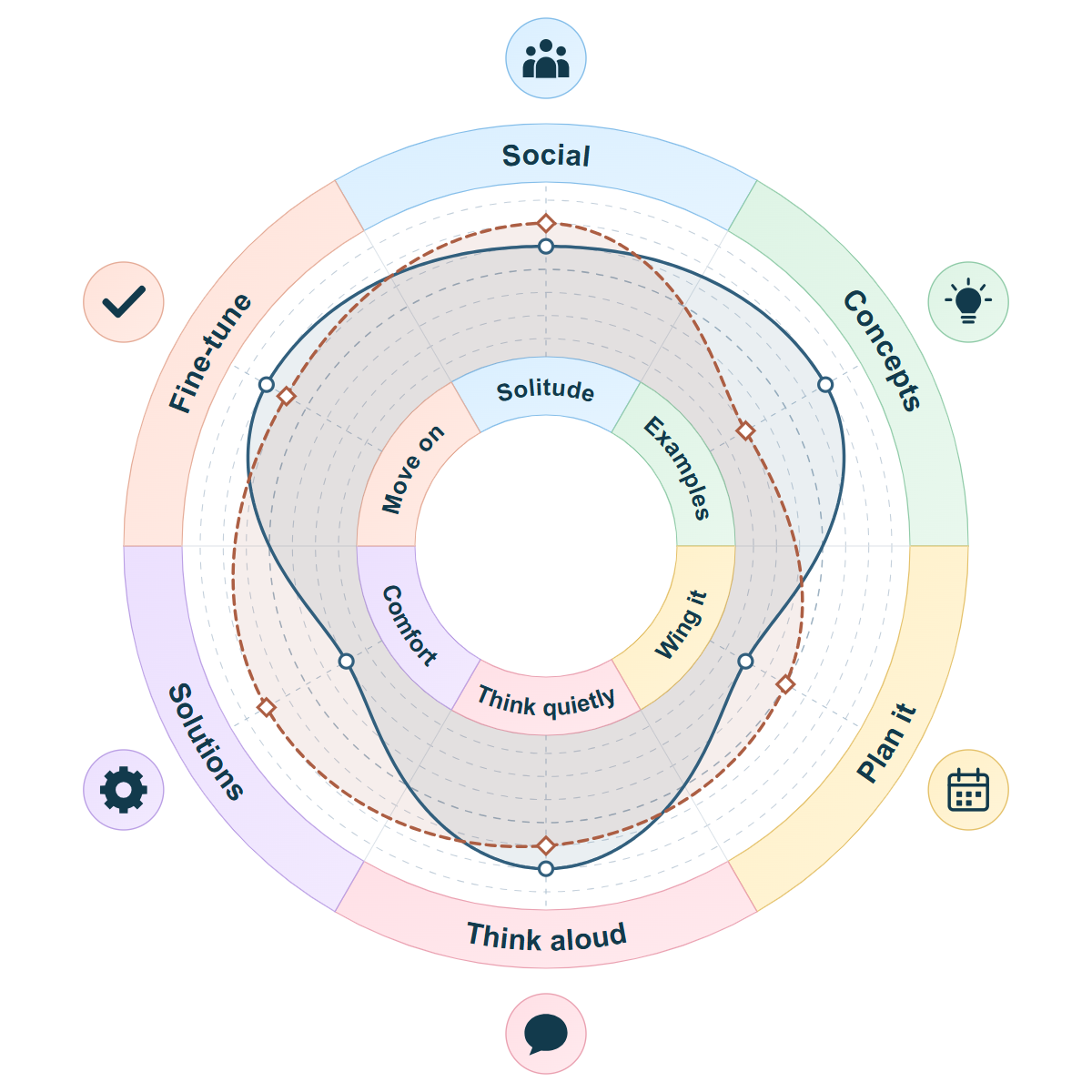
How to read the wheel
Each spoke follows a 1–7 scale. The source illustration has been cropped around the original wheel, without changing its lines or positions.
Recharging
1 = Time alone
7 = Time with people
Gwen Stefani: 5
Blake Shelton: 6
Learning something new
1 = Start with an example
7 = Start with the big idea
Gwen Stefani: 6
Blake Shelton: 2
Making plans
1 = Keep options open
7 = Decide ahead
Gwen Stefani: 2
Blake Shelton: 4
Finding your words
1 = Think before speaking
7 = Think by talking
Gwen Stefani: 6
Blake Shelton: 5
The support you offer
1 = Hear the feeling
7 = Work on the problem
Gwen Stefani: 2
Blake Shelton: 6
Knowing when it is done
1 = Good enough for its purpose
7 = Keep refining
Gwen Stefani: 6
Blake Shelton: 5
“We could just buy new ones”
Where this combination gets interesting is when a perfectly workable solution leaves out the reason someone wanted it in the first place.
Consider an imaginary couple moving into a new home. One wants to take rose cuttings from a garden that belonged to their grandmother. The other wonders whether they will survive the move and suggests buying healthy plants from the nursery instead.
On one level, that is an excellent suggestion. The plants would already have roots. They could choose a variety suited to the new yard. There would be much less chance of disappointment.
But the first person wasn't mainly asking how to acquire roses.
They wanted a piece of that particular garden to come with them. New plants could be beautiful and still leave that wish unanswered.
So they explain why the old roses matter. Their partner responds with more detail about transporting and growing them. Now the first person feels they have to make the meaning clearer, while the second feels they have to make the difficulties clearer.
Before long, one is defending a family connection and the other is defending the idea that plants need roots. Neither expected to be having this argument.
That is the possible pattern shown below. A practical objection starts sounding like indifference. A stronger explanation of the meaning starts sounding like refusal to face the practical problem. Each person gives more of the response that the other is already struggling to hear.
“This matters to me” meets “How would it work?”
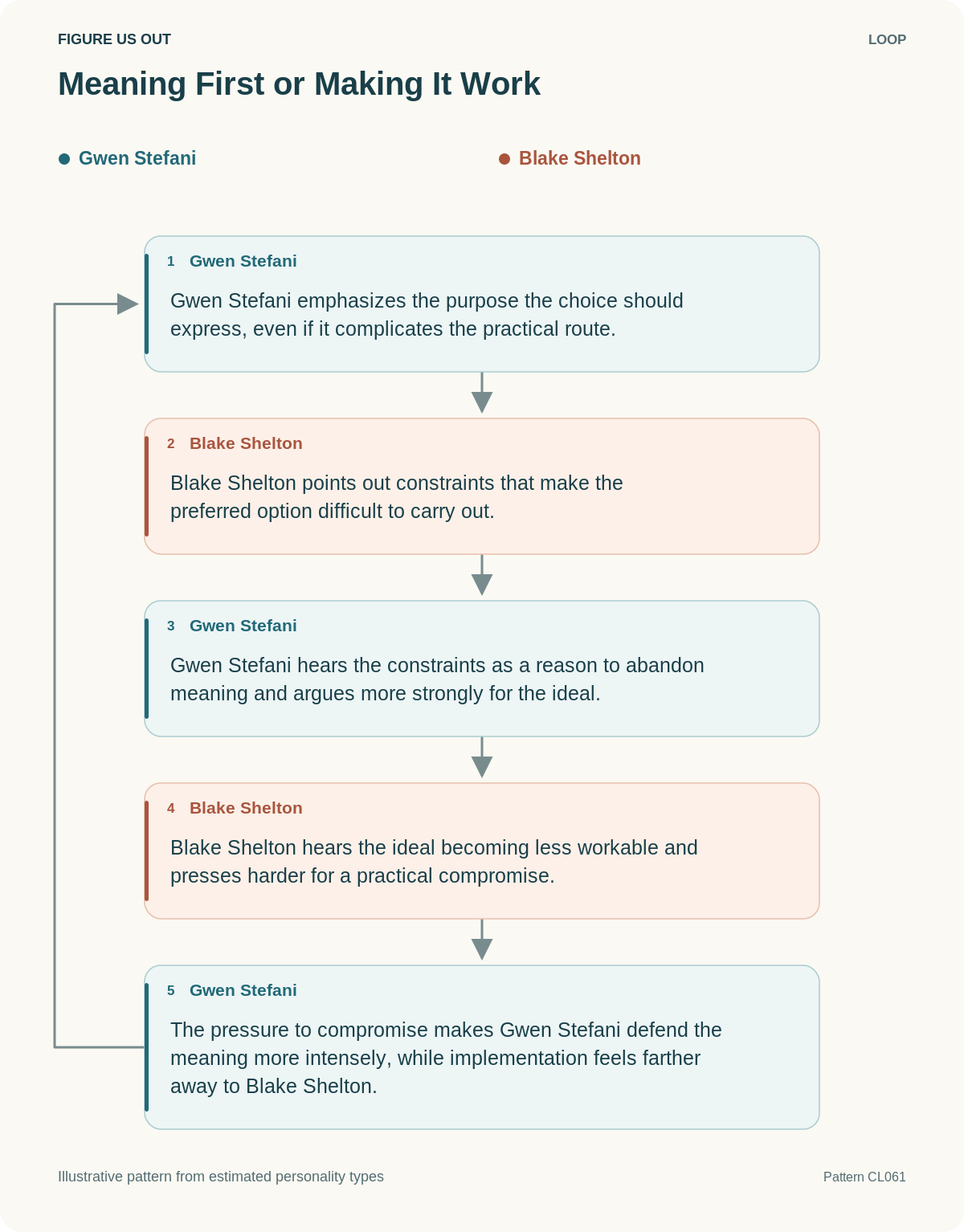
Gwen’s side explains the meaning they want the choice to keep.
Blake’s side points out the practical difficulties.
Gwen’s side hears a reason to give up what matters and defends the idea harder.
Blake’s side sees a plan getting harder to carry out and pushes for a compromise.
The pressure makes the meaning feel more threatened, restarting the argument.
↻ Step 5 reinforces step 1, so the exchange can repeat.
The way through begins with identifying what actually has to survive.
Perhaps the important thing is having one plant descended from that garden. It doesn't have to fill the whole new yard. They could ask someone experienced to take several cuttings, transport them carefully, and buy other plants while those grow.
Now the practical partner has a useful problem to help solve. The meaning-focused partner has room to change the method without feeling that the entire idea has been dismissed.
Sometimes the original plan really won't work. Saying so doesn't require treating the wish behind it as foolish. It may still be possible to preserve a memory, a tradition, or a feeling in a different form. And sometimes hearing why it matters is enough to make a little extra effort feel worthwhile.
A partner's meaning isn't always obvious
The same misunderstanding could happen over a birthday, a gift, or which restaurant to choose for an anniversary.
You might suggest the place with easier parking and better food. Your partner might want the slightly inconvenient place where you used to go when you were first dating. Until you understand that, their preference can look like unnecessary difficulty.
It can go the other way too. Someone may keep adding meaningful details until a celebration becomes more work than either person can reasonably do. A partner asking what they can leave out might be trying to protect the pleasure of the occasion.
Both questions deserve a real answer: what makes this matter, and what can we actually manage?
In the estimated Gwen-and-Blake combination, paying attention to those two questions could turn a frustrating difference into a strength. Gwen's side could keep a plan connected to something personal. Blake's could help find a way to enjoy it without making it impossible to carry out.
Neither contribution belongs permanently to one person. The one who usually handles logistics may have a very sentimental wish about this particular day. The one with the big idea may be the first to notice that everyone is exhausted.
Knowing your partner means leaving room for that surprise.
Sometimes the best help comes second
Their profiles suggest another useful difference: the order in which support might feel welcome.
The Gwen estimate leans toward wanting the feeling understood before working out a solution. The Blake estimate leans toward finding a useful next step. Both responses can be caring. The timing can make them land very differently.
Imagine coming home disappointed after something you worked hard on didn't go well. Your partner immediately offers three ways to improve it next time. Those ideas may be good. You might even use all three tomorrow.
Tonight, you were hoping to tell someone why it hurt.
One person is trying to make the problem smaller. The other needs the effort behind it to be visible first. Moving straight to repairs can accidentally make that effort feel overlooked.
A little acknowledgment changes what comes next. “You put a lot into that. Which part are you most disappointed about?” gives the person room to explain. Then advice can respond to the actual concern, rather than to the first problem the listener thought they heard.
The person speaking can help too: “I do want your ideas. Let me be disappointed for a minute first.” That makes the pause understandable instead of leaving a willing partner wondering why every suggestion is being rejected.
The strength here is having both warmth and practical help available. No one needs to become a different person to offer them in an order their partner can receive.
There should still be room to sing in the car
The serious explanations shouldn't crowd out the fun of this pairing. There is also the possibility of shared playfulness: two people can help an ordinary moment become enjoyable without turning either one into the household entertainment department.
One of the lovelier details in the NYLON interview was Gwen's account of hearing an early version of their song “Purple Irises.” She and Blake stayed in the car in the driveway listening and laughing. They had somewhere perfectly comfortable to go inside. They were enjoying being right where they were.
Their public performances have offered another version of that pleasure. Soon after the wedding, they surprised a crowd at Ole Red in Tishomingo. They sang together, and Blake pointed toward Gwen as the crowd applauded. It was a small-town stage with a very recognizable guest.
You don't need a duet or a ranch to understand the appeal. It's the pleasure of having someone beside you who is interested in what you're doing and happy to be part of it.
That is worth protecting when a practical question starts sounding like criticism. A person asking how something will work may be trying to join in. A person insisting on one particular detail may be trying to tell you why the whole thing matters.
Before deciding your partner is making a simple choice difficult, try asking:
“What part of this would you be disappointed to lose?”
The answer might make the next decision surprisingly easy. Or it might explain why the easy option was never going to be enough.
Gwen and Blake's story gives us plenty of room for both: the sentimental gesture, the useful skill, the shared joke, and an unexpected piece of farm equipment. A relationship can make space for more of you than anyone would guess from looking at the two names separately.
What could your own pairing show you?
Figure Us Out brings together a personal guide for each of you, a couples guide, a 12-week workbook, and a downloadable book. Explore the strengths and recurring misunderstandings your own personalities could create.
A little more to explore
The article follows a few possibilities. These optional graphics show the rest of the supplied strengths and patterns.
Three possible shared strengths
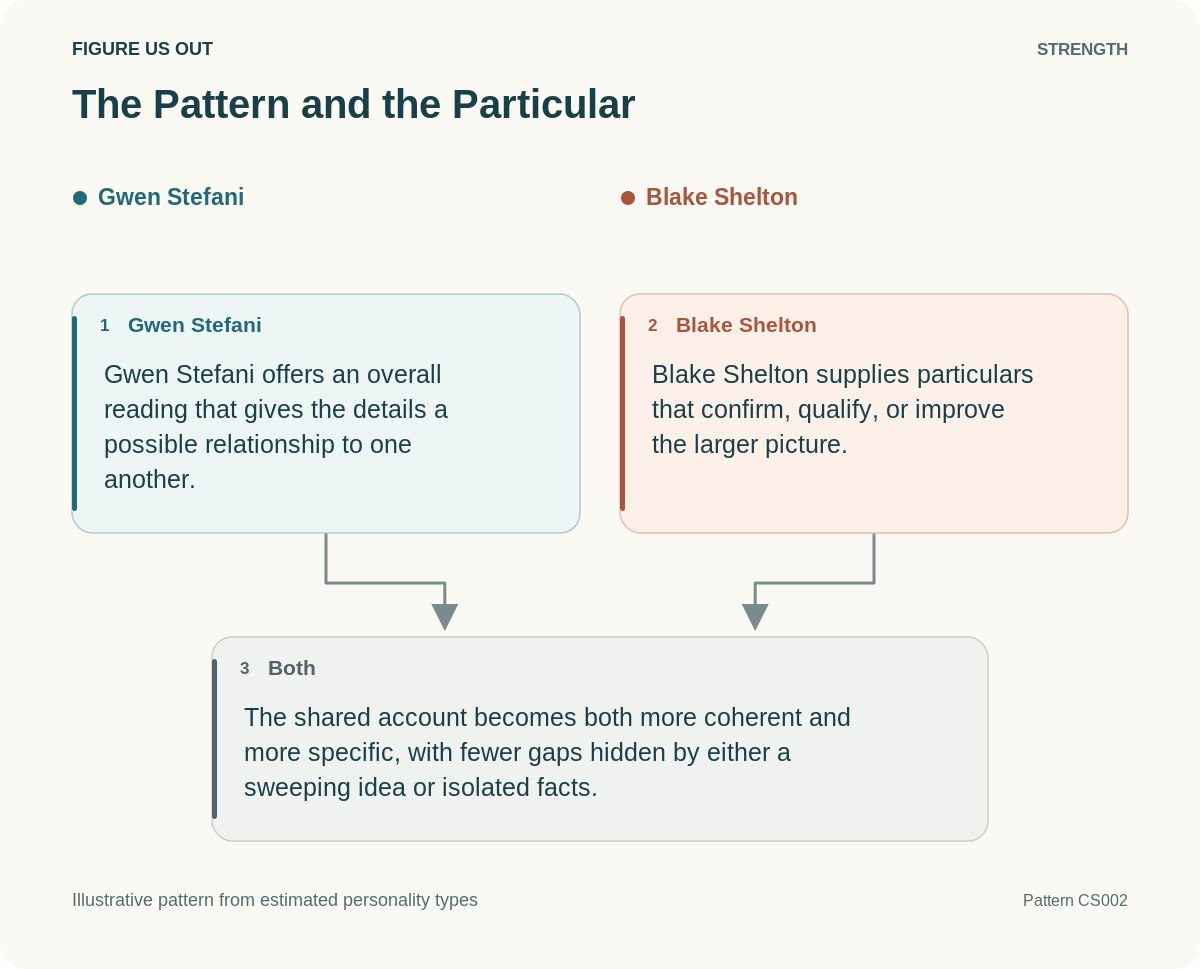
The Pattern and the Particular
Read the steps
1. Gwen Stefani offers an overall reading that gives the details a possible relationship to one another.
2. Blake Shelton supplies particulars that confirm, qualify, or improve the larger picture.
3. The shared account becomes both more coherent and more specific, with fewer gaps hidden by either a sweeping idea or isolated facts.
Contributions 1 and 2 both feed outcome 3. Neither contribution causes the other.
Try: Ask one person for the overall picture and the other for the detail most likely to change it, then revise the picture together.
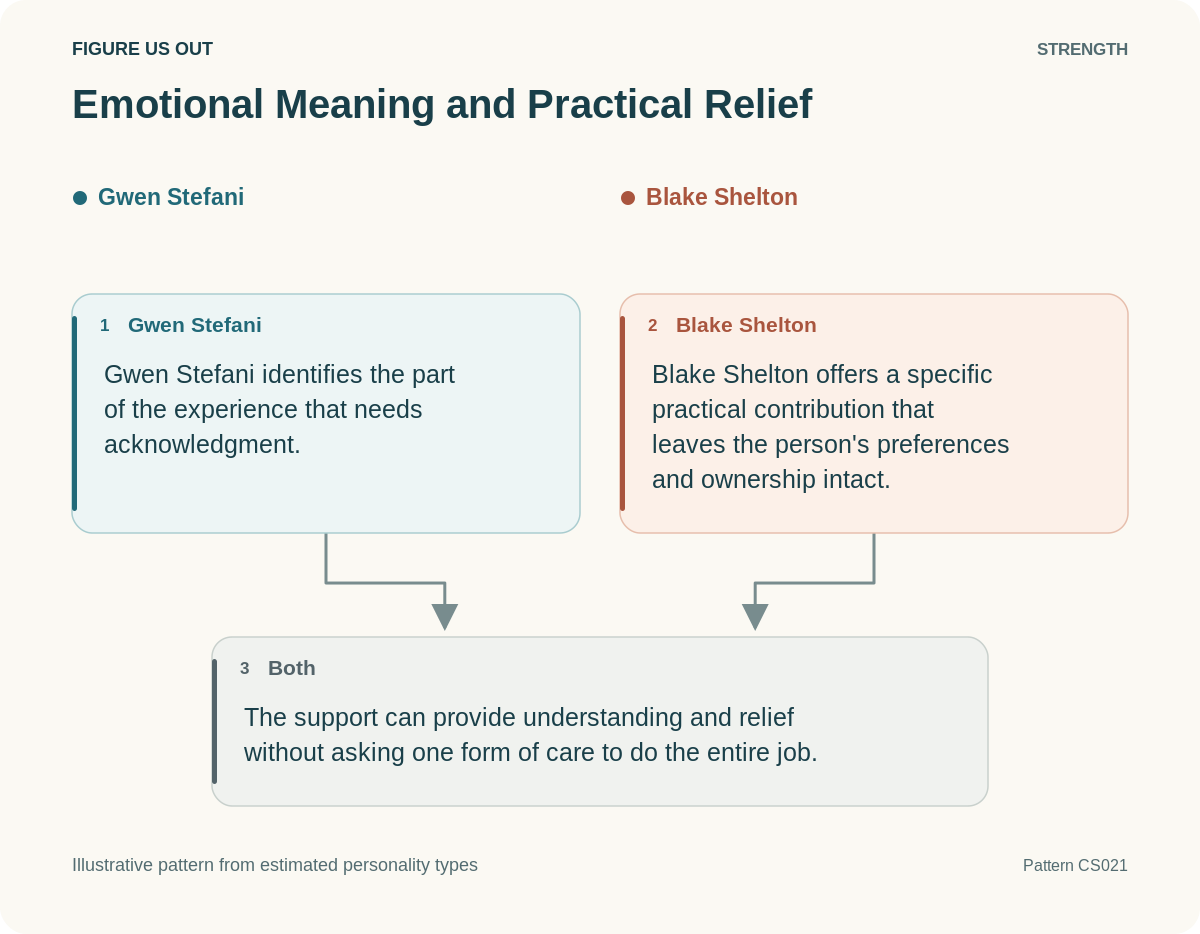
Emotional Meaning and Practical Relief
Read the steps
1. Gwen Stefani identifies the part of the experience that needs acknowledgment.
2. Blake Shelton offers a specific practical contribution that leaves the person's preferences and ownership intact.
3. The support can provide understanding and relief without asking one form of care to do the entire job.
Contributions 1 and 2 both feed outcome 3. Neither contribution causes the other.
Try: Ask what would help first: being understood, a concrete contribution, or a little of both.
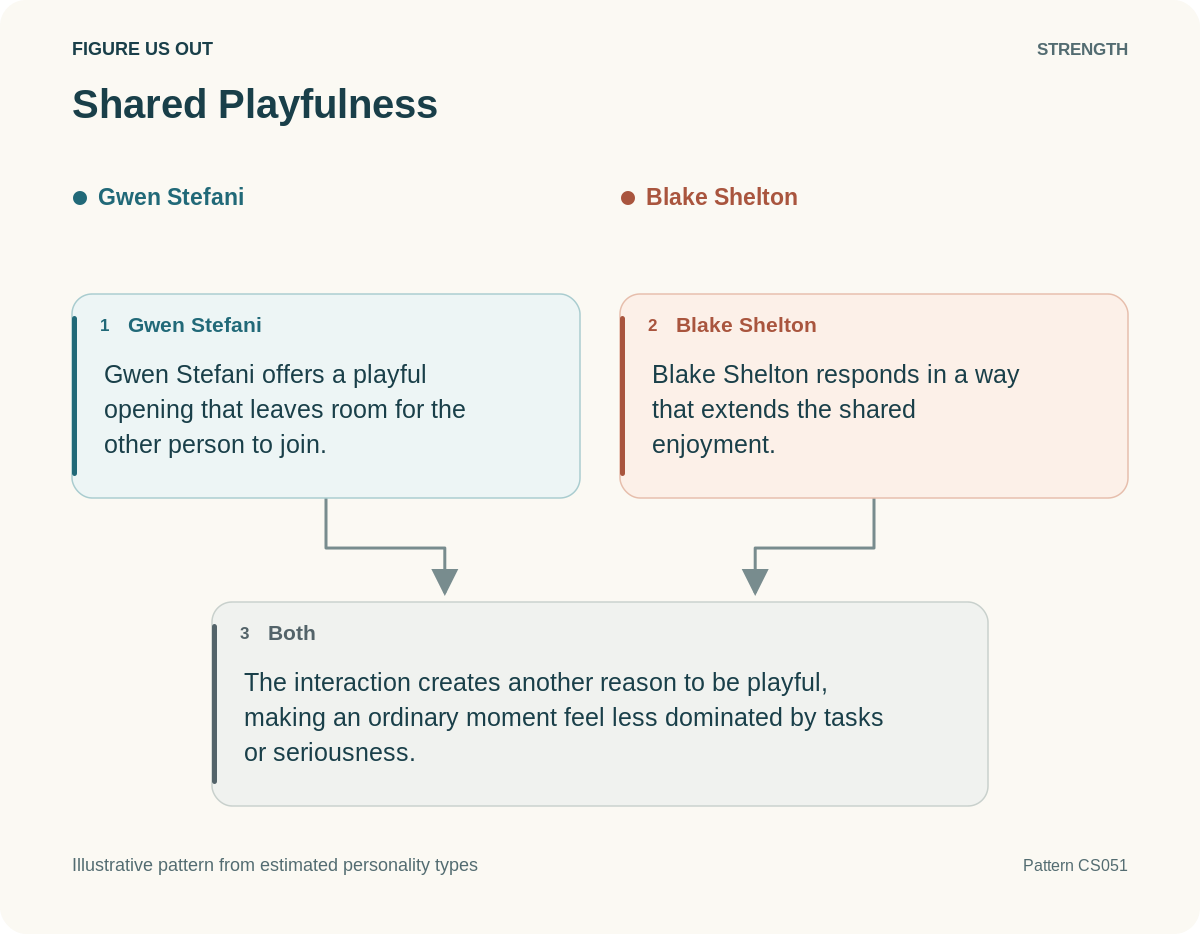
Shared Playfulness
Read the steps
1. Gwen Stefani offers a playful opening that leaves room for the other person to join.
2. Blake Shelton responds in a way that extends the shared enjoyment.
3. The interaction creates another reason to be playful, making an ordinary moment feel less dominated by tasks or seriousness.
Contributions 1 and 2 both feed outcome 3. Neither contribution causes the other.
Try: Offer a small playful invitation and follow the other person's actual response rather than assuming they must join.
Two other possible recurring patterns
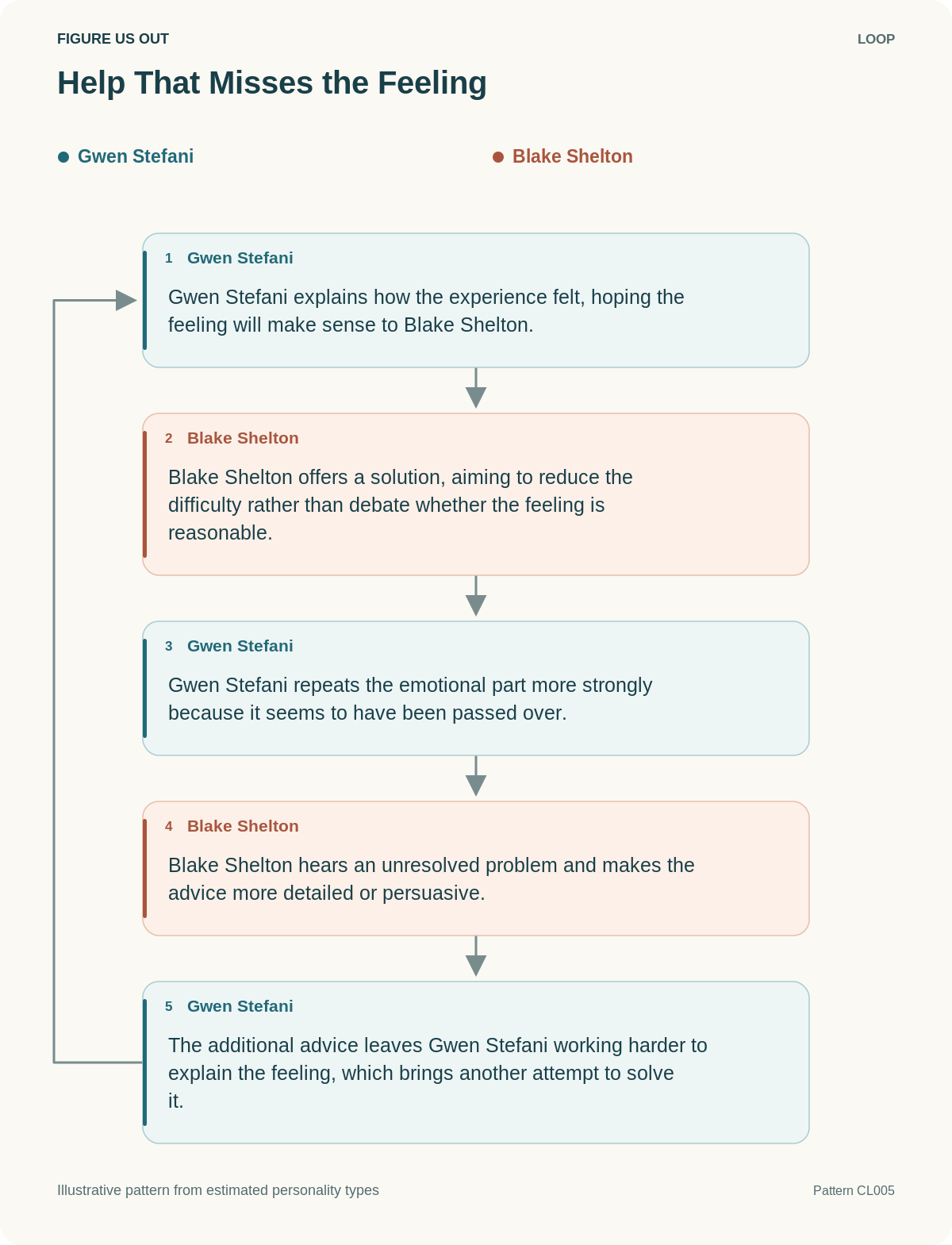
Help That Misses the Feeling
Read the steps
1. Gwen Stefani explains how the experience felt, hoping the feeling will make sense to Blake Shelton.
2. Blake Shelton offers a solution, aiming to reduce the difficulty rather than debate whether the feeling is reasonable.
3. Gwen Stefani repeats the emotional part more strongly because it seems to have been passed over.
4. Blake Shelton hears an unresolved problem and makes the advice more detailed or persuasive.
5. The additional advice leaves Gwen Stefani working harder to explain the feeling, which brings another attempt to solve it.
Steps 1 → 2 → 3 → 4 → 5 → 1 form the repeating loop.
Try: Ask what kind of help belongs first in this particular moment rather than assigning permanent emotional and practical roles.
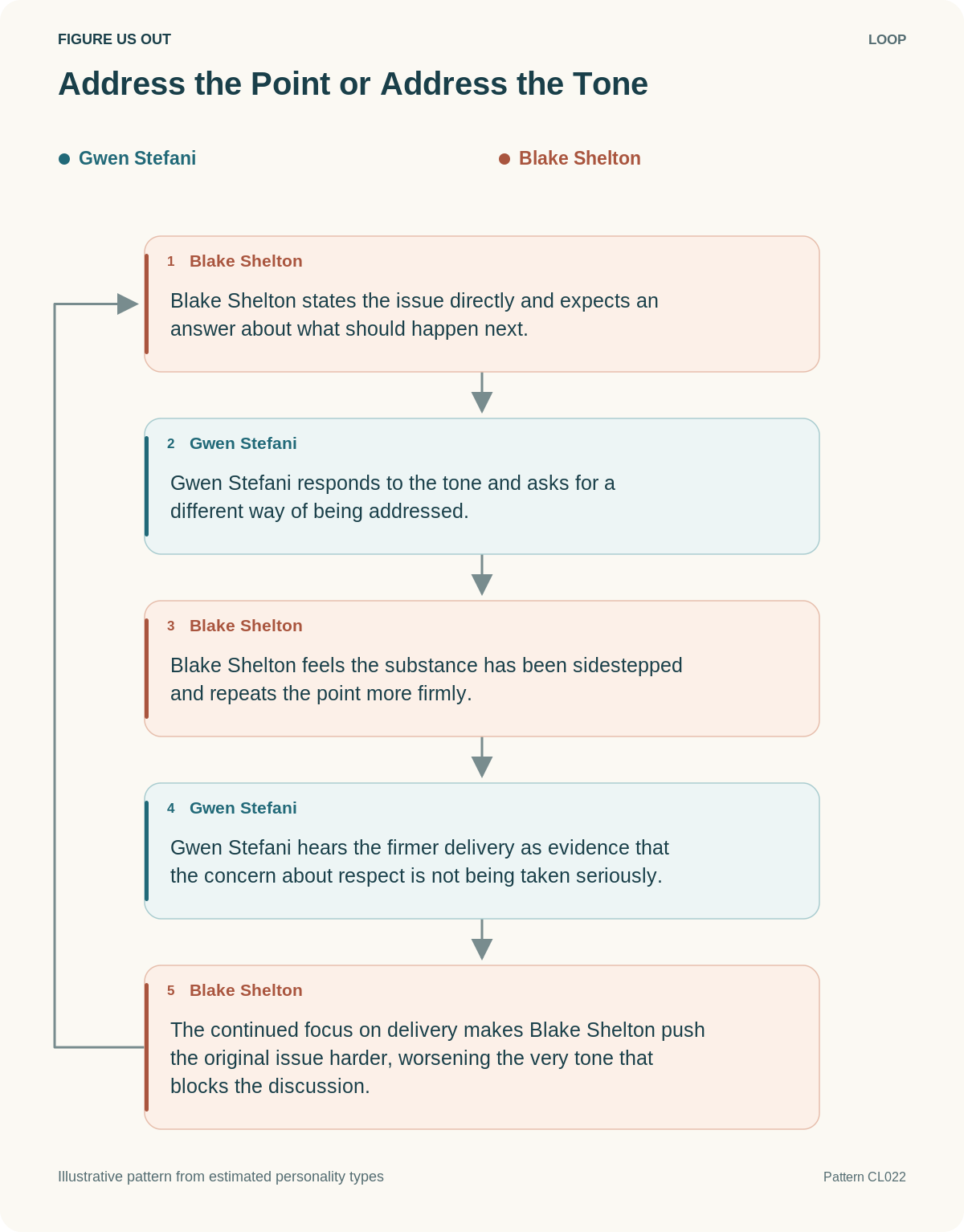
Address the Point or Address the Tone
Read the steps
1. Blake Shelton states the issue directly and expects an answer about what should happen next.
2. Gwen Stefani responds to the tone and asks for a different way of being addressed.
3. Blake Shelton feels the substance has been sidestepped and repeats the point more firmly.
4. Gwen Stefani hears the firmer delivery as evidence that the concern about respect is not being taken seriously.
5. The continued focus on delivery makes Blake Shelton push the original issue harder, worsening the very tone that blocks the discussion.
Steps 1 → 2 → 3 → 4 → 5 → 1 form the repeating loop.
Try: Reset the wording once, then discuss the issue without using either tone or substance to erase the other.
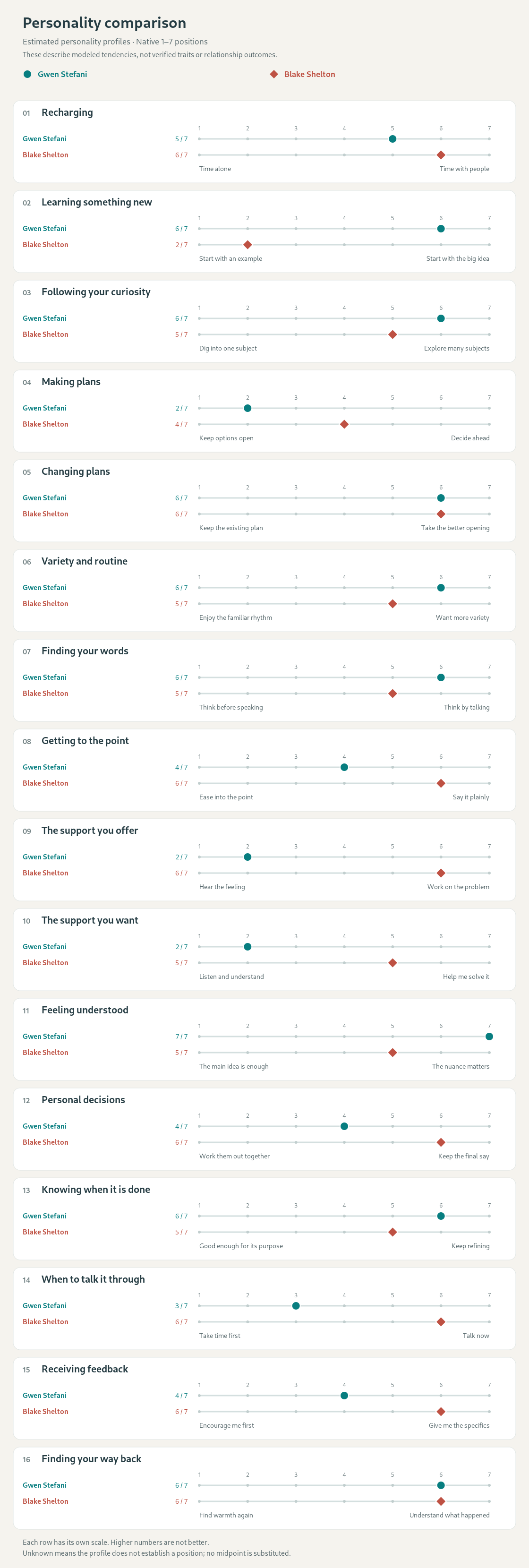
All 16 personality comparisons
Modeled preferences on the source 1–7 scales, not individual measurements. Neither end is better, and differences are not a forecast of relationship success.
Recharging
1 = Time alone7 = Time with people
Gwen Stefani: 5/7
Blake Shelton: 6/7
Learning something new
1 = Start with an example7 = Start with the big idea
Gwen Stefani: 6/7
Blake Shelton: 2/7
Following your curiosity
1 = Dig into one subject7 = Explore many subjects
Gwen Stefani: 6/7
Blake Shelton: 5/7
Making plans
1 = Keep options open7 = Decide ahead
Gwen Stefani: 2/7
Blake Shelton: 4/7
Changing plans
1 = Keep the existing plan7 = Take the better opening
Gwen Stefani: 6/7
Blake Shelton: 6/7
Variety and routine
1 = Enjoy the familiar rhythm7 = Want more variety
Gwen Stefani: 6/7
Blake Shelton: 5/7
Finding your words
1 = Think before speaking7 = Think by talking
Gwen Stefani: 6/7
Blake Shelton: 5/7
Getting to the point
1 = Ease into the point7 = Say it plainly
Gwen Stefani: 4/7
Blake Shelton: 6/7
The support you offer
1 = Hear the feeling7 = Work on the problem
Gwen Stefani: 2/7
Blake Shelton: 6/7
The support you want
1 = Listen and understand7 = Help me solve it
Gwen Stefani: 2/7
Blake Shelton: 5/7
Feeling understood
1 = The main idea is enough7 = The nuance matters
Gwen Stefani: 7/7
Blake Shelton: 5/7
Personal decisions
1 = Work them out together7 = Keep the final say
Gwen Stefani: 4/7
Blake Shelton: 6/7
Knowing when it is done
1 = Good enough for its purpose7 = Keep refining
Gwen Stefani: 6/7
Blake Shelton: 5/7
When to talk it through
1 = Take time first7 = Talk now
Gwen Stefani: 3/7
Blake Shelton: 6/7
Receiving feedback
1 = Encourage me first7 = Give me the specifics
Gwen Stefani: 4/7
Blake Shelton: 6/7
Finding your way back
1 = Find warmth again7 = Understand what happened
Gwen Stefani: 6/7
Blake Shelton: 6/7
View the original full comparison chart
The full chart scrolls horizontally on smaller screens.