Celebrity couples · Figure Us Out
John Legend and Chrissy Teigen: He Fell for Her Texts, Then Wrote Her a Love Song
An unlikely dressing-room introduction, a very famous song, and two different ways of keeping a conversation going.
Chrissy Teigen's first impression of John Legend wasn't exactly the grand entrance you might expect from a future EGOT winner.
They were working on the music video for his song “Stereo” in 2006. Chrissy went into his dressing room and found John ironing his clothes while wearing his underwear. Apparently the man could write a beautiful song, make his own clothes look presentable, and handle both tasks without a team of people hovering around him. 1
After the shoot, the story involved In-N-Out burgers and a night together. But the relationship didn't suddenly turn into one long, romantic music video. John was touring, Chrissy was working, and much of their early connection grew through calls and texts.
John has said her messages made him laugh. Eventually, he started realizing how much he missed hearing from her when they were apart. 2
I love that detail more than almost anything else about their early story. The thing that kept drawing him in wasn't a perfect photograph. It was what she had to say.

And then there was “All of Me”
A few years later, John wrote “All of Me,” the song that seemed destined to appear at every wedding for the next decade. It was inspired by Chrissy. The music video was filmed at Lake Como, where they married in 2013. 3
Their public relationship has always had that funny contrast. He writes the kind of sweeping love song that can make an entire wedding reception cry. She can post something funny enough to make you snort while drinking coffee. Somehow both things belong in the same marriage.
In a 2024 interview, Chrissy talked about how close they are, how much they laugh together, and how John can explain complicated things in a way that makes them easier to understand. She said he would have made a wonderful teacher. 4
That may be one of the most affectionate compliments someone can give. It's specific. She notices not only that he's smart, but that he can make another person feel included in what he knows.
Quiet and outspoken isn't the same as caring and not caring
For this Figure Us Out exploration, we're using working personality estimates of John as ISFP 9w1 and Chrissy as ESFJ 7w8. Neither has supplied our assessment results, and the estimates, especially Chrissy's Enneagram assignment, are uncertain. Any everyday interactions below are illustrations suggested by the model, not claims about their private conversations. 5
This particular combination is interesting because it suggests different ways of using conversation.
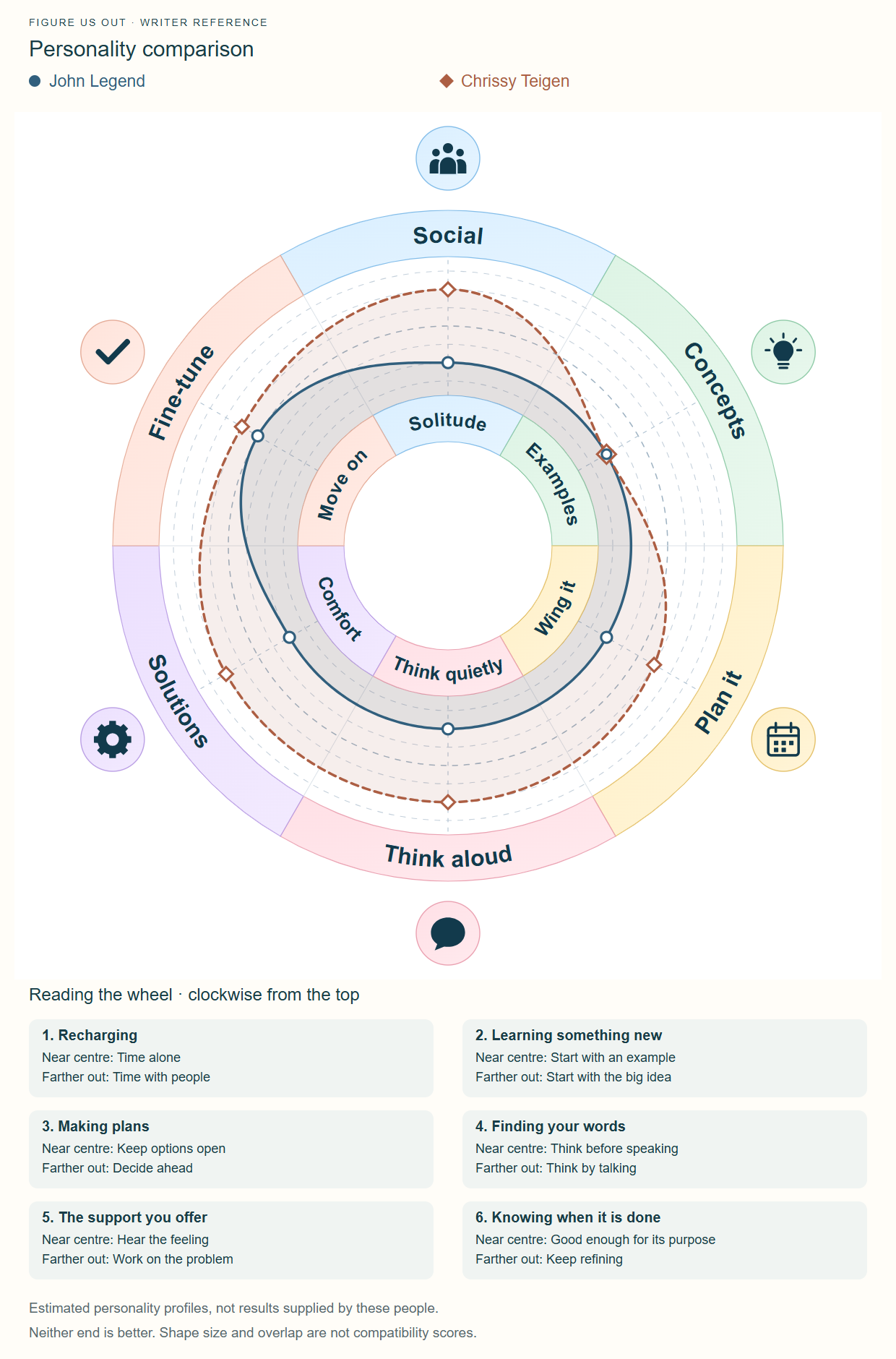
John's estimated profile favors thinking privately before speaking and beginning with the emotional meaning of something. Chrissy's favors thinking more out loud, speaking plainly, and often looking for an action that might improve the situation.
I can imagine how lovely those differences could be when they're working together. A person who is comfortable speaking up can make a quiet partner feel as if they don't have to carry every conversation. Someone who listens patiently can make the more expressive person feel genuinely welcome rather than merely tolerated.
But it would be a mistake to turn that into a rule that one person talks and the other listens. Quiet people have plenty to say. Expressive people need to be heard too. And neither person's preferred amount of conversation tells you how much they care.
The trouble with trying to fill every silence
Picture a couple driving home from dinner. One has been quiet for a few minutes. They're thinking about something that happened earlier, or maybe they're just enjoying a little silence.
The other person notices and asks if everything is okay.
“Yeah, I'm just thinking.”
They wait a few seconds. Then comes another question. “Are you upset? Did I say something?”
Now the quiet person feels a little crowded and answers more briefly. The shorter answer looks even more worrying. Their partner tries harder to make conversation, hoping to get back to the easy connection they had a minute earlier.
Before long, one person feels pursued and the other feels shut out, even though the original silence may not have meant anything troubling at all.
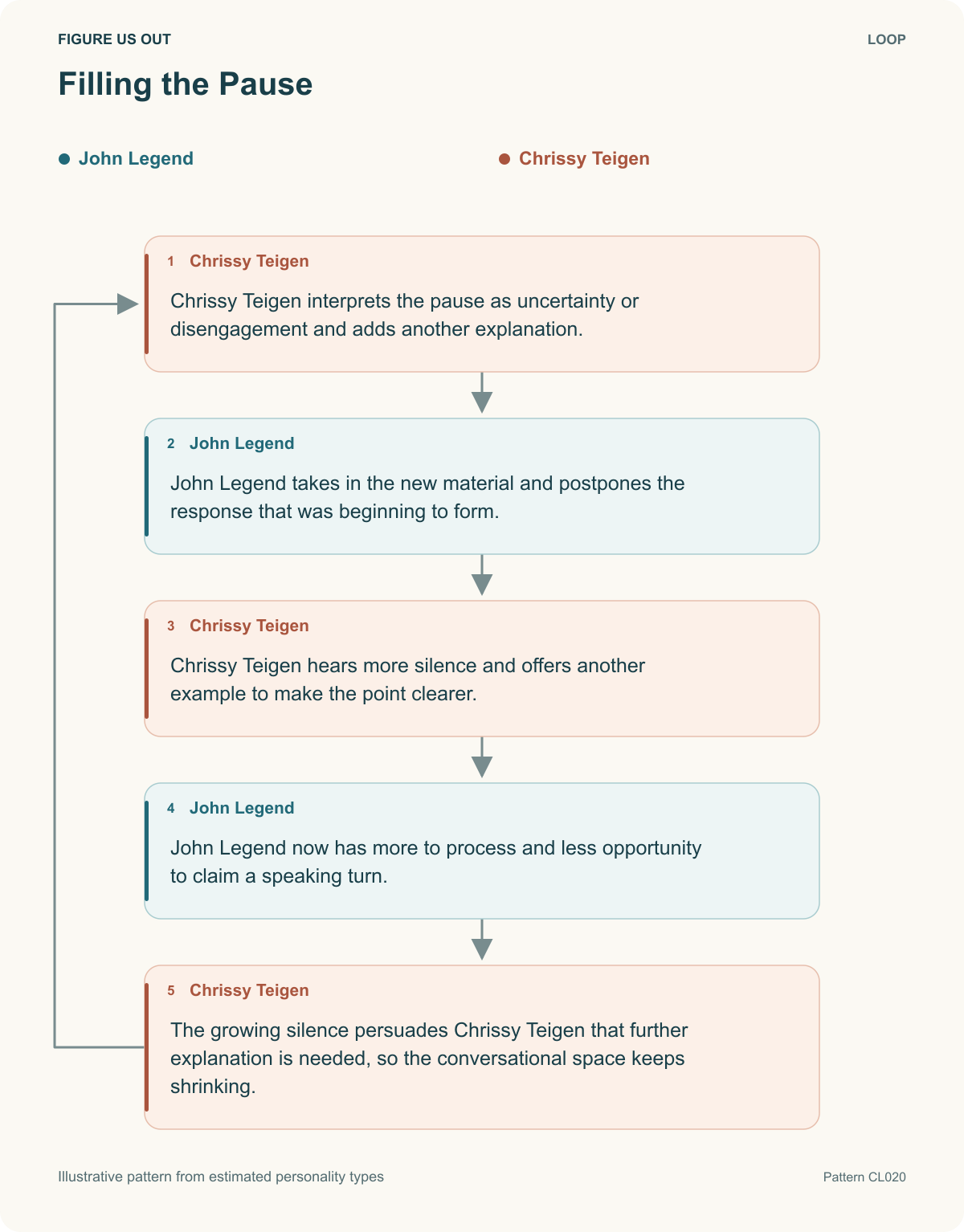
This is the “Filling the Pause” pattern in the supplied personality packet. When one person reads quiet as a signal that something needs attention, extra conversation can create more withdrawal, which makes the quiet seem even more significant. 5
Filling the Pause
Chrissy Teigen interprets the pause as uncertainty or disengagement and adds another explanation.
John Legend takes in the new material and postpones the response that was beginning to form.
Chrissy Teigen hears more silence and offers another example to make the point clearer.
John Legend now has more to process and less opportunity to claim a speaking turn.
The growing silence persuades Chrissy Teigen that further explanation is needed, so the conversational space keeps shrinking.
↺ How this loops: the final response encourages more of the original reaction.
Sometimes the nicest thing you can say is, “You seem quiet. Want company, or a little time?”
And if you're the one who needs silence, it helps to tell the other person what it means. “I'm fine. I just want to think for a bit, and then I'd love to catch up.” That gives the pause a beginning and an end without making anyone guess.
I think a lot of couples spend years having versions of this conversation. One partner thinks silence means peace. The other thinks silence means distance. Neither has ever stopped to ask whether they're hearing the same thing.
The right help can arrive at the wrong moment
There's another difference in these estimated profiles that I think readers will recognize.
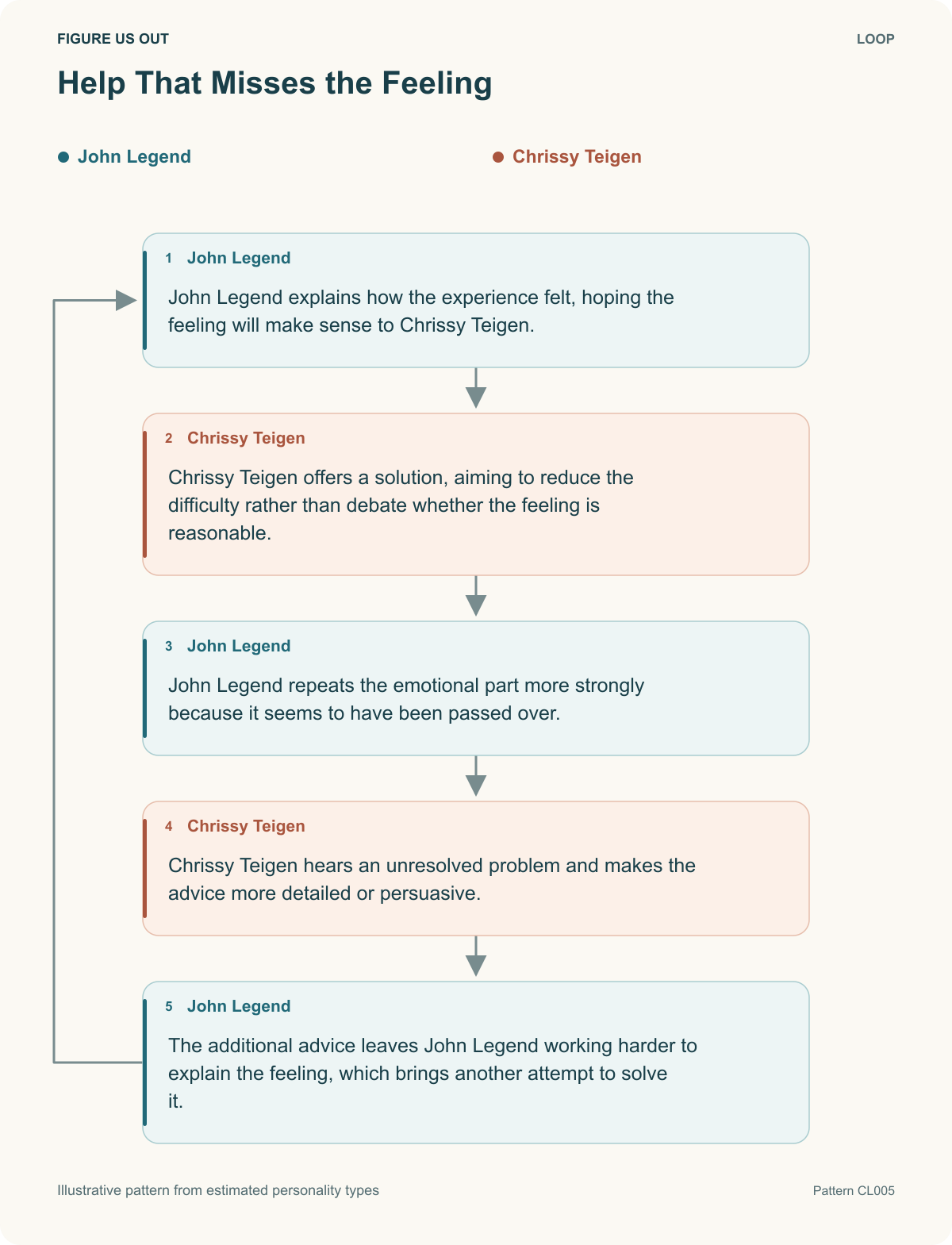
Chrissy's side of the model is more inclined to offer a practical next step when a problem comes up. John's is more inclined to want the feeling understood first. A good idea can feel unhelpful if it arrives before the person is finished telling you why they're upset.
Imagine one partner talking about a stressful conversation at work. The other listens for thirty seconds, sees a perfectly sensible answer, and offers it. The frustrated partner replies, “That's not really what I'm talking about.” The helpful partner thinks, But it solves the problem.
It might! The trouble is that the person speaking wanted a witness before they wanted a solution.
It's equally possible for someone to spend too long circling the hurt when their partner is ready to make a decision. The aim isn't for both people to talk about their feelings for exactly the same amount of time. It's to discover what kind of help is wanted right now.
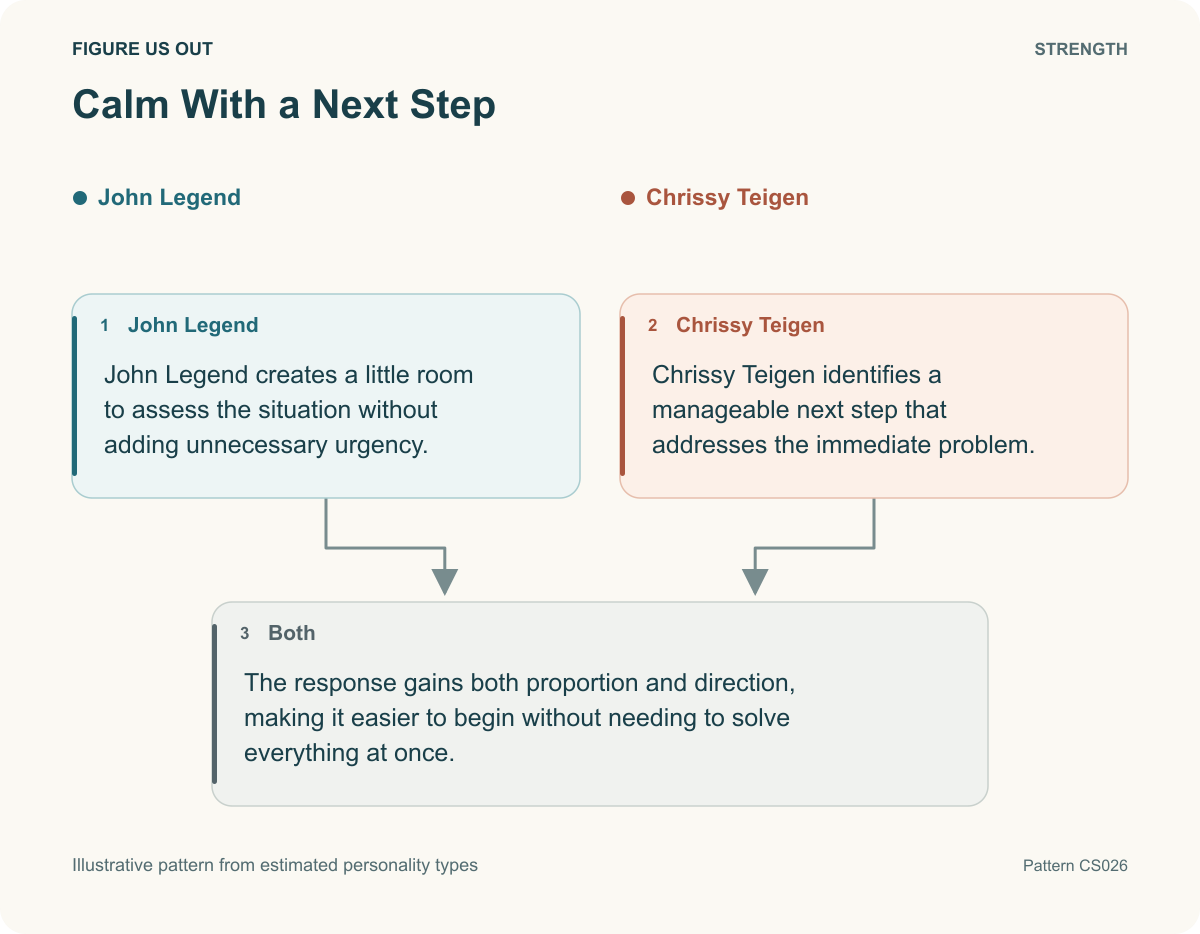
The pairing also includes a possible strength called “Calm With a Next Step.” A steady, accepting response and a practical action can be wonderful together. The order can make all the difference. 5
A little reassurance tells someone you're with them. A useful next step shows them you will help. When both are welcome, the combination can be better than either response alone.
What if the person who speaks plainly has a gentle partner?
Chrissy's public humor can be quite direct. John often comes across as gentler and more measured. That is an impression from public appearances, of course, not a complete picture of either person.
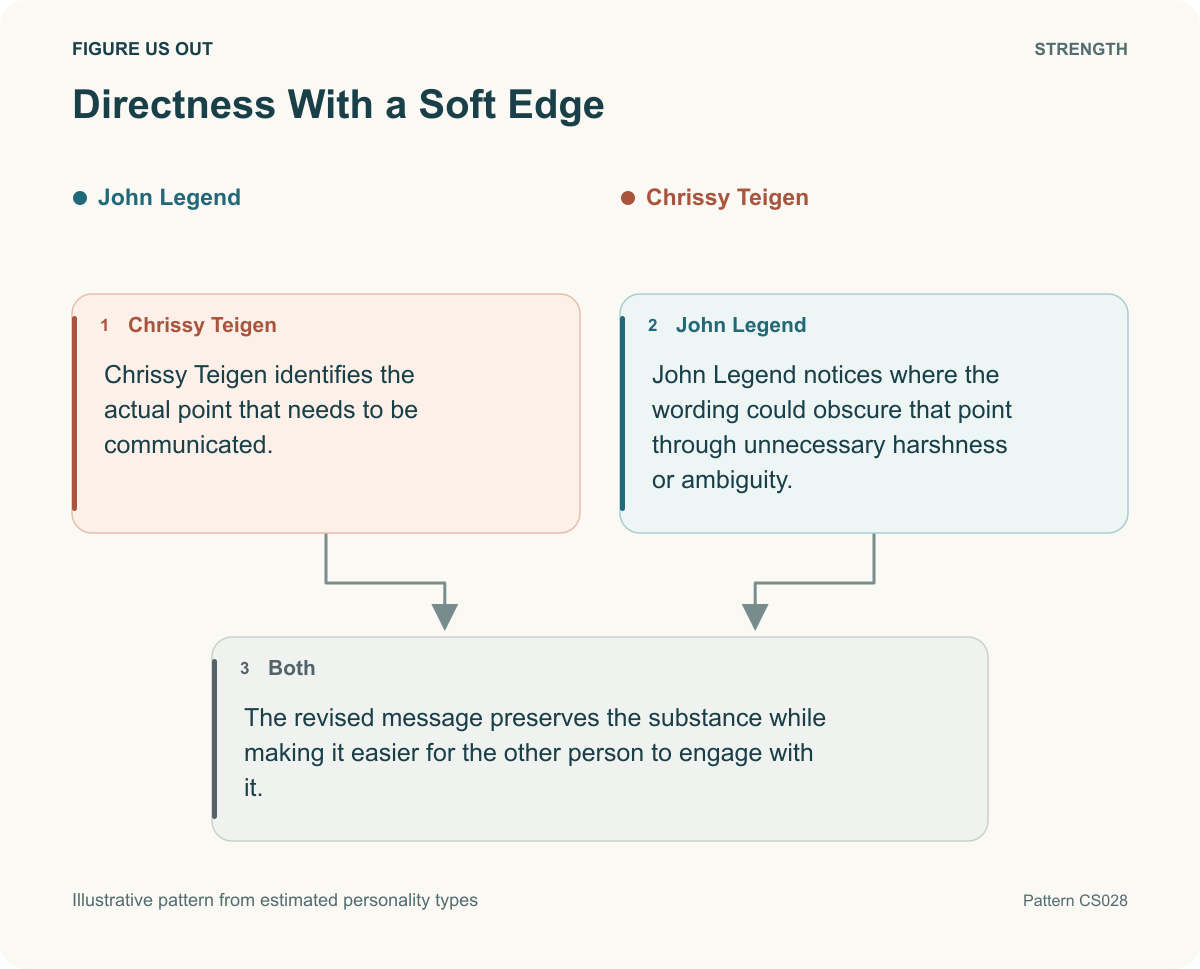
The source model suggests a potentially useful combination: one person helps get an important point into the open, while the other notices how wording or timing could make it easier to hear. 5
Think about the last time you and your partner needed to send a difficult family message. One of you may have written something so polite that nobody could tell what you were asking. The other might have written something so blunt that the recipient could barely notice the reasonable request underneath it.
Together, you might find a message that says exactly what needs saying without adding a fight you weren't trying to start.
That isn't a job for a designated “nice one” and a designated “honest one.” Both kindness and clarity belong to both people. But it's useful when you can appreciate the form of attention your partner offers instead of immediately rejecting how different it is from your first instinct.
Thirteen years, four kids, and a little room for the two of them
In September 2026, John and Chrissy celebrated their thirteenth wedding anniversary with a trip to Morocco. Chrissy reflected on continuing to discover what being a couple means beyond the busy years of raising children. 6
That's a surprisingly familiar thought from a couple whose lives look nothing like most people's. Even when you have a beautiful wedding song and an extraordinary career, you still have to make room for an actual relationship inside everyday life.
There are seasons when nearly everything revolves around other people, work, schedules and responsibilities. Then you look up and realize you would like to spend an evening remembering what you enjoy about being together.
Maybe for some couples it's going out somewhere special. For others it's cooking at home and talking without interruptions. One partner may find connection through a long conversation. The other might simply like sharing the same room, quietly doing different things.
At Figure Us Out, we're interested in helping couples see these preferences before they misread them as evidence of how much they're loved. You don't have to become your partner's personality to give them something meaningful. You can learn what closeness looks and feels like to the person beside you.
Here's a question to try the next time one of you has had a long day: “Do you want to talk, do you want help, or would it feel good just to be together for a while?”
No perfect answer is required. The point is to give each other an honest choice.
What do the two of you need from each other?
Figure Us Out helps you and your partner understand your own personalities, the strengths you can build on, and the everyday misunderstandings that can develop between different people. The full couples package brings together two personal guides, a couples guidebook and a 12-week workbook in a downloadable, print-ready book. One payment covers both of you, with no subscription.
Explore your own relationship at Figure Us Out
Explore more relationship strengths and loops
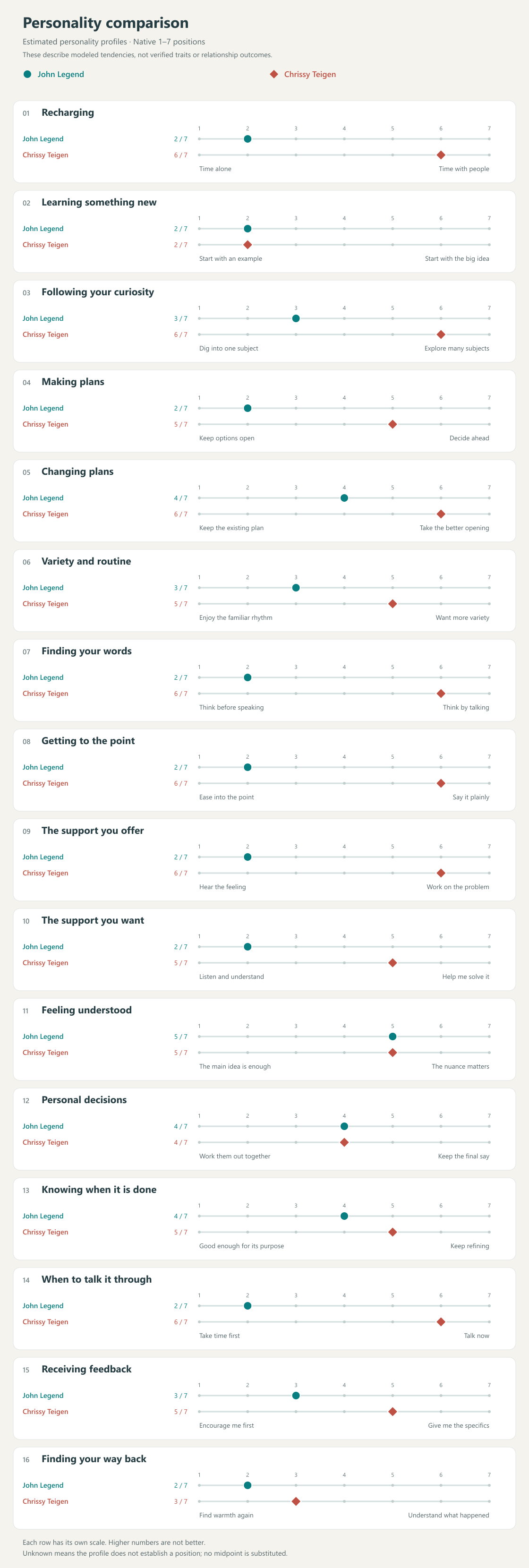
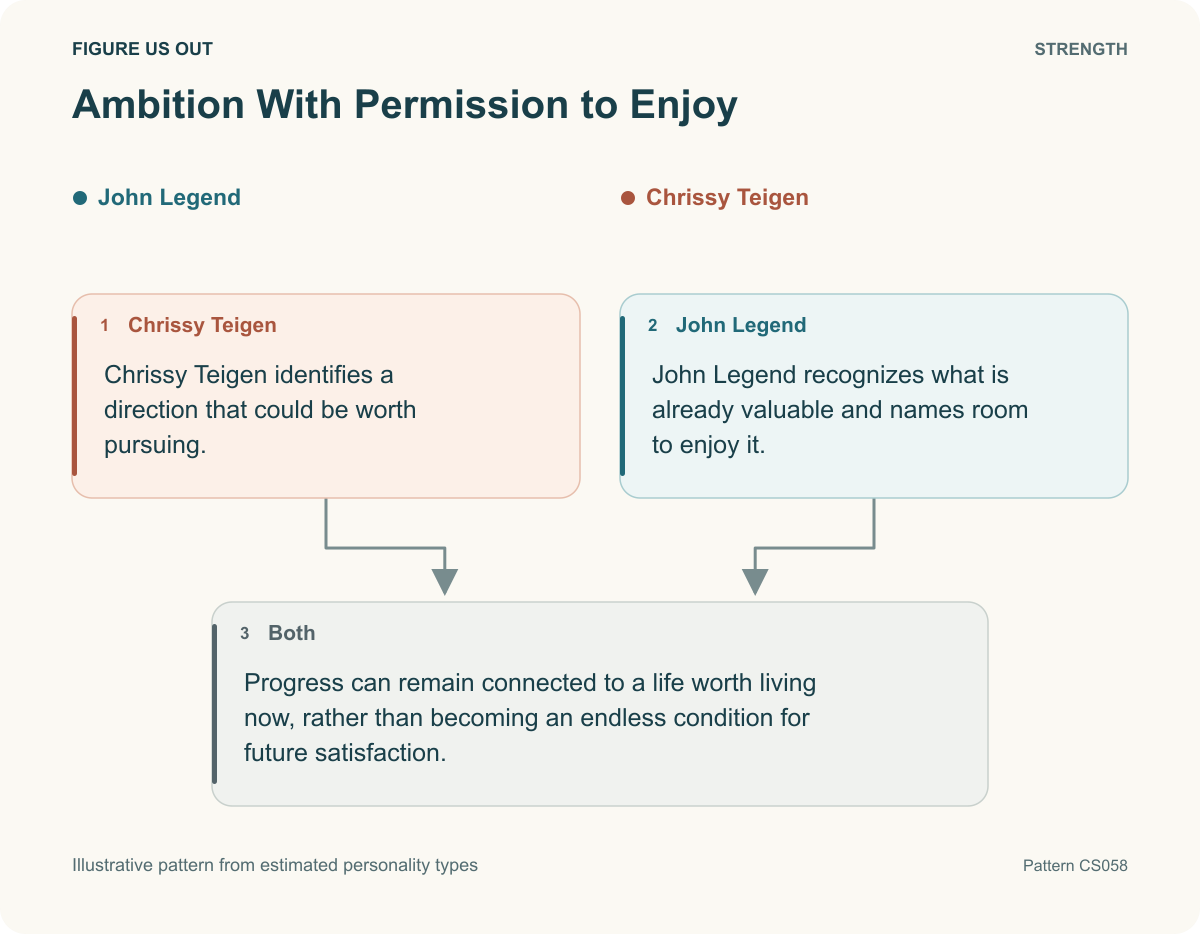
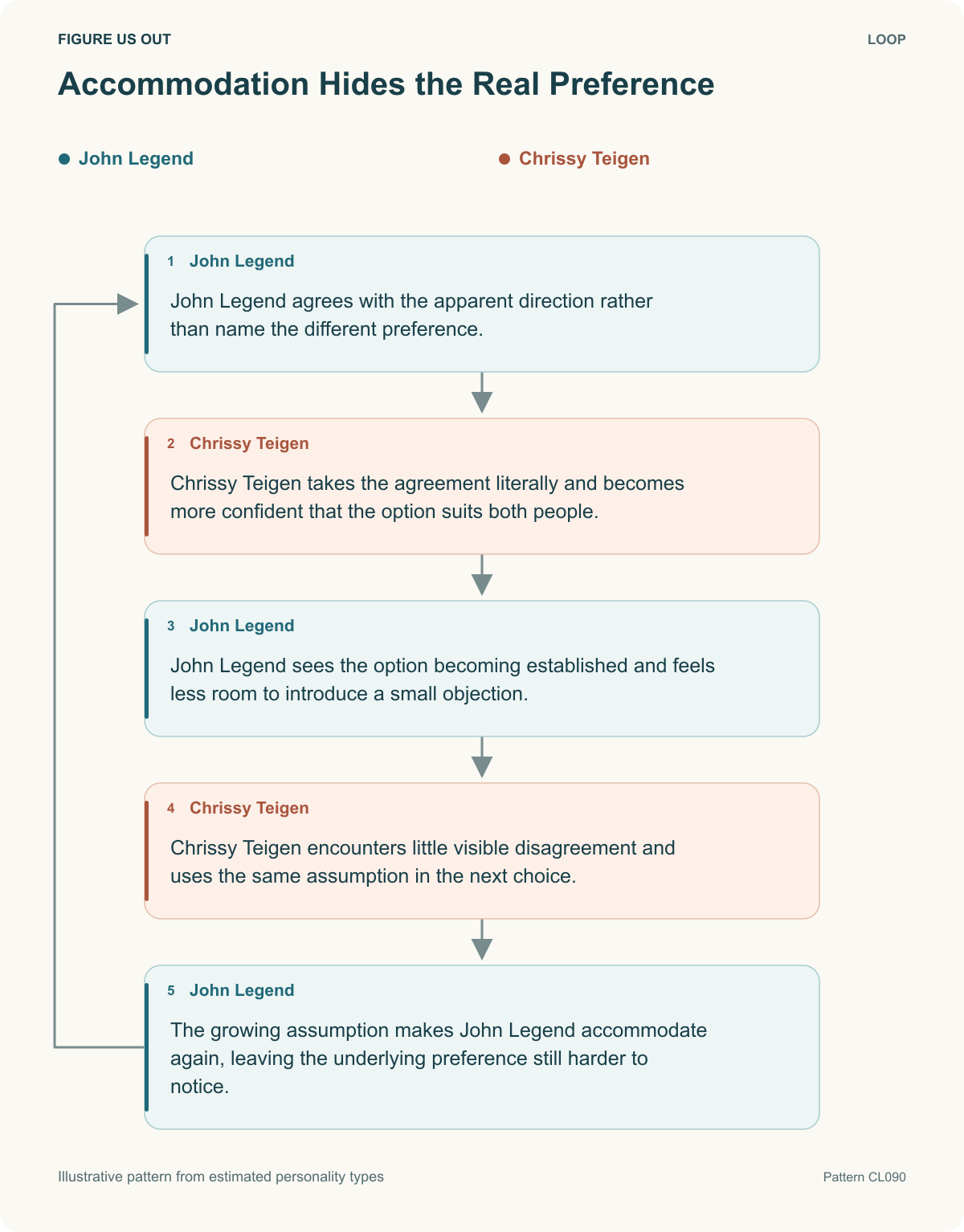
These optional diagrams come from the same prepared pairing and represent possible tendencies. They do not establish what the couple actually does.
See all 16 modeled personality comparisons
Each position is a type-based estimate on the original 1–7 scale. These are not measurements of these public figures, compatibility ratings, or relationship-success probabilities.
John Legend: 2/7 Chrissy Teigen: 6/7
Time alone ↔ Time with peopleJohn Legend: 2/7 Chrissy Teigen: 2/7
Start with an example ↔ Start with the big ideaJohn Legend: 3/7 Chrissy Teigen: 6/7
Dig into one subject ↔ Explore many subjectsJohn Legend: 2/7 Chrissy Teigen: 5/7
Keep options open ↔ Decide aheadJohn Legend: 4/7 Chrissy Teigen: 6/7
Keep the existing plan ↔ Take the better openingJohn Legend: 3/7 Chrissy Teigen: 5/7
Enjoy the familiar rhythm ↔ Want more varietyJohn Legend: 2/7 Chrissy Teigen: 6/7
Think before speaking ↔ Think by talkingJohn Legend: 2/7 Chrissy Teigen: 6/7
Ease into the point ↔ Say it plainlyJohn Legend: 2/7 Chrissy Teigen: 6/7
Hear the feeling ↔ Work on the problemJohn Legend: 2/7 Chrissy Teigen: 5/7
Listen and understand ↔ Help me solve itJohn Legend: 5/7 Chrissy Teigen: 5/7
The main idea is enough ↔ The nuance mattersJohn Legend: 4/7 Chrissy Teigen: 4/7
Work them out together ↔ Keep the final sayJohn Legend: 4/7 Chrissy Teigen: 5/7
Good enough for its purpose ↔ Keep refiningJohn Legend: 2/7 Chrissy Teigen: 6/7
Take time first ↔ Talk nowJohn Legend: 3/7 Chrissy Teigen: 5/7
Encourage me first ↔ Give me the specificsJohn Legend: 2/7 Chrissy Teigen: 3/7
Find warmth again ↔ Understand what happened