Figure Us Out · Celebrity Couples
Justin and Hailey Bieber: Different Outfits, Same Dinner Plans
A surprising phone call, two ways to get dressed, and why a small question can turn into a conversation about how it was asked.


Justin Bieber in Rosemont, Illinois, November 18, 2015. Photo: Lou Stejskal. Source · CC BY 2.0.
Hailey Bieber at the WWD Style Awards, January 9, 2026. Photo: Kevin Paul / WikiPortraits. Source · CC BY 4.0.
Separate portraits from different events and years; paired here for editorial illustration. Resized with a display crop. No endorsement is implied.
Justin and Hailey Bieber don't always look as though they're dressed for the same occasion. Hailey gave a wonderfully ordinary explanation in a 2023 GQ interview: he might want to wear sweats while she feels like wearing a dress. He also tends to get ready first.
That is quite a bit less dramatic than the story you could invent from a photograph.
Sometimes one person put together an outfit. The other put on the clothes they wanted to wear. Both are still going to dinner.
Their public story is full of moments like that: something easy to turn into a grand theory, followed by a detail that makes the people involved sound much more familiar.
The phone call after the bottle trick
One of the better examples came when Hailey explained how they reconnected in 2018.
On The Tonight Show, she had opened a beer bottle with her teeth. After Justin saw the appearance, he called her the next morning. She later told Jimmy Fallon about the connection, which Entertainment Tonight reported in 2020.
It wasn't their first introduction. They had met years earlier, when her father introduced them at Today. But the television appearance gave Justin a reason to pick up the phone again.
There are more conventional ways to restart a romance. Still, a person calling because you made them laugh is a fairly sweet beginning. You don't have to recommend the party trick to appreciate the phone call.
They married at a New York courthouse on September 13, 2018, and marked their eighth anniversary in 2026. The larger South Carolina celebration followed in September 2019. For that occasion, Hailey's custom Off-White wedding dress, designed with Virgil Abloh, made one thing clear: she certainly knows when she wants to dress up.
They could share more than the outfits suggest
For this Figure Us Out article, we're exploring Justin as ESFP 3w4 and Hailey as ESFJ 9w1. These are public personality estimates, not confirmed results they supplied. Other interpretations exist. The charts and imagined examples show how this pairing could interact; they aren't evidence about private arguments or an endorsement.
There is quite a bit of common ground in those profiles. Both lean toward company, conversation, and concrete experiences. They could enjoy being out together, doing something rather than only discussing it, and sharing the small details of an ordinary day.
Justin's estimated combination adds an appetite for variety and a wish to express something distinctly his own. Doing a thing well can matter, and so can having room to approach it in his own way.
Hailey's estimated combination puts more weight on a settled arrangement and the warmth between people. Remembering what someone likes, checking that a plan works for everyone, or making a familiar occasion feel comfortable could be satisfying in itself.
Those tendencies can create real pleasure together. One person suggests a different place to go. The other remembers that it's near somewhere they've both wanted to visit. An outing becomes a little more interesting because each was paying attention to something different.
And both should get to be the person with the idea. A considerate partner has preferences of their own; someone who likes spontaneity can still think ahead about the person coming with them.
A look at the two estimated profiles
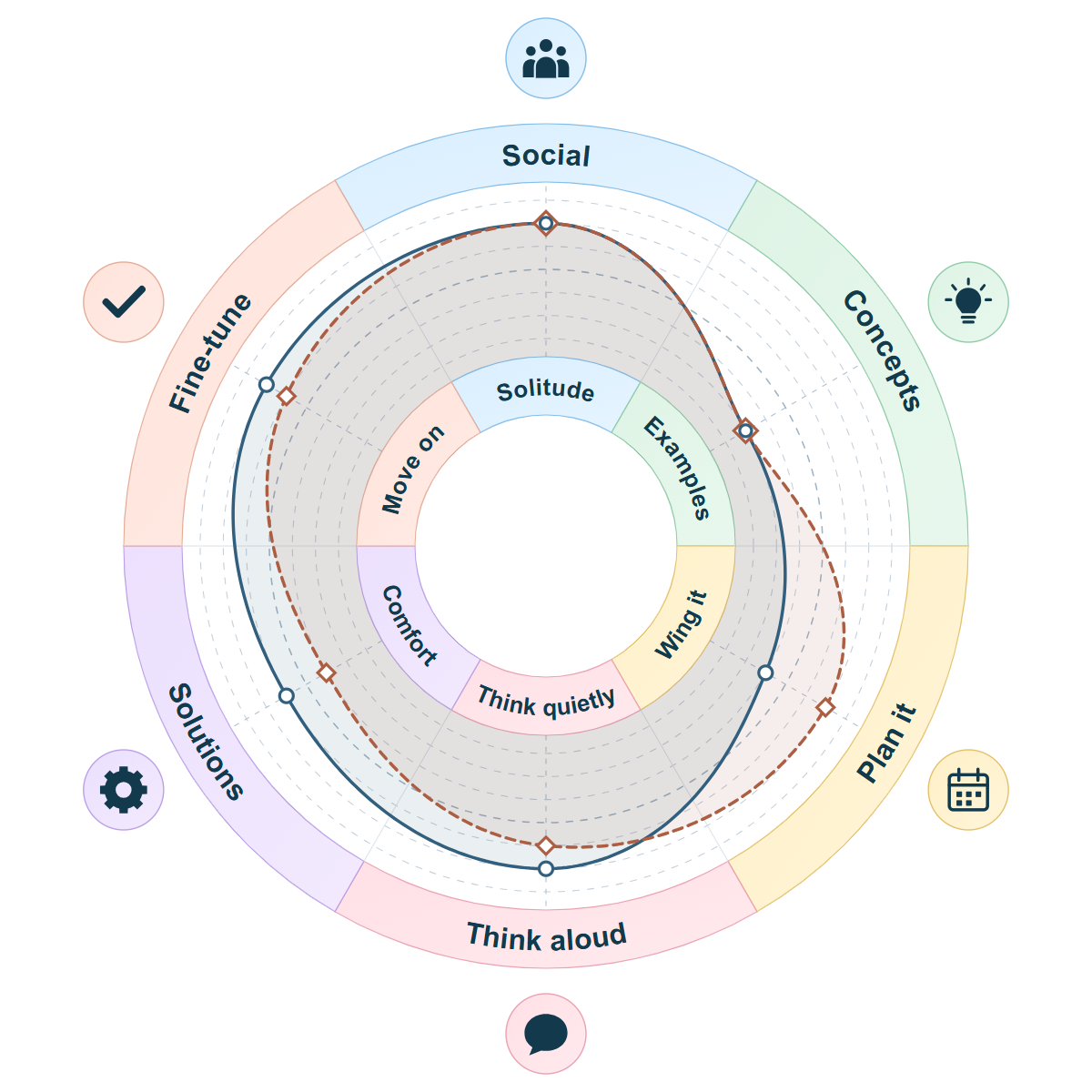
How to read the wheel
Each spoke follows a 1–7 scale. The source illustration has been cropped around the original wheel, without changing its lines or positions.
Recharging
1 = Time alone
7 = Time with people
Justin Bieber: 6
Hailey Bieber: 6
Learning something new
1 = Start with an example
7 = Start with the big idea
Justin Bieber: 2
Hailey Bieber: 2
Making plans
1 = Keep options open
7 = Decide ahead
Justin Bieber: 3
Hailey Bieber: 6
Finding your words
1 = Think before speaking
7 = Think by talking
Justin Bieber: 6
Hailey Bieber: 5
The support you offer
1 = Hear the feeling
7 = Work on the problem
Justin Bieber: 5
Hailey Bieber: 3
Knowing when it is done
1 = Good enough for its purpose
7 = Keep refining
Justin Bieber: 6
Hailey Bieber: 5
A missing charger becomes something else
The main pattern worth exploring in this pairing isn't about clothes. It's about how a practical question can acquire a second meaning on its way across the room.
Imagine an ordinary couple getting ready to leave. One reaches for the charger they expected to find on the kitchen counter. It isn't there.
“Why did you move my charger?”
The other person hears the accusation before they've had a chance to answer. They ask why they're being spoken to like that.
Now the first person is frustrated. They wanted to find an object, and the conversation appears to have become about everything except its location. They repeat the question more sharply.
That sharper response confirms the second person's concern. Their objection to the tone hasn't been taken seriously. They repeat it too.
The charger is still missing. The conversation now contains enough material for a much longer disagreement.
One person is trying to get an answer about what happened. The other is trying to establish how they should be treated while answering. Both think the other person is avoiding the obvious issue.
In this estimated pairing, Justin's side tends to state the practical point more directly, while Hailey's side is more attentive to the way the exchange feels. The illustration below follows that possible pattern. It is not a claim about how Justin speaks to Hailey or how she responds to him.
The question, or the way it was asked?
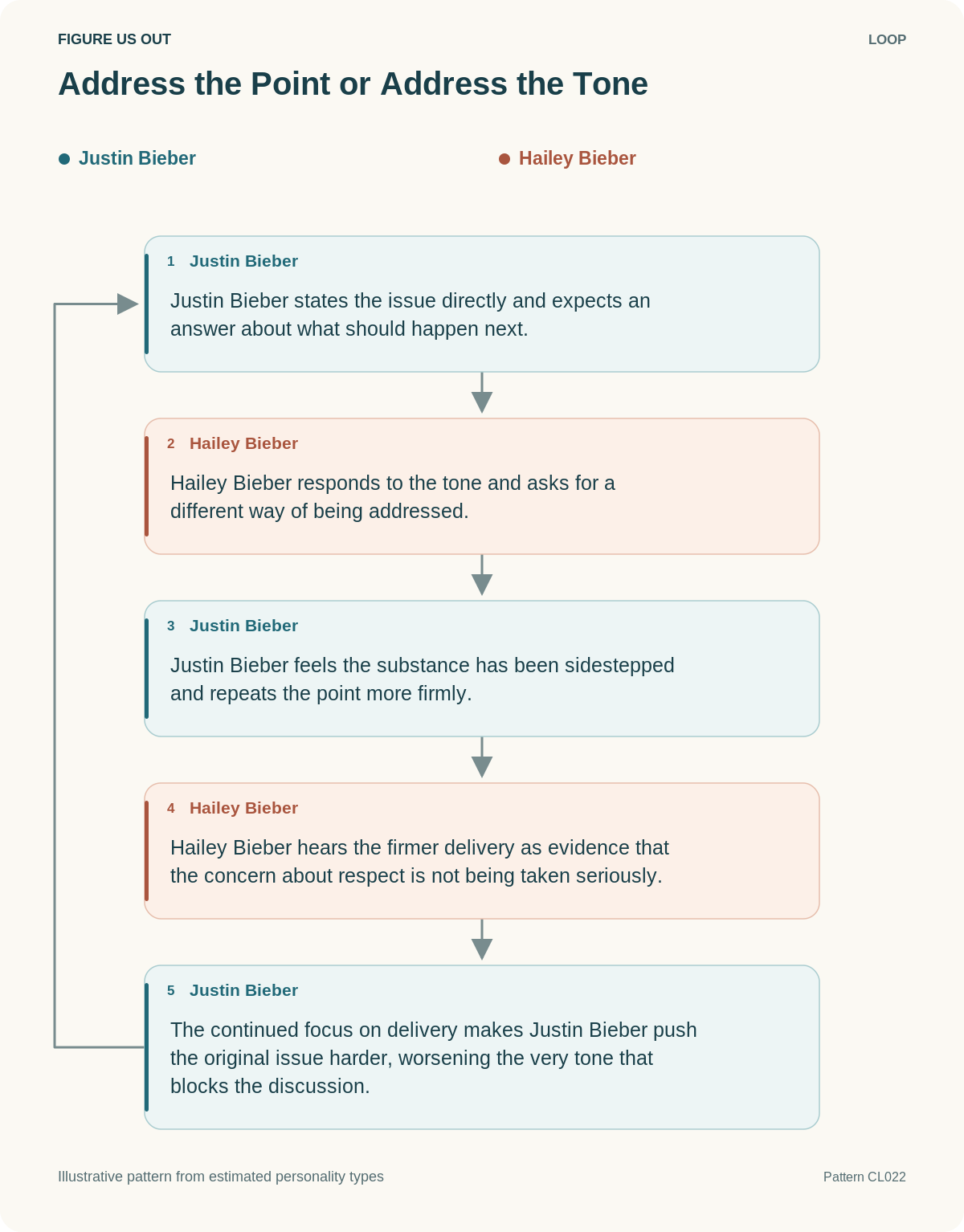
Justin’s side asks about the problem and expects a practical answer.
Hailey’s side objects to the delivery and asks for a different tone.
Justin’s side feels the question was skipped and repeats it more firmly.
Hailey’s side hears more evidence that the concern about respect was ignored.
Justin’s side pushes the original point again, making the delivery harder to hear.
↻ Step 5 reinforces step 1, so the exchange can repeat.
The useful change is surprisingly small, provided both people follow through.
“Let me ask that again. Do you know where the charger went?”
“Yes. I put it beside the bag so we wouldn't forget it.”
They may still need to talk about where shared things belong. They have also discovered that the person who seemed to be causing a problem was trying to help them leave.
Even if the item really was moved carelessly, the same principle holds. You can ask about it respectfully. Your partner can answer the question without having to accept an accusation as the price of participating.
Neither half of the conversation has to disappear
The point-and-tone disagreement gets harder when each person believes that acknowledging one issue means surrendering the other.
Someone may think that apologizing for how they asked will allow the practical problem to vanish. Their partner may think that answering immediately will make it seem as though the delivery was acceptable.
So they each hold out for their own concern to be recognized first. A conversation that could have taken a minute starts feeling like a contest.
A better sequence makes room for both. Restate the concern without the accusation, answer it, and then decide what needs to change. The person asking doesn't have to pretend that the missing item was unimportant. The person answering doesn't have to pretend that the opening felt fine.
This is about ordinary misunderstandings, not making excuses for contempt, threats, or repeated disrespect. Personality preferences don't make harmful treatment something a partner should put up with.
It also doesn't mean that any uncomfortable question has been asked unfairly. Sometimes your partner has a legitimate concern, and hearing it feels unpleasant even when the wording is reasonable. Keeping the discussion specific helps both people tell the difference.
The goal is to make the concern easier to understand, rather than make the other person easier to silence.
A little planning can leave more room for fun
There is a useful strength to consider alongside that possible friction. Hailey's estimated preference for some advance coordination and Justin's preference for flexibility could help them create a plan with enough room inside it.
Imagine two people going out for the afternoon. They agree on the reservation they need to keep and the time they have to be home. Between those points, they can take a walk, stop at a shop, or change direction when something looks interesting.
The settled parts reduce the chance of a last-minute problem. The open parts keep the day from feeling like a list of obligations.
That only works when both people carry the agreement. The flexible person can't keep changing the parts their partner was counting on. The organized person can't quietly fill every open hour and then wonder why the day feels restrictive.
There is a nice possibility here: preparation can help someone enjoy a spontaneous choice. You know the important things are taken care of, so a detour doesn't mean inventing the rest of the day all over again.
The difference becomes much less irritating when you can see what it gives you.
Notice the care that arrives in a familiar form
Another strength in these profiles is the combination of a considerate gesture and a response that makes the gesture feel noticed.
Someone remembers your usual order. You acknowledge that they remembered. Someone checks a detail because it matters to you, and you recognize the attention rather than treating the result as something that simply appeared.
That is ordinary care, but it can make a shared day feel very different.
The Hailey estimate may be drawn toward anticipating what would make things easier or warmer. The Justin estimate can respond with visible appreciation and enjoyment. Neither tendency guarantees that an actual couple does these things. It gives us one possible place where a contribution could be received in a satisfying way.
The kindness still needs to be voluntary. Appreciating a thoughtful partner doesn't mean assuming they will always handle everything. Sometimes the best way to receive their care is to notice what they would enjoy and make the next gesture yourself.
And sometimes the gift is simply showing that you are glad to be there. There is a difference between accompanying someone and spending the whole outing making it clear that you would rather have stayed home.
You don't have to turn every difference into a verdict
Their eighth-anniversary post included the two of them playing pool together. That small public moment is a useful place to return after all this discussion: two people can enjoy something together without presenting a perfectly coordinated picture.
What we can see publicly will always be incomplete. An outfit won't tell us what was agreed that morning. A photograph won't tell us how a conversation went afterward. Personality estimates don't fill in those missing facts.
What they can offer in an article like this is a way to recognize something in your own life.
Maybe you and your partner both enjoy being out, but one feels better with a few details decided first. Maybe one person asks a direct question and the other hears a criticism that wasn't intended. Maybe you offer care in a form so familiar that you forget it still deserves appreciation.
Understanding those differences should give you something useful to do next. It shouldn't give you a new label to bring out whenever your partner annoys you.
A question to try when an exchange begins going sideways:
“What am I trying to ask, and what might my partner be hearing?”
Then ask it in a way that makes the first part clearer. Leave room for an actual answer.
Justin and Hailey's public story began long before the clothes became a talking point. The more interesting question for any couple is whether there is room for both people in the life they are choosing together.
The outfits can be different. The evening can still be yours.
What could your own pairing show you?
Figure Us Out brings your personalities together in two personal guides, a couples guide, a 12-week workbook, and a downloadable book. Explore the ways you might connect easily and the misunderstandings worth noticing sooner.
A little more to explore
The article follows a few possibilities. These optional graphics show the rest of the supplied strengths and patterns.
Three possible shared strengths
Planning That Leaves Room
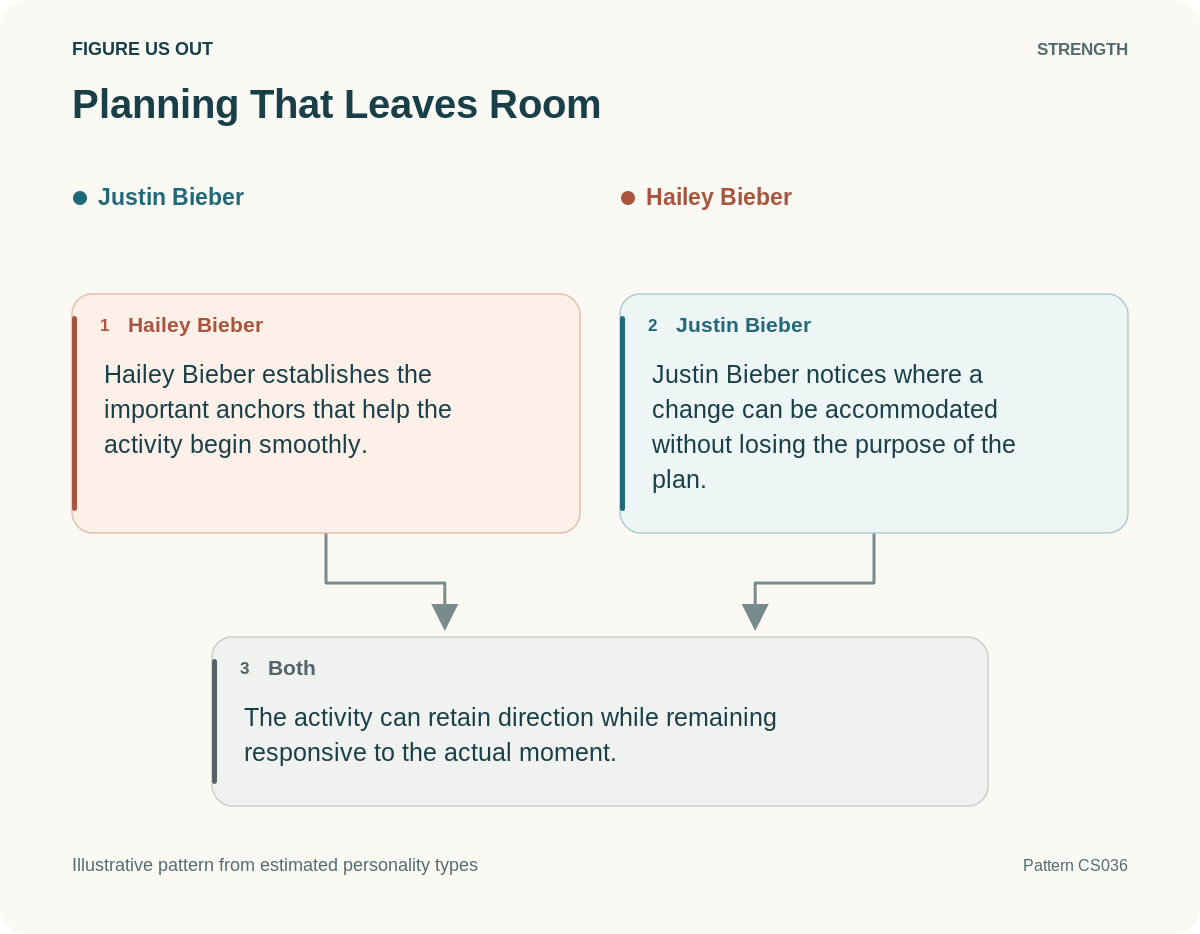
Read the steps
1. Hailey Bieber establishes the important anchors that help the activity begin smoothly.
2. Justin Bieber notices where a change can be accommodated without losing the purpose of the plan.
3. The activity can retain direction while remaining responsive to the actual moment.
Contributions 1 and 2 both feed outcome 3. Neither contribution causes the other.
Try: Choose the few fixed anchors and explicitly leave the rest adaptable.
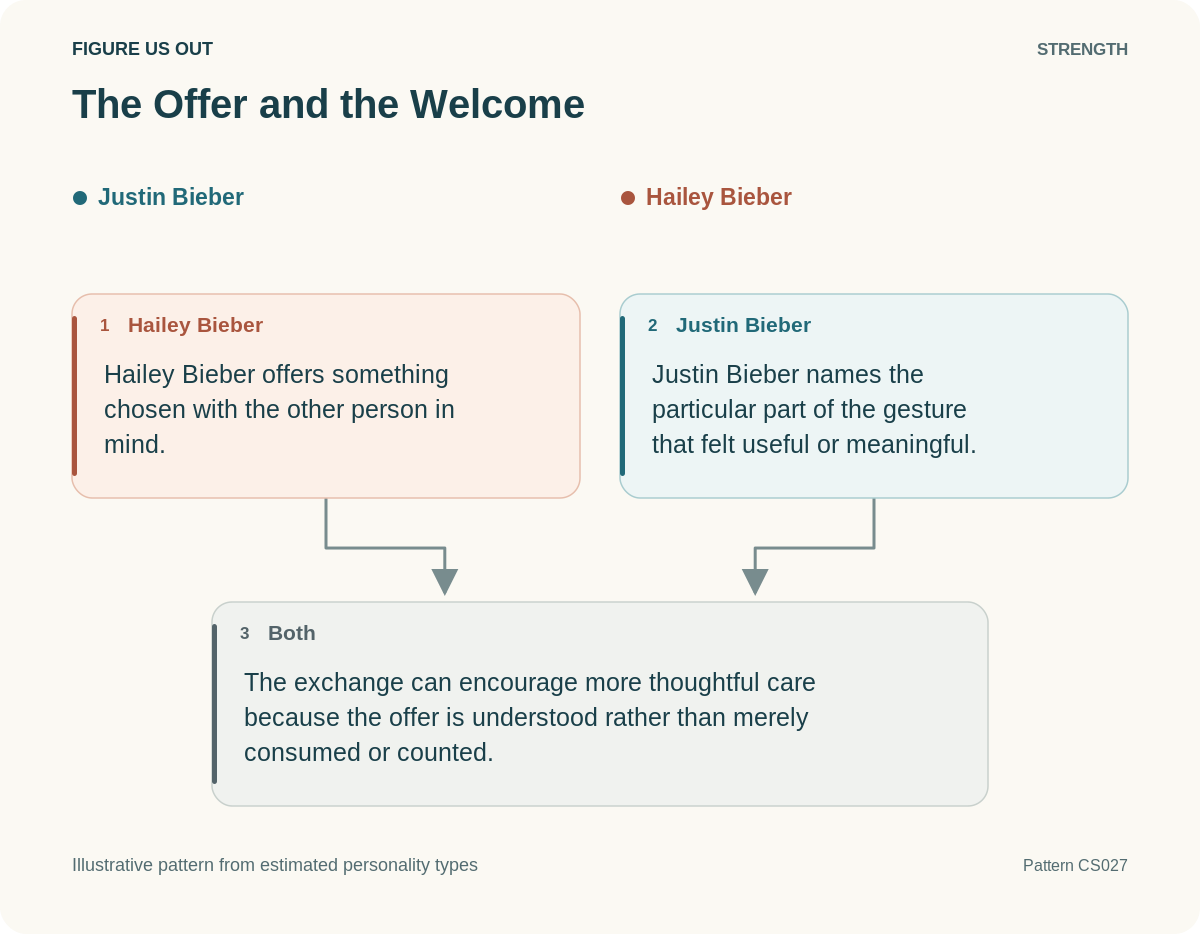
The Offer and the Welcome
Read the steps
1. Hailey Bieber offers something chosen with the other person in mind.
2. Justin Bieber names the particular part of the gesture that felt useful or meaningful.
3. The exchange can encourage more thoughtful care because the offer is understood rather than merely consumed or counted.
Contributions 1 and 2 both feed outcome 3. Neither contribution causes the other.
Try: When receiving an offer, name what landed rather than giving only a generic thank-you.
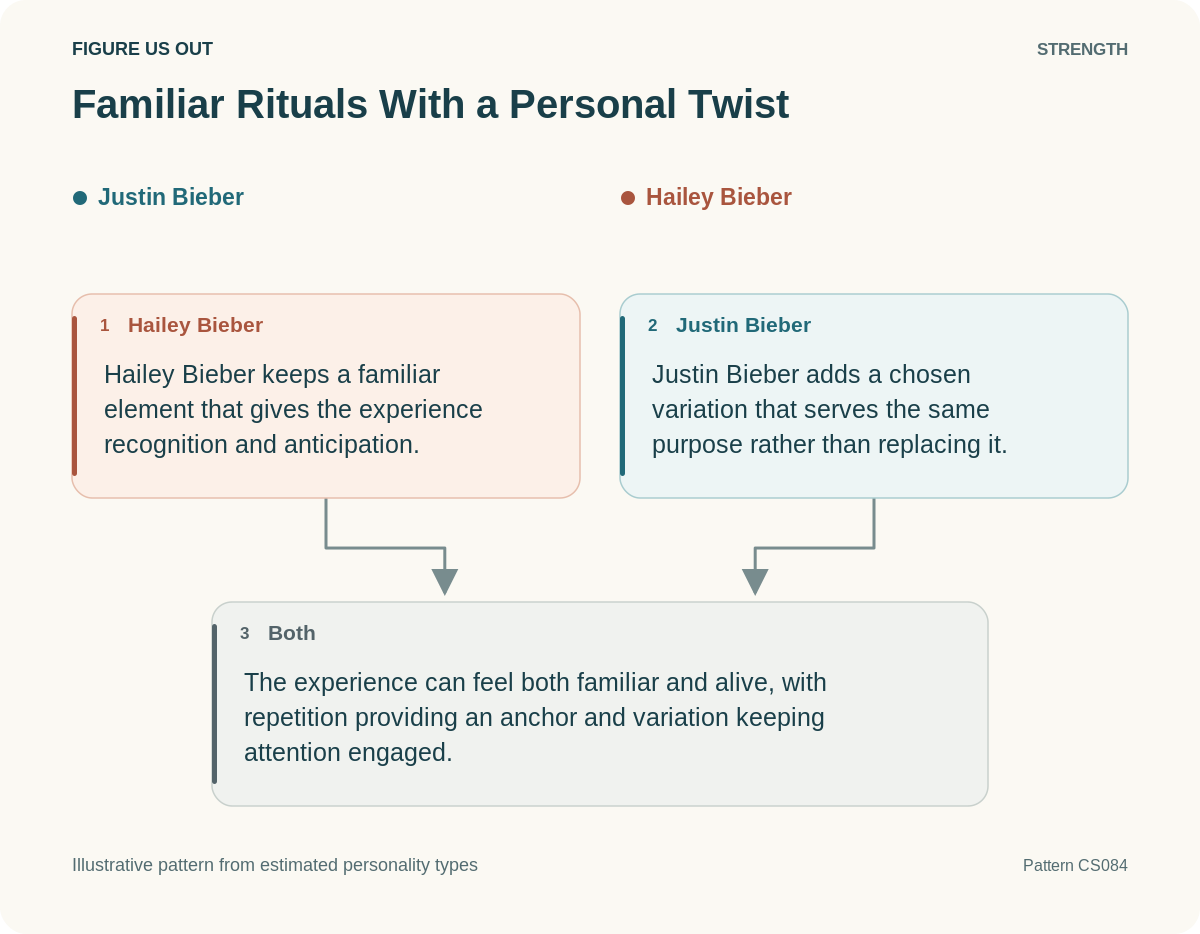
Familiar Rituals With a Personal Twist
Read the steps
1. Hailey Bieber keeps a familiar element that gives the experience recognition and anticipation.
2. Justin Bieber adds a chosen variation that serves the same purpose rather than replacing it.
3. The experience can feel both familiar and alive, with repetition providing an anchor and variation keeping attention engaged.
Contributions 1 and 2 both feed outcome 3. Neither contribution causes the other.
Try: Name what you enjoy repeating and what you are free to vary, then keep both choices voluntary.
Two other possible recurring patterns
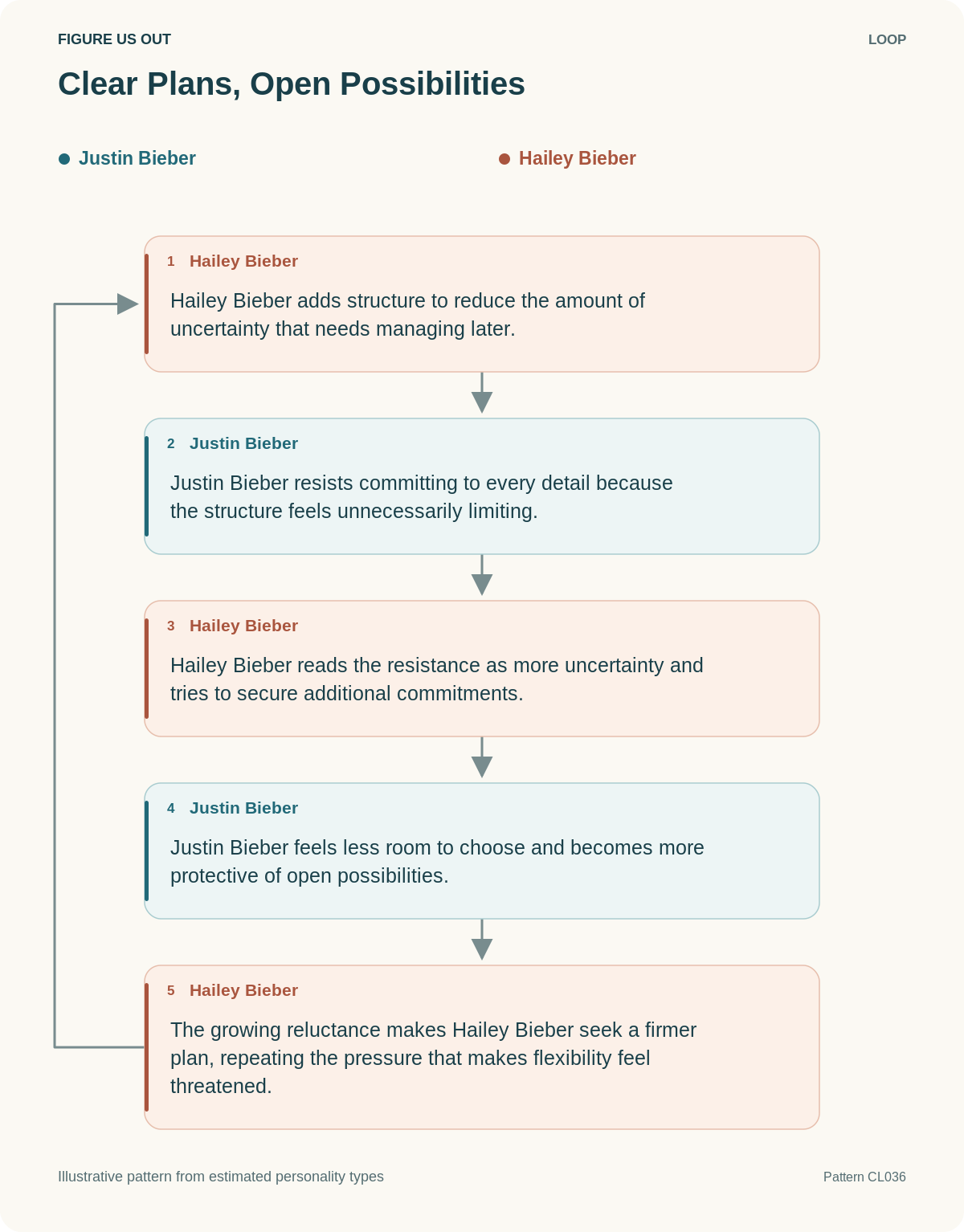
Clear Plans, Open Possibilities
Read the steps
1. Hailey Bieber adds structure to reduce the amount of uncertainty that needs managing later.
2. Justin Bieber resists committing to every detail because the structure feels unnecessarily limiting.
3. Hailey Bieber reads the resistance as more uncertainty and tries to secure additional commitments.
4. Justin Bieber feels less room to choose and becomes more protective of open possibilities.
5. The growing reluctance makes Hailey Bieber seek a firmer plan, repeating the pressure that makes flexibility feel threatened.
Steps 1 → 2 → 3 → 4 → 5 → 1 form the repeating loop.
Try: Choose a small fixed core and a clearly open remainder.
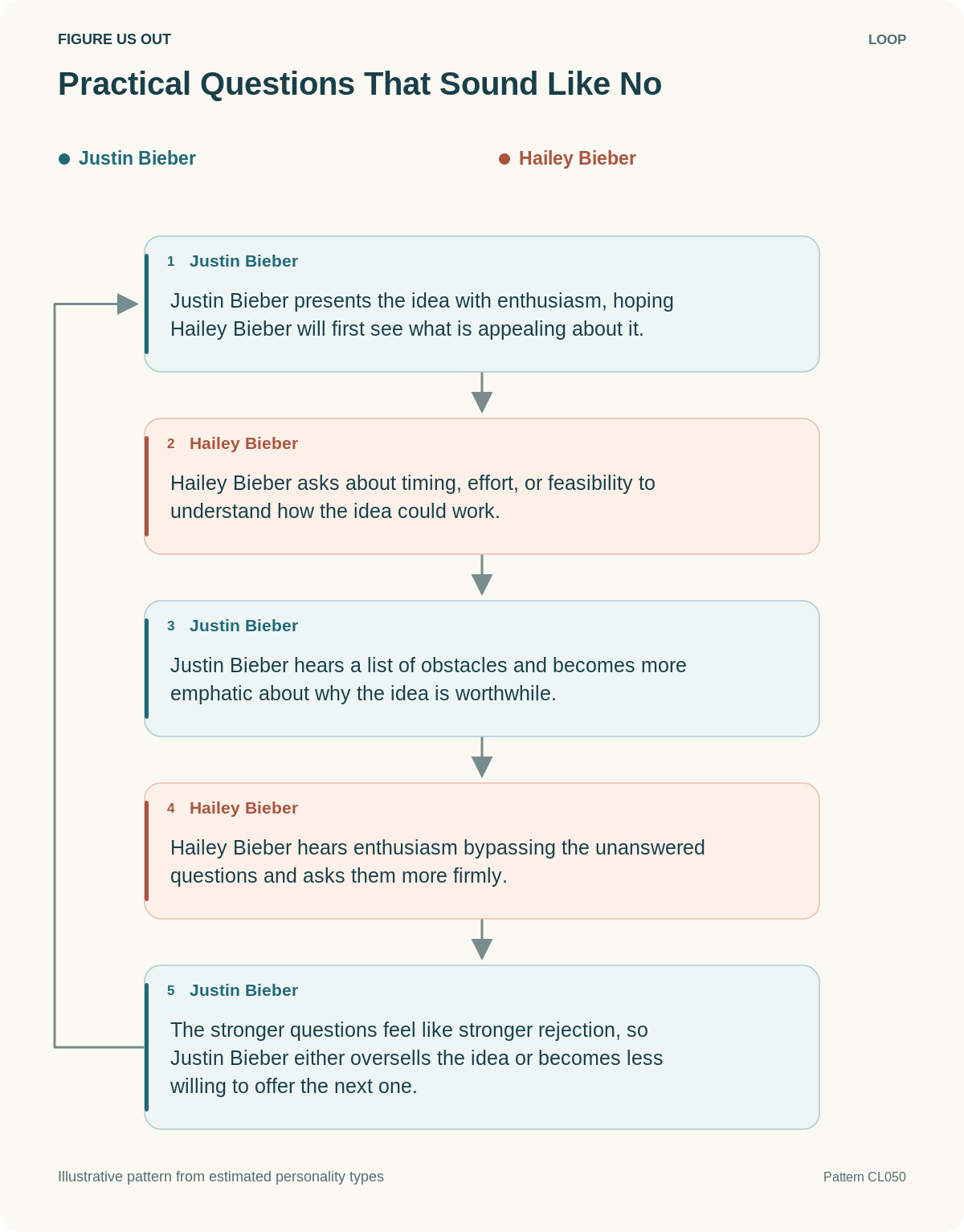
Practical Questions That Sound Like No
Read the steps
1. Justin Bieber presents the idea with enthusiasm, hoping Hailey Bieber will first see what is appealing about it.
2. Hailey Bieber asks about timing, effort, or feasibility to understand how the idea could work.
3. Justin Bieber hears a list of obstacles and becomes more emphatic about why the idea is worthwhile.
4. Hailey Bieber hears enthusiasm bypassing the unanswered questions and asks them more firmly.
5. The stronger questions feel like stronger rejection, so Justin Bieber either oversells the idea or becomes less willing to offer the next one.
Steps 1 → 2 → 3 → 4 → 5 → 1 form the repeating loop.
Try: Give the idea a moment of acknowledgment, then decide together whether to explore or evaluate it.
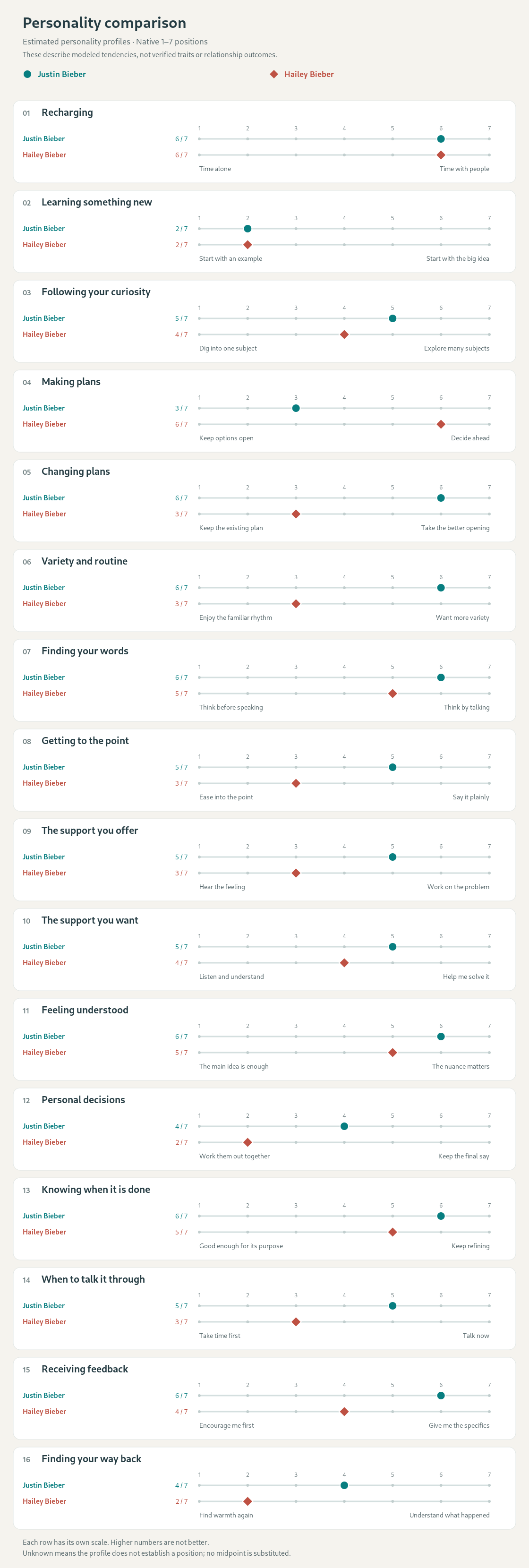
All 16 personality comparisons
Modeled preferences on the source 1–7 scales, not individual measurements. Neither end is better, and differences are not a forecast of relationship success.
Recharging
1 = Time alone7 = Time with people
Justin Bieber: 6/7
Hailey Bieber: 6/7
Learning something new
1 = Start with an example7 = Start with the big idea
Justin Bieber: 2/7
Hailey Bieber: 2/7
Following your curiosity
1 = Dig into one subject7 = Explore many subjects
Justin Bieber: 5/7
Hailey Bieber: 4/7
Making plans
1 = Keep options open7 = Decide ahead
Justin Bieber: 3/7
Hailey Bieber: 6/7
Changing plans
1 = Keep the existing plan7 = Take the better opening
Justin Bieber: 6/7
Hailey Bieber: 3/7
Variety and routine
1 = Enjoy the familiar rhythm7 = Want more variety
Justin Bieber: 6/7
Hailey Bieber: 3/7
Finding your words
1 = Think before speaking7 = Think by talking
Justin Bieber: 6/7
Hailey Bieber: 5/7
Getting to the point
1 = Ease into the point7 = Say it plainly
Justin Bieber: 5/7
Hailey Bieber: 3/7
The support you offer
1 = Hear the feeling7 = Work on the problem
Justin Bieber: 5/7
Hailey Bieber: 3/7
The support you want
1 = Listen and understand7 = Help me solve it
Justin Bieber: 5/7
Hailey Bieber: 4/7
Feeling understood
1 = The main idea is enough7 = The nuance matters
Justin Bieber: 6/7
Hailey Bieber: 5/7
Personal decisions
1 = Work them out together7 = Keep the final say
Justin Bieber: 4/7
Hailey Bieber: 2/7
Knowing when it is done
1 = Good enough for its purpose7 = Keep refining
Justin Bieber: 6/7
Hailey Bieber: 5/7
When to talk it through
1 = Take time first7 = Talk now
Justin Bieber: 5/7
Hailey Bieber: 3/7
Receiving feedback
1 = Encourage me first7 = Give me the specifics
Justin Bieber: 6/7
Hailey Bieber: 4/7
Finding your way back
1 = Find warmth again7 = Understand what happened
Justin Bieber: 4/7
Hailey Bieber: 2/7
View the original full comparison chart
The full chart scrolls horizontally on smaller screens.