
Kristen Bell and Dax Shepard: The Sloth Was the Easy Part
A birthday surprise, a homemade music video, and the everyday art of knowing when to jump in.

Dax Shepard once arranged a birthday surprise for Kristen Bell that had her crying before she’d even seen it.
It was a sloth.
For her 31st birthday, he brought in a visit from the animal she adored. When Kristen told the story on Ellen in 2012, she also shared his video of her reaction. She was on the bed, completely overwhelmed by the excitement. 1
I love how personal that gift was. Flowers would have been easier. But he knew the particular, slightly ridiculous thing that would mean the world to her, and he went with it.
That’s a pretty good place to start a story about these two. There’s plenty to say about relationships and personality differences. There is also a woman crying because a sloth is nearby, and a man who made that happen.
The first meeting was not a romantic triumph
When Kristen and Dax first met at a dinner party, she didn’t exactly leave thinking she’d found her person.
Recalling it for Sunday TODAY in 2019, Kristen said she didn’t recognize him and remembered how much he talked. Dax remembered her telling a very enthusiastic story about a bargain at Target. She described the encounter as having “no sparks whatsoever.”
They crossed paths again at a hockey game a couple of weeks later. This time they flirted. A cheeky text from Dax afterward helped things along. 2 They began dating in 2007 and married in 2013. 3
It’s reassuring that the first conversation didn’t have to carry the entire relationship. Sometimes someone makes a much better impression the second time around. Sometimes you need to get past the Target story.
Finding someone who will join the joke
There’s another public moment that says a lot about the kind of fun they’re willing to have together.
In 2016, they shared a homemade music video from an earlier trip to Africa. Instead of simply posting vacation photos, they lip-synced to Toto’s “Africa,” with dancing, wildlife scenery, and Dax performing in a bathtub. The trip had taken place before they had children. 4
You don’t need a safari to appreciate what’s enjoyable about that. One person has a silly idea, and the other joins in rather than standing there waiting for them to finish being embarrassing.
A bit becomes funnier because somebody answers it. A routine errand can turn into a running joke. You get to enjoy a side of yourself that might not come out around everyone.
That’s a real pleasure worth making room for in a relationship. It doesn’t have to accomplish anything. Sometimes the two of you are just having a good time.
Similar energy, different ways of feeling close
For this Figure Us Out article, we’re exploring Kristen as ENFP 2w3 and Dax as ENTP 8w7. These are unconfirmed estimates from public personality discussions, not assessment results they provided. Other typings exist, especially for Dax. The examples below explore the pairing, not their private arguments.
In this combination, both people tend to enjoy ideas, conversation, variety, and room to change course. You wouldn’t expect all the fun to come from one person while the other manages the calendar.
The difference becomes more interesting around closeness. Someone with Kristen’s estimated personality may feel connected by getting involved, encouraging someone, and making their day easier. Someone with Dax’s may appreciate support while strongly wanting to handle a personal decision or project in their own way.
Both could be generous. Both could love spending time together. But an offer of help might feel different depending on which side of it you’re on.
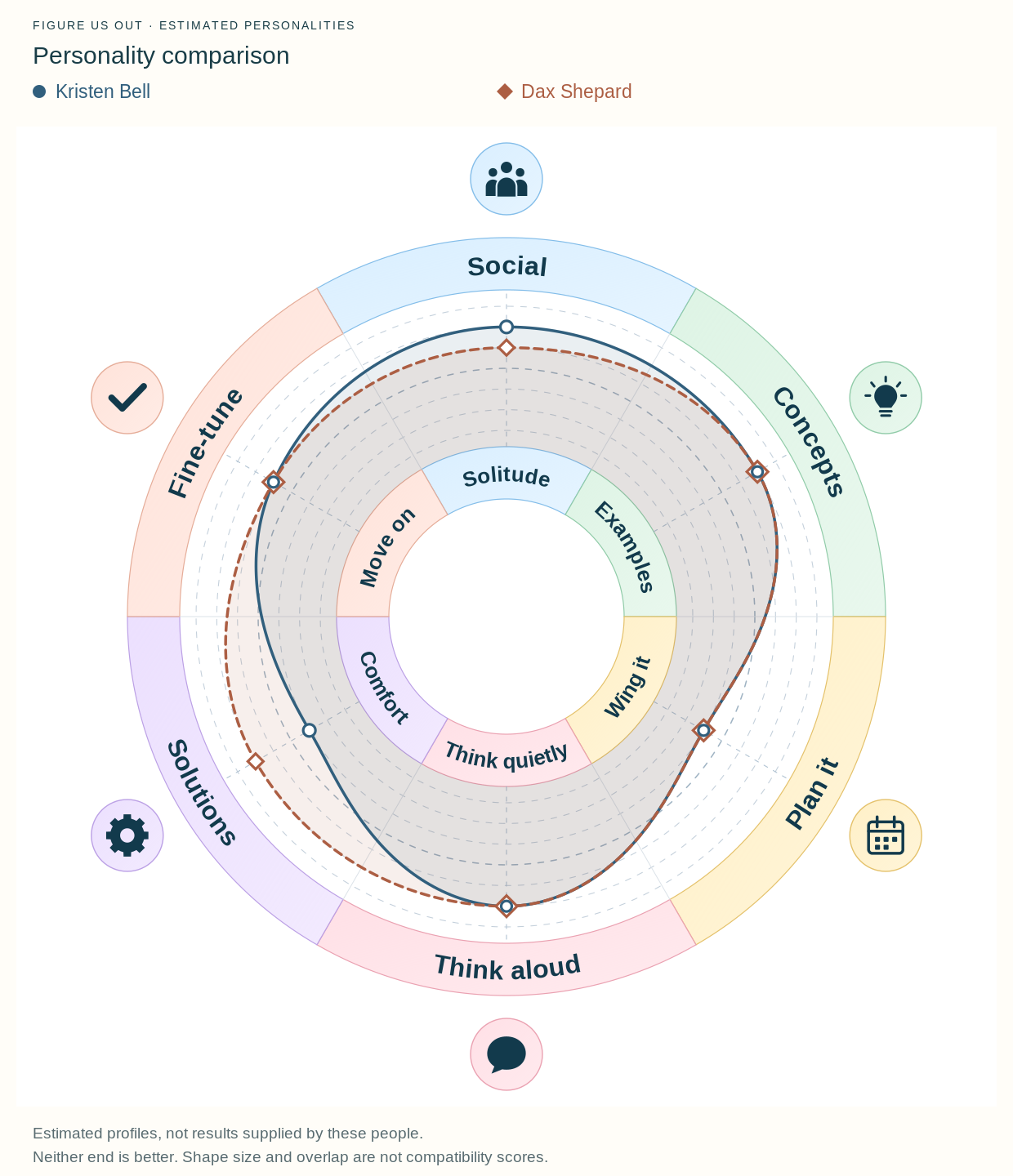
Read the six preferences in plain text
Recharging
1: Time alone · 7: Time with people
Kristen Bell: 6
You are often renewed by warm conversation, shared enthusiasm, and feeling connected, while still needing some quiet time after too much activity.
Dax Shepard: 5
You often regain energy through lively, interesting company, while still needing some private time after too much intensity.
Learning something new
1: Start with an example · 7: Start with the big idea
Kristen Bell: 6
You are likely to enter a new subject through the larger idea, the possible meaning, or what it could lead to, then use examples to make it concrete.
Dax Shepard: 6
You often want the larger idea, possibility, or principle first, then use examples to test and sharpen it.
Making plans
1: Keep options open · 7: Decide ahead
Kristen Bell: 3
You usually prefer leaving room for possibility and deciding some things as the day develops, while making advance choices for commitments that matter.
Dax Shepard: 3
You are likely to keep room for new options rather than settle every part of an ordinary day in advance.
Finding your words
1: Think before speaking · 7: Think by talking
Kristen Bell: 6
Talking can help you discover what you think, connect ideas, and bring emotional meaning into focus. A live exchange may give your thoughts energy and direction.
Dax Shepard: 6
You may discover and sharpen your ideas while speaking, especially through lively debate or quick back-and-forth.
The support you offer
1: Hear the feeling · 7: Work on the problem
Kristen Bell: 3
You usually want to understand the feeling, but your care often quickly turns toward encouragement or a useful next step.
Dax Shepard: 6
You are likely to look for a practical way forward quickly, while still recognizing that the person is upset. You may show care by helping make the situation clearer or more workable.
Knowing when it is done
1: Good enough for its purpose · 7: Keep refining
Kristen Bell: 5
You often notice ways to improve a result, especially when quality affects people or reflects something you care about, but you may stop when the purpose has been met.
Dax Shepard: 5
You may stop once the result works, but you are also likely to refine it when a sharper, stronger, or more effective version is visible.
“I’m only trying to help” can start a surprisingly long conversation
Imagine your partner working on an old bicycle in the garage. You offer to find a tutorial, hold something steady, or look up the part they need. It seems like an easy way to be useful and spend a little time together.
They say they’re fine. They want to figure it out themselves.
So you try a smaller offer. Surely you can at least look up the instructions? Or order the part while they keep working?
Now they’re firmer. They said they’ve got it.
From your side, the reaction seems unnecessary. You’re being nice. Why are they acting as though you’re interfering?
From their side, they’ve declined help twice and you’re still trying to find a way into the project. Figuring it out is part of what they wanted to enjoy. They weren’t asking to be rescued from the bicycle.
This is one possible loop in the estimated pairing. Helping can carry a wish to feel wanted, while declining can carry a wish to keep ownership. The more unwanted the helper feels, the more they try to contribute. The more crowded the other person feels, the more strongly they refuse.
Before long, neither of you is really talking about the bicycle.
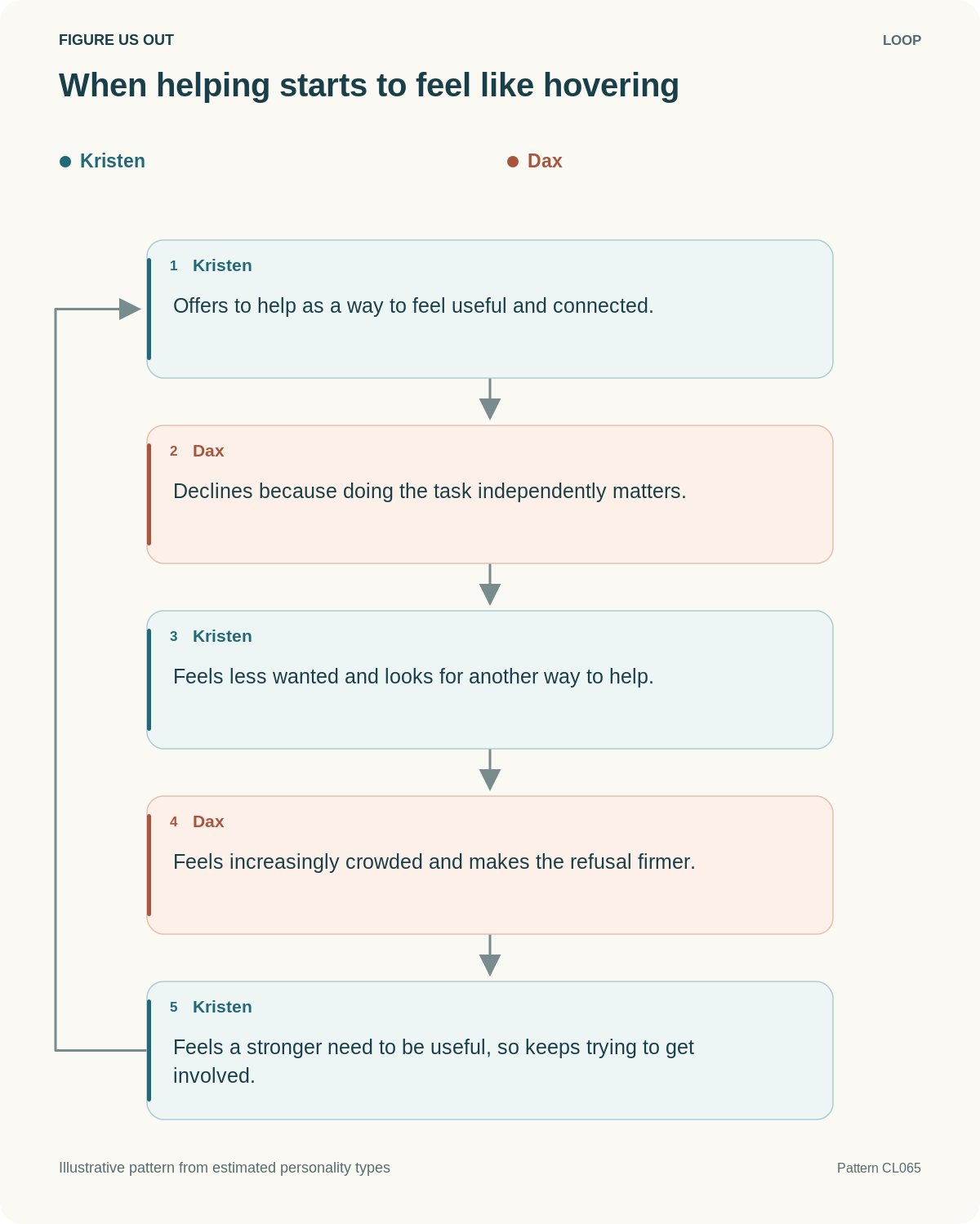
ILLUSTRATIVE PATTERN · ESTIMATED TYPES
When helping starts to feel like hovering
Offers to help as a way to feel useful and connected.
Declines because doing the task independently matters.
Feels less wanted and looks for another way to help.
Feels increasingly crowded and makes the refusal firmer.
Feels a stronger need to be useful, so keeps trying to get involved.
↩ Feeling less wanted brings more offers; feeling less independent brings stronger refusals.
It helps to separate two questions: “Do you need a hand?” and “Would you like some company?”
The answers don’t have to match.
You can be wanted without being needed for the job
“I want to figure this out myself, but I’d love you to hang out with me” offers something a flat “I’m fine” doesn’t. It leaves room for the relationship without handing over the project.
From the other side, “I was hoping to spend a little time with you” is easier to answer than several more offers of help. Now your partner knows what you were reaching for.
Sometimes they really do want an hour alone. That can be fine too, especially when there’s another time to reconnect and neither person has to turn the afternoon into a test of how much they’re loved.
The independent person has something to consider as well. Accepting help doesn’t automatically make the accomplishment less theirs. And sharing a life means some decisions really do belong to both people. “I want to handle this myself” is different when you’re repairing your own bicycle than when you’re deciding something that affects the whole household.
For a couple with these tendencies, the aim is to make care easier to receive. Help stays an offer. Company doesn’t have to earn its place by finding a job to do.
Being direct doesn’t have to mean being sharp
Kristen and Dax’s estimated profiles also suggest a difference in how a difficult point gets expressed. One may take care with the opening; the other may want to get straight to what needs to change.
You can see how that could complicate the garage conversation. “I already told you I don’t need help” gets the point across. It may also give the listener a whole new problem with the way it was said.
Then one person wants to discuss the request and the other wants to discuss the tone. Repeating the same words more forcefully is unlikely to make either feel understood.
A clearer response could be: “I know you’re offering because you care. I still want to do this part myself.” The answer hasn’t changed. There’s just less room to mistake it for a rejection of the person.
And someone who starts gently still needs to say the actual thing they want. “Could we spend some time together after you finish?” gives their partner a request they can respond to, rather than a feeling they’re supposed to work out from hints.
That’s the useful possibility in this difference: keeping the point clear and making it easier to hear. Neither tact nor directness is a good excuse to leave the other person guessing or feeling put down.
Keep the fun, even when you have something to work on
It would be easy to look at the sloth video or the homemade music video and leave it at “couple goals.” But a funny, affectionate moment doesn’t tell us everything about a marriage.
Kristen has said as much herself. In an interview reported by Entertainment Tonight, she described growing pains, arguments, and the effort they put into working things out. 4
That doesn’t take the pleasure out of those lighter moments. A relationship can contain both a conversation you need to get better at and a person who will enthusiastically join your ridiculous vacation video.
Understanding your personalities should help you keep more of what you enjoy. The person who loves helping doesn’t need to stop being generous. The person who likes independence doesn’t need to give up every project they enjoy doing alone. They need ways to make their intentions clearer and to hear the answer that actually comes back.
Next time an offer of help lands badly, try asking: “Do you want help, company, or some time to yourself?”
That gives your partner three perfectly reasonable answers. None of them requires arranging a visit from a sloth.
What happens when your two personalities meet?
Maybe you recognized the garage conversation. Maybe you’re the person who wants to help, or the one who keeps saying you’ve got it. Figure Us Out helps you explore those differences alongside the things you naturally enjoy about each other.
Your couples package includes a personal report for each of you, a shared couples guidebook, and a 12-week workbook you can use online or print. 5
A little more to explore
Curious about the details? Open a section below. All comparisons and patterns use the same estimated profiles.
The fun of someone joining in
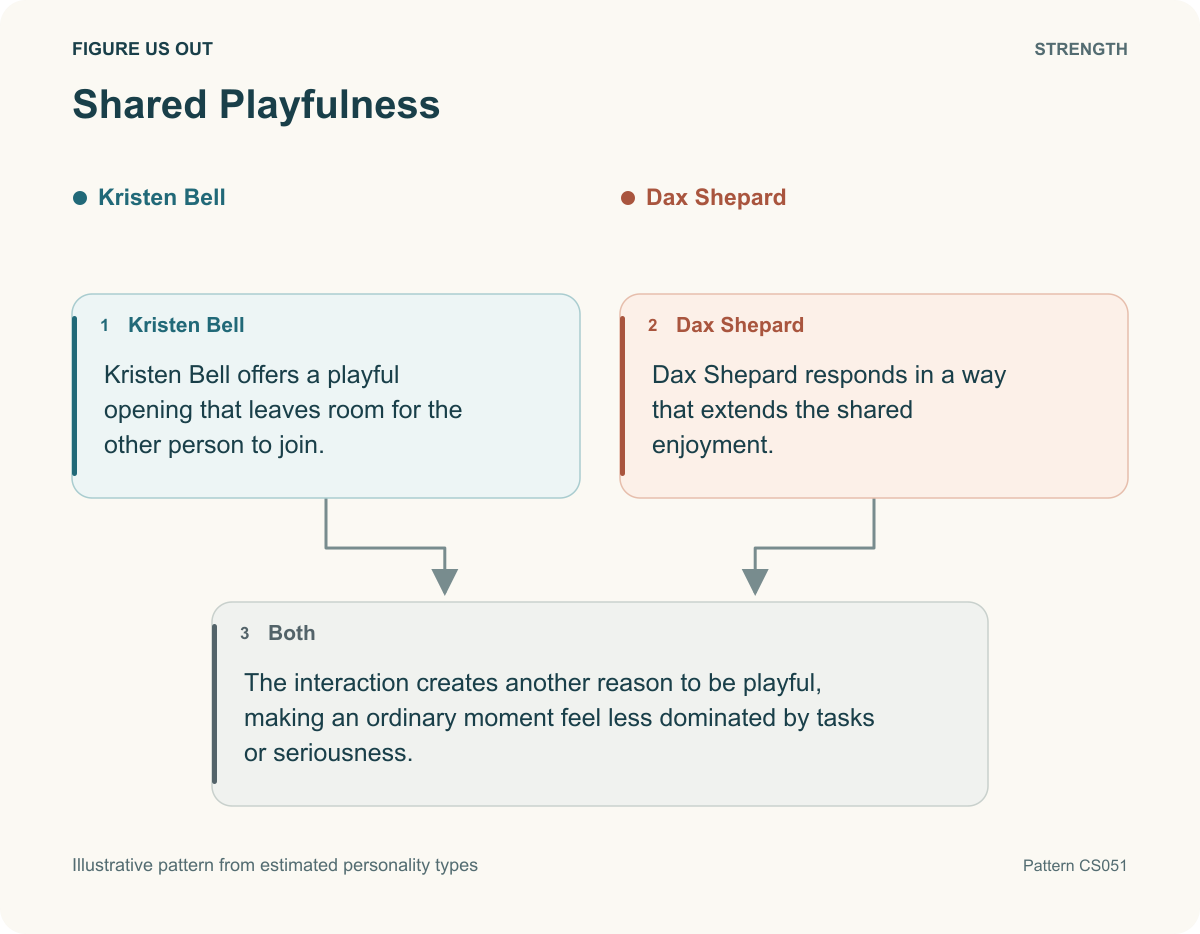
Two contributions combine in one possible benefit. This is not a sequence or a guaranteed outcome.
1. Kristen Bell offers a playful opening that leaves room for the other person to join.
2. Dax Shepard responds in a way that extends the shared enjoyment.
3. The interaction creates another reason to be playful, making an ordinary moment feel less dominated by tasks or seriousness.
A clear point that is easier to hear
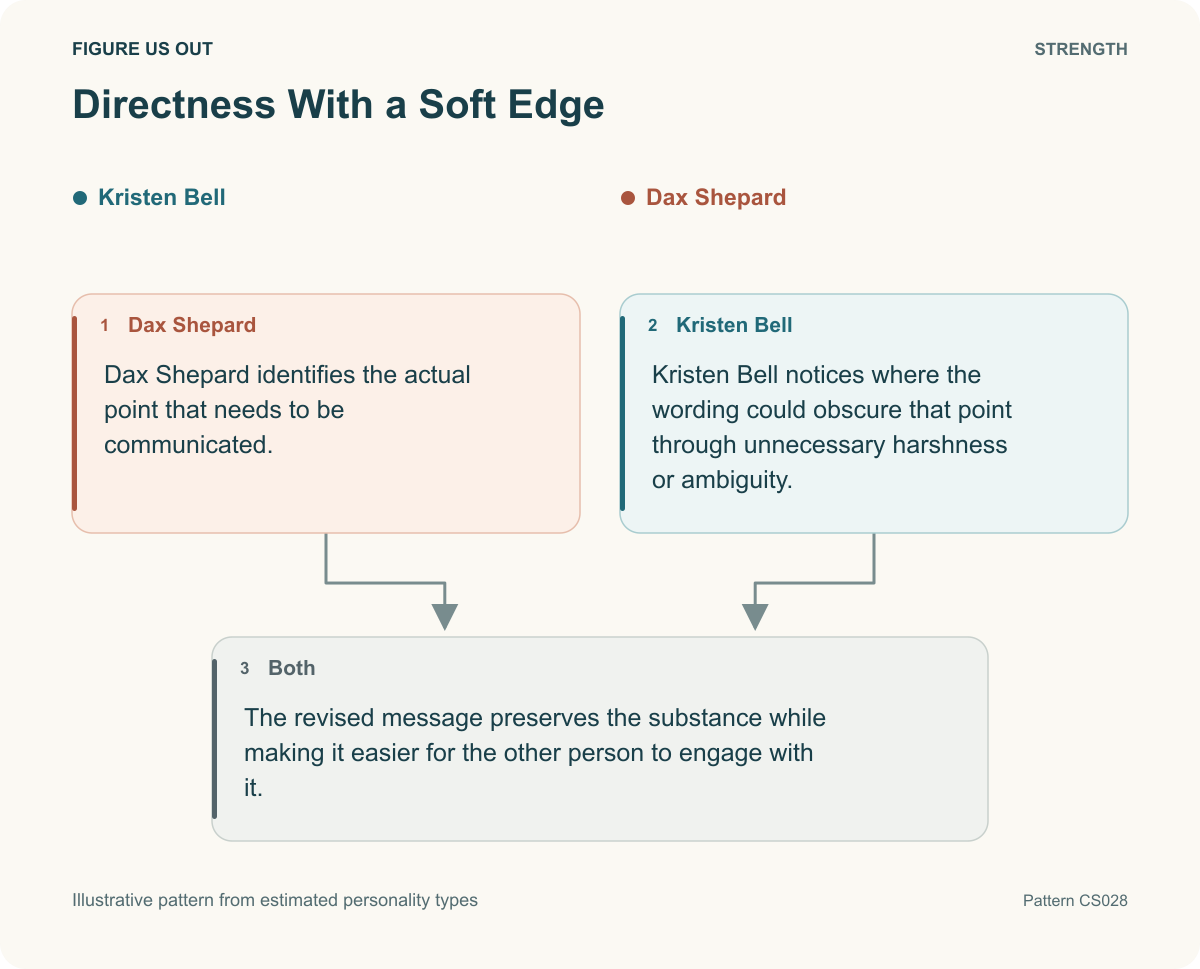
Two contributions combine in one possible benefit. This is not a sequence or a guaranteed outcome.
1. Dax Shepard identifies the actual point that needs to be communicated.
2. Kristen Bell notices where the wording could obscure that point through unnecessary harshness or ambiguity.
3. The revised message preserves the substance while making it easier for the other person to engage with it.
Are we discussing the point or the tone?
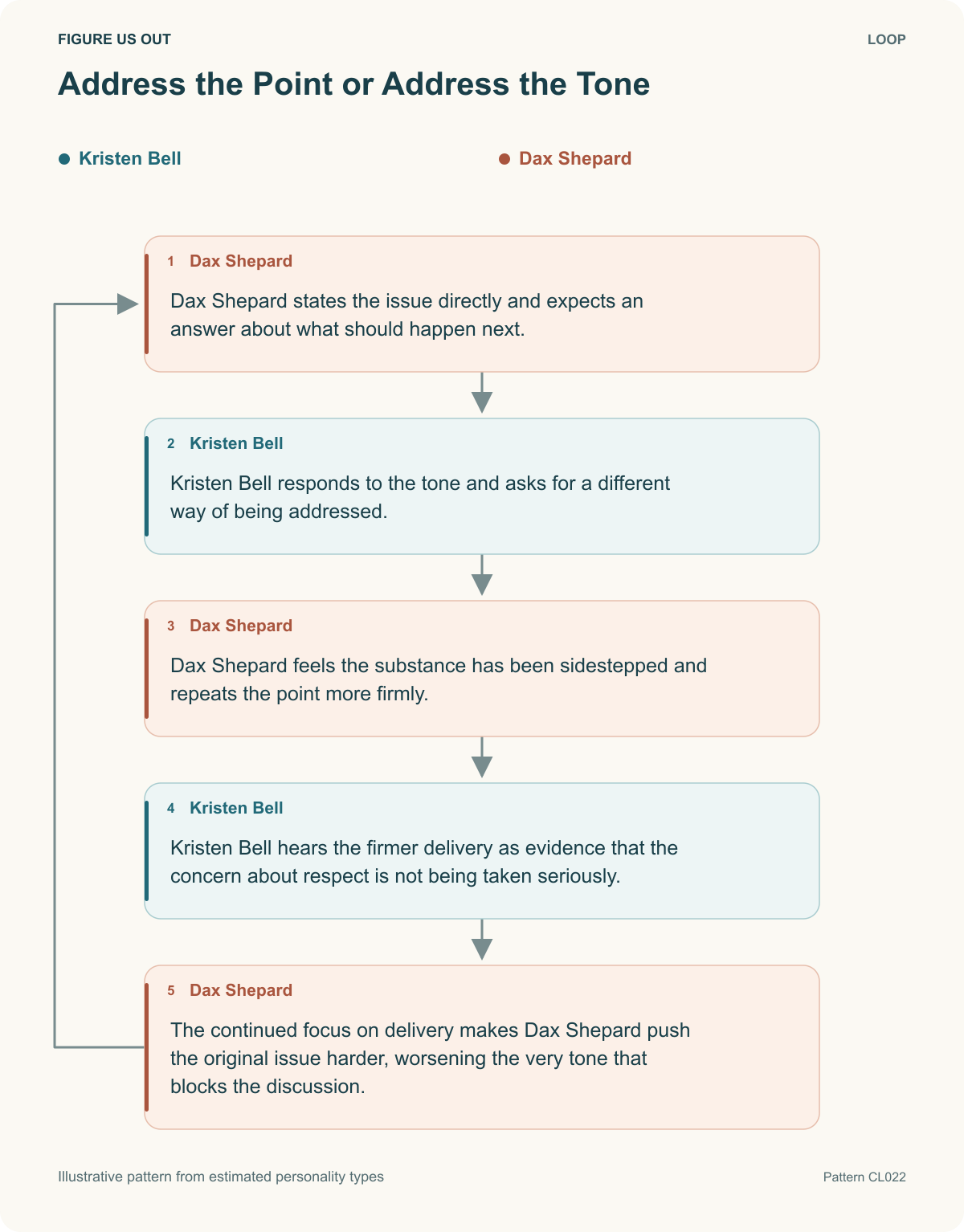
A possible repeating interaction, not a claim about a private event.
1. Dax Shepard states the issue directly and expects an answer about what should happen next.
2. Kristen Bell responds to the tone and asks for a different way of being addressed.
3. Dax Shepard feels the substance has been sidestepped and repeats the point more firmly.
4. Kristen Bell hears the firmer delivery as evidence that the concern about respect is not being taken seriously.
5. The continued focus on delivery makes Dax Shepard push the original issue harder, worsening the very tone that blocks the discussion.
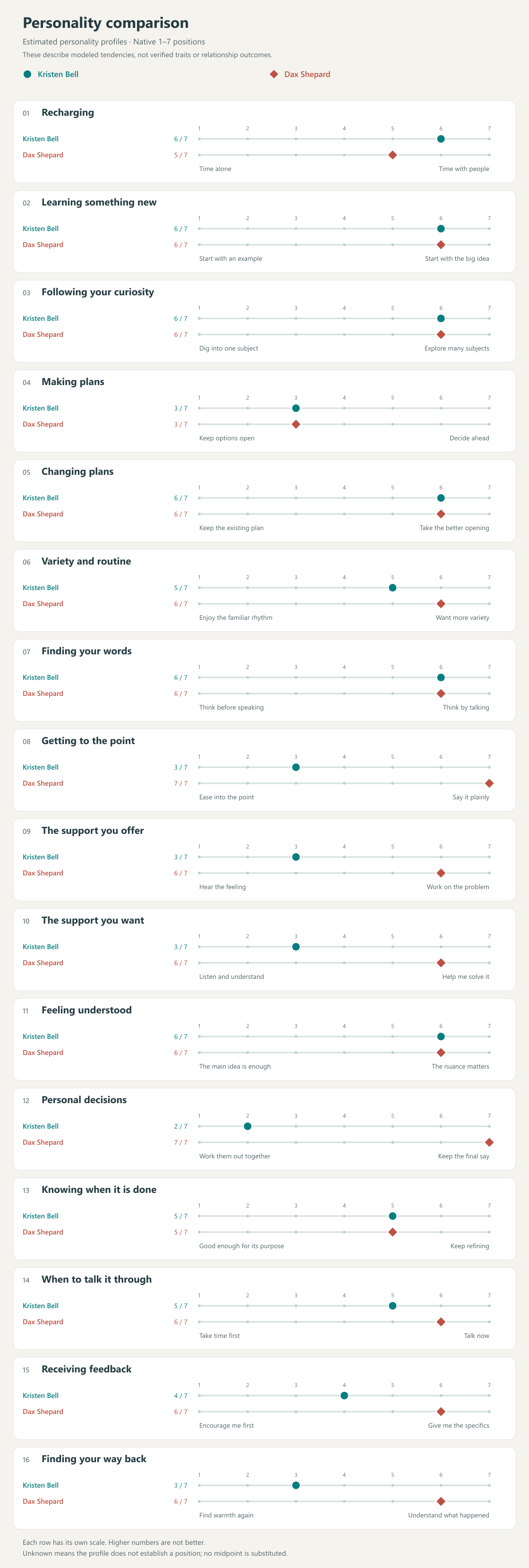
All 16 personality comparisons
These are type-based preferences on the original 1–7 scales, not personal test answers or percentages. Neither end is better.
Recharging
1: Time alone · 7: Time with people
Kristen Bell: 6
You are often renewed by warm conversation, shared enthusiasm, and feeling connected, while still needing some quiet time after too much activity.
Dax Shepard: 5
You often regain energy through lively, interesting company, while still needing some private time after too much intensity.
Learning something new
1: Start with an example · 7: Start with the big idea
Kristen Bell: 6
You are likely to enter a new subject through the larger idea, the possible meaning, or what it could lead to, then use examples to make it concrete.
Dax Shepard: 6
You often want the larger idea, possibility, or principle first, then use examples to test and sharpen it.
Following your curiosity
1: Dig into one subject · 7: Explore many subjects
Kristen Bell: 6
You are likely to follow several related interests, especially when they connect people, ideas, creativity, and growth.
Dax Shepard: 6
You are likely to follow branches, compare possibilities, and connect several interests rather than staying with one narrow path.
Making plans
1: Keep options open · 7: Decide ahead
Kristen Bell: 3
You usually prefer leaving room for possibility and deciding some things as the day develops, while making advance choices for commitments that matter.
Dax Shepard: 3
You are likely to keep room for new options rather than settle every part of an ordinary day in advance.
Changing plans
1: Keep the existing plan · 7: Take the better opening
Kristen Bell: 6
You are often open to changing a nonessential plan when a more meaningful, exciting, or helpful opportunity appears.
Dax Shepard: 6
A promising alternative may quickly become more interesting than the original plan, especially if it offers better energy, freedom, or results.
Variety and routine
1: Enjoy the familiar rhythm · 7: Want more variety
Kristen Bell: 5
You tend to want some reliable anchors but may feel ready for variety when days become too repetitive or emotionally flat.
Dax Shepard: 6
Repeated days may soon feel limiting, and you are likely to want fresh problems, settings, ideas, or ways of doing things.
Finding your words
1: Think before speaking · 7: Think by talking
Kristen Bell: 6
Talking can help you discover what you think, connect ideas, and bring emotional meaning into focus. A live exchange may give your thoughts energy and direction.
Dax Shepard: 6
You may discover and sharpen your ideas while speaking, especially through lively debate or quick back-and-forth.
Getting to the point
1: Ease into the point · 7: Say it plainly
Kristen Bell: 3
You may ease into a difficult point, showing care before stating what you need or disagree with. The message can still become clear, but protecting the connection may shape how quickly you say it.
Dax Shepard: 7
You are likely to state the main point plainly rather than rely on hints, especially when something important needs to change.
The support you offer
1: Hear the feeling · 7: Work on the problem
Kristen Bell: 3
You usually want to understand the feeling, but your care often quickly turns toward encouragement or a useful next step.
Dax Shepard: 6
You are likely to look for a practical way forward quickly, while still recognizing that the person is upset. You may show care by helping make the situation clearer or more workable.
The support you want
1: Listen and understand · 7: Help me solve it
Kristen Bell: 3
You generally want to feel understood first, while still appreciating someone who helps you find a constructive next step.
Dax Shepard: 6
When you are upset, useful problem-solving is likely to feel more helpful than extended emotional acknowledgment. You may prefer a direct conversation that identifies what happened, what matters, and what can be done.
Feeling understood
1: The main idea is enough · 7: The nuance matters
Kristen Bell: 6
You may want people to understand not only the main point but also the feeling, motive, and personal meaning behind it. Being seen accurately can make connection feel more mutual.
Dax Shepard: 6
You are likely to care about whether people understand your reasoning, motives, and distinctions, not just the headline of what you said.
Personal decisions
1: Work them out together · 7: Keep the final say
Kristen Bell: 2
You often welcome trusted input and may prefer to work through a personal decision with someone rather than carry it alone.
Dax Shepard: 7
For decisions that mainly affect you, you strongly prefer to keep the final say. Advice can be useful, but the decision needs to remain yours rather than becoming an instruction from someone else.
Knowing when it is done
1: Good enough for its purpose · 7: Keep refining
Kristen Bell: 5
You often notice ways to improve a result, especially when quality affects people or reflects something you care about, but you may stop when the purpose has been met.
Dax Shepard: 5
You may stop once the result works, but you are also likely to refine it when a sharper, stronger, or more effective version is visible.
When to talk it through
1: Take time first · 7: Talk now
Kristen Bell: 5
You often prefer to talk reasonably soon so uncertainty does not damage the connection, though you may need a short pause to gather yourself.
Dax Shepard: 6
Once a disagreement is clear, you are likely to prefer discussing it soon rather than carrying uncertainty. Immediate conversation gives you a chance to test the facts, state your position, and restore freedom of movement.
Receiving feedback
1: Encourage me first · 7: Give me the specifics
Kristen Bell: 4
You are likely to value both personal encouragement and specific guidance: you want to know what is working, while also wanting feedback that helps you improve.
Dax Shepard: 6
You are likely to value clear, actionable detail early. Knowing exactly what is weak or what needs to change gives you something concrete to test, improve, or challenge.
Finding your way back
1: Find warmth again · 7: Understand what happened
Kristen Bell: 3
Once tension has eased, you are likely to look for a warmer connection and signs that the bond is okay, while still appreciating enough explanation to understand the issue.
Dax Shepard: 6
After tension settles, you are likely to want a clear account of what happened before returning fully to easy warmth. Understanding the issue helps you decide whether trust and cooperation are actually restored.
See the complete source chart
Story sources and a note about the personalities
Public interviews and reporting support the celebrity details. Personality interpretations come from Figure Us Out’s October 15, 2026 writer packet. The imagined exchanges are examples, not reports of private events. A real anecdote does not confirm a type or a private relationship pattern.
- ABC News / Us Weekly: ABC News, “Kristen Bell’s Emotional Meeting with a Sloth,” February 1, 2012; Us Weekly, January 31, 2012, reporting her Ellen appearance.
- iHeart / Sunday TODAY: iHeart, “Kristen Bell Says She Felt No Sparks Whatsoever When She Met Dax Shepard,” November 22, 2019, reporting Sunday TODAY.
- Fox News: Sasha Savitsky, “Kristen Bell, Dax Shepard did not have love at first sight,” November 24, 2019.
- Entertainment Tonight: Jackie Willis, “Kristen Bell and Dax Shepard Made an Adorable Music Video of Their Visit to Africa,” January 28, 2016.
- Figure Us Out: Current couples-package page, checked October 16, 2026.
Estimated profiles and alternatives: Kristen ENFP 2w3; Dax ENTP 8w7. Both unconfirmed. Kristen has ENFJ/core Six alternatives; Dax has 7w8 and ESTP alternatives. Dax’s input has low source confidence.
No celebrity endorsement is implied.

.jpg)