
Zendaya and Tom Holland: The Charm, the Quiet, and the Door He Fixed
A little home repair, a very sweet compliment, and the fun of loving someone whose mind moves differently from yours.
 Zendaya
 Tom Holland
Tom Holland’s account of his early romance with Zendaya includes a detail you don’t usually get in a Hollywood love story: a broken door.
In a 2023 interview with UNILAD, he said he’d fixed a door at her house early in their relationship. His conclusion was wonderfully straightforward: “And now we’re in love.” 1
There are worse ways to make an impression. A charming conversation is lovely, but so is noticing something that needs fixing and knowing what to do about it.
Of course, their story involved a little more than carpentry. They met while making Spider-Man: Homecoming in 2016, became friends, and their romance became public in 2021. 2 That gives the door story a certain extra charm. Behind the superhero movies and red carpets, there was also a guy at a girl’s house making himself useful.
She was asked about her costars. She picked Tom anyway.
During her 2024 BuzzFeed puppy interview, Zendaya was asked which of her Dune costars had the most charisma. She jokingly nominated herself, then found a way to bring Tom into the answer, despite his not being in the movie.
She described herself as more shy and quiet, while praising how easily he talks to people and gets to know them. The quality she admired was something she felt she had to work harder at herself. 3
I like how specific that is. It’s one thing to say your partner is wonderful. It’s another to notice the thing they do easily that takes effort for you.
Maybe your partner can walk into a room and find someone to talk to before you’ve figured out where to put your coat. You don’t necessarily want to become that person. You might just enjoy arriving with them.
And the person who makes conversation easily can appreciate being with someone who doesn’t need every quiet moment filled. There’s room for both kinds of company in a relationship.
The quieter person can have just as many ideas
For this Figure Us Out article, we’re exploring Zendaya as INFJ 6w7 and Tom as ENFP 7w6. These are estimates from public personality discussions, not assessment results they provided. The types are unconfirmed, and the relationship examples below are possibilities, not accounts of their private life.
You don’t need to know those letters to follow the interesting part. In this combination, both people are drawn to ideas, possibilities, and the meaning behind things. The difference is often in how those thoughts come out.
Someone with Tom’s estimated personality may discover what they think by saying it. A conversation gives the idea somewhere to grow. Someone with Zendaya’s may want a little time to consider it privately before putting it into words.
That can be a lovely combination. One gets something started; the other comes back with a detail or question that makes it better. Both are interested. Both have something to contribute. The quieter person hasn’t necessarily been waiting for the more talkative one to have all the ideas.
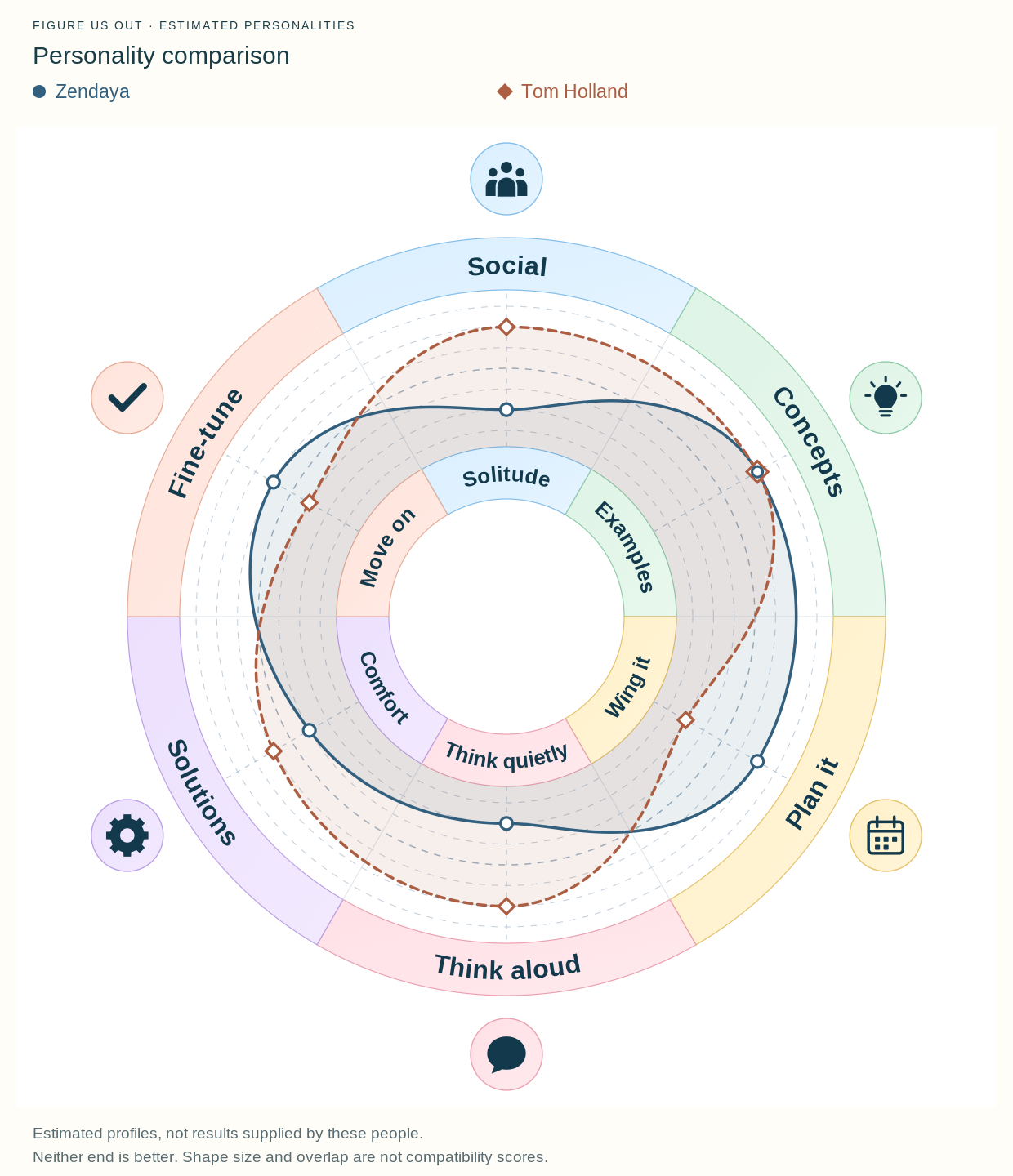
Read the six preferences in plain text
Recharging
1: Time alone · 7: Time with people
Zendaya: 2
Quiet time usually helps you recover, although trusted company can also feel restorative when it is easy and supportive.
Tom Holland: 6
You often regain energy through warm conversation, shared excitement, and contact with people, though quiet time can still help you reset.
Learning something new
1: Start with an example · 7: Start with the big idea
Zendaya: 6
You usually want the main idea and its meaning first, then use examples to make the concept concrete.
Tom Holland: 6
You often want the larger idea first, then enjoy seeing how it works through examples and stories.
Making plans
1: Keep options open · 7: Decide ahead
Zendaya: 6
You generally feel better when important choices are settled ahead of time, leaving less uncertainty about what comes next.
Tom Holland: 2
You are likely to prefer leaving room for options and deciding some things as the day unfolds, especially when the plan feels restrictive.
Finding your words
1: Think before speaking · 7: Think by talking
Zendaya: 2
You are more likely to form a thought privately and speak once it has enough shape, rather than discovering the whole idea while talking.
Tom Holland: 6
You often discover and sharpen your ideas by saying them aloud, making conversation part of the thinking process.
The support you offer
1: Hear the feeling · 7: Work on the problem
Zendaya: 3
You tend to hear what is wrong while also looking for a useful next step. When the situation feels uncertain, you may move toward practical help to make it feel safer and clearer.
Tom Holland: 5
You tend to look for a useful way forward while still recognizing that the feeling matters.
Knowing when it is done
1: Good enough for its purpose · 7: Keep refining
Zendaya: 5
You are often drawn to another refinement when it makes the result more coherent, helpful, or aligned with your values.
Tom Holland: 3
You are often ready to stop once the result serves its purpose, especially when more polishing would drain energy from a new possibility.
“We could” and “we should” are very different conversations
Imagine a couple looking at the spare room. One says it would make a great little movie room. They’re picturing a comfortable couch, dark curtains, maybe a projector. Saying it out loud is half the fun.
The other person starts taking the idea seriously. What would happen to the desk? Would they still have somewhere for guests to sleep? Is this something they want to do soon?
Now the first person is backtracking. Maybe it could still be a guest room. Or perhaps they could just put a bigger television in the living room. They haven’t chosen anything yet.
The second person is getting confused. Which idea are they supposed to be considering? A moment ago they were discussing the spare room. Now apparently they’re buying a television.
To someone who usually thinks before speaking, a suggestion can sound further along than it really is. You assume your partner has already had the private conversation you would have had with yourself.
To someone who thinks aloud, all those changes may be the conversation working exactly as intended. They’re finding out what appeals to them as they go.
The trouble starts when the questions feel like objections. One person adds possibilities to keep the idea alive. The other asks more questions because there is now even less agreement about what’s being proposed. Neither feels joined in the conversation they thought they were having.
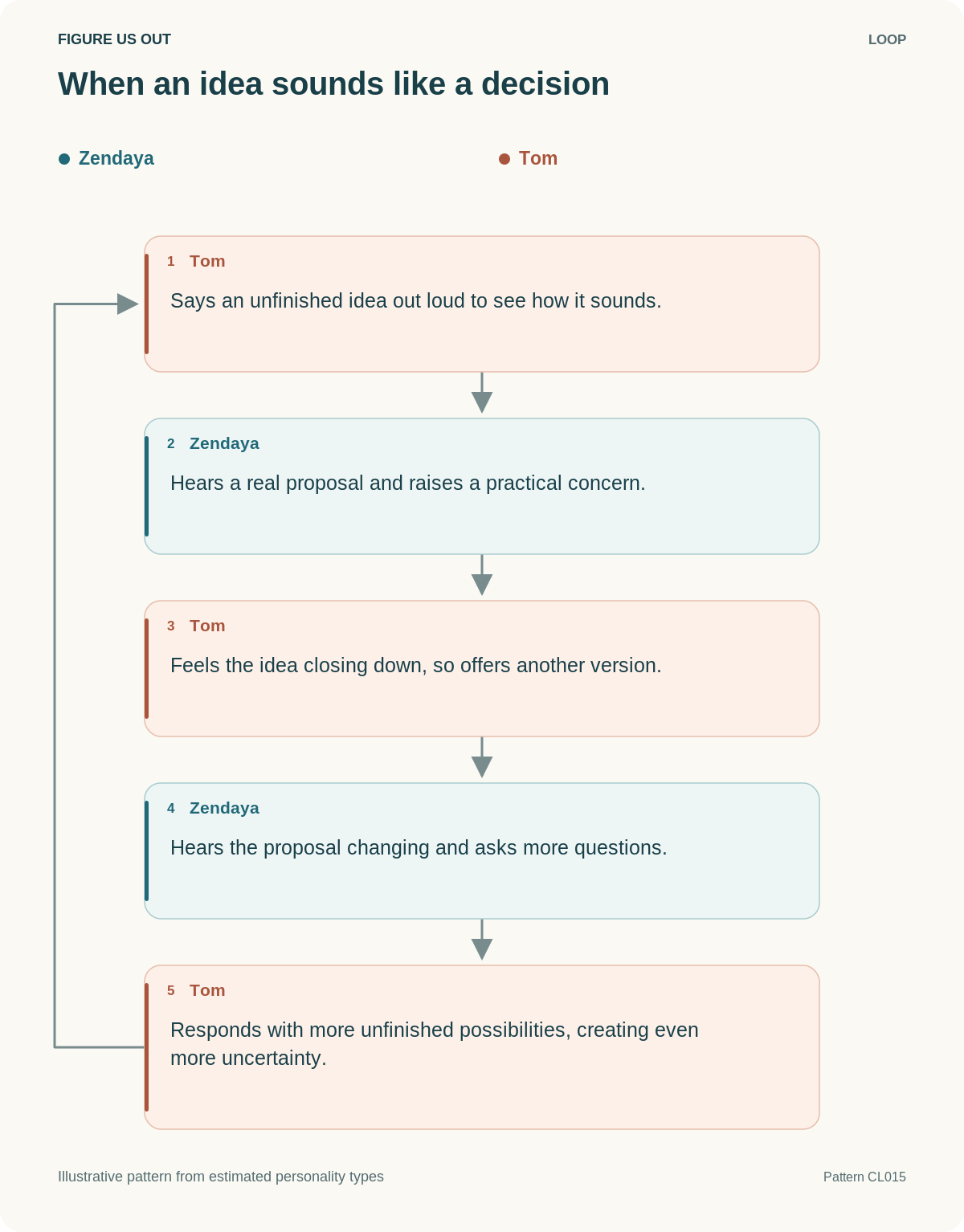
ILLUSTRATIVE PATTERN · ESTIMATED TYPES
When an idea sounds like a decision
Says an unfinished idea out loud to see how it sounds.
Hears a real proposal and raises a practical concern.
Feels the idea closing down, so offers another version.
Hears the proposal changing and asks more questions.
Responds with more unfinished possibilities, creating even more uncertainty.
↩ More uncertainty leads to more questions, which invite still more versions of the idea.
A little context can save quite a bit of frustration: “I’m just playing with an idea. We don’t have to do anything about it.”
Or, from the other side: “I like the sound of that. Are we imagining it, or are you asking whether we should do it?”
That leaves room to enjoy an idea without ordering the couch. It also leaves room to ask a practical question without accidentally becoming the person who ruins every interesting suggestion.
A second thought can make the first one better
There’s a strength hiding in the same difference. The first person may get the conversation going before everything is worked out. The second may come back later with something that makes the idea more appealing to both of them.
In the imaginary movie-room conversation, perhaps the quieter partner suggests a sofa bed. They’ve been thinking about how to keep the part they liked without losing the guest room. The pause wasn’t necessarily a lack of interest. Something was happening during it.
For this estimated pairing, enthusiasm and a second look could work well together when neither person treats their own timing as the correct one. The person thinking aloud can give a question time to breathe. The person thinking privately can say, “I’m still considering it,” so the silence doesn’t have to be interpreted.
You get more out of the difference when there is room for an idea to change before either of you has to defend it.
He can show up without making it about him
One of Tom’s public comments offers a different kind of sweetness. In his 2025 Men’s Health cover interview, he explained why he didn’t typically walk Zendaya’s red carpets with her: “because it’s not my moment, it’s her moment, and if we go together, it’s about us.” 4
That’s a thoughtful distinction. Being supportive doesn’t always mean standing in the middle of the photograph.
The same idea can matter far from a premiere. Your partner might appreciate company before an important event but want to handle the event itself their own way. They might want your opinion without wanting you to make the decision. Or they might want you right beside them, because that’s the part that would make it easier.
The helpful question is what kind of support they would actually enjoy. Someone can be capable and independent and still appreciate knowing you’re there. You can offer something generous without deciding in advance what accepting it has to look like.
In the personality pairing we’re exploring, that gives both people something worth keeping: dependable backing and room to make their own choices.
Sometimes the best plan is a walk
For all the attention around these two, one of Zendaya’s descriptions of an ideal break is pretty ordinary. In a July 2026 British Vogue interview, she talked about walking with their dogs, visiting the park, and enjoying a drink. She also mentioned needing her allergy medicine. 5
A very glamorous life can still contain a perfectly familiar outing: take the dogs, get something nice to drink, remember the thing that stops you sneezing.
It’s a useful reminder when we talk about personality differences. The outgoing person doesn’t need every day to be a party. The quieter person doesn’t need every experience to be predictable. There can be plenty they enjoy together without either becoming someone else.
The little adjustments matter because they make room for that enjoyment. Let an unfinished idea stay unfinished for a while. Let a pause mean thinking rather than rejection. Ask how your partner would like you to show up.
Next time a suggestion becomes unexpectedly frustrating, try one question: “Were you sharing an idea, or asking us to make a decision?”
You might both like the movie room. You just weren’t both shopping for the couch yet.
What would your own personalities help you understand?
You and your partner may have a completely different combination of things that come easily and things you keep misunderstanding. Figure Us Out helps you explore both personalities together, with a personal report for each of you, a couples guidebook, and a 12-week workbook you can use online or print. 6
A little more to explore
Curious about the details? Open a section below. All comparisons and patterns use the same estimated profiles.
The first thought and the second look
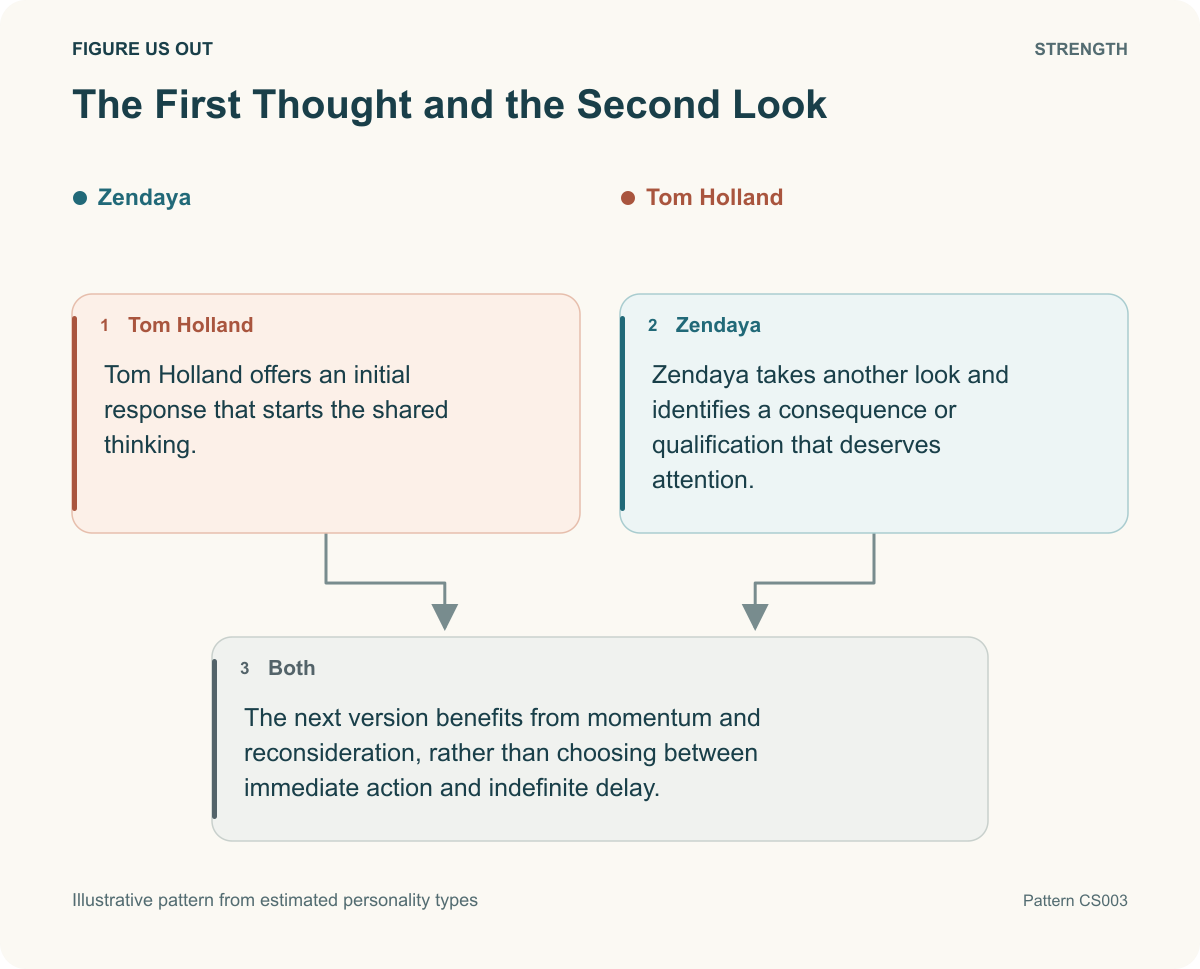
Two contributions combine in one possible benefit. This is not a sequence or a guaranteed outcome.
1. Tom Holland offers an initial response that starts the shared thinking.
2. Zendaya takes another look and identifies a consequence or qualification that deserves attention.
3. The next version benefits from momentum and reconsideration, rather than choosing between immediate action and indefinite delay.
Showing up without taking over
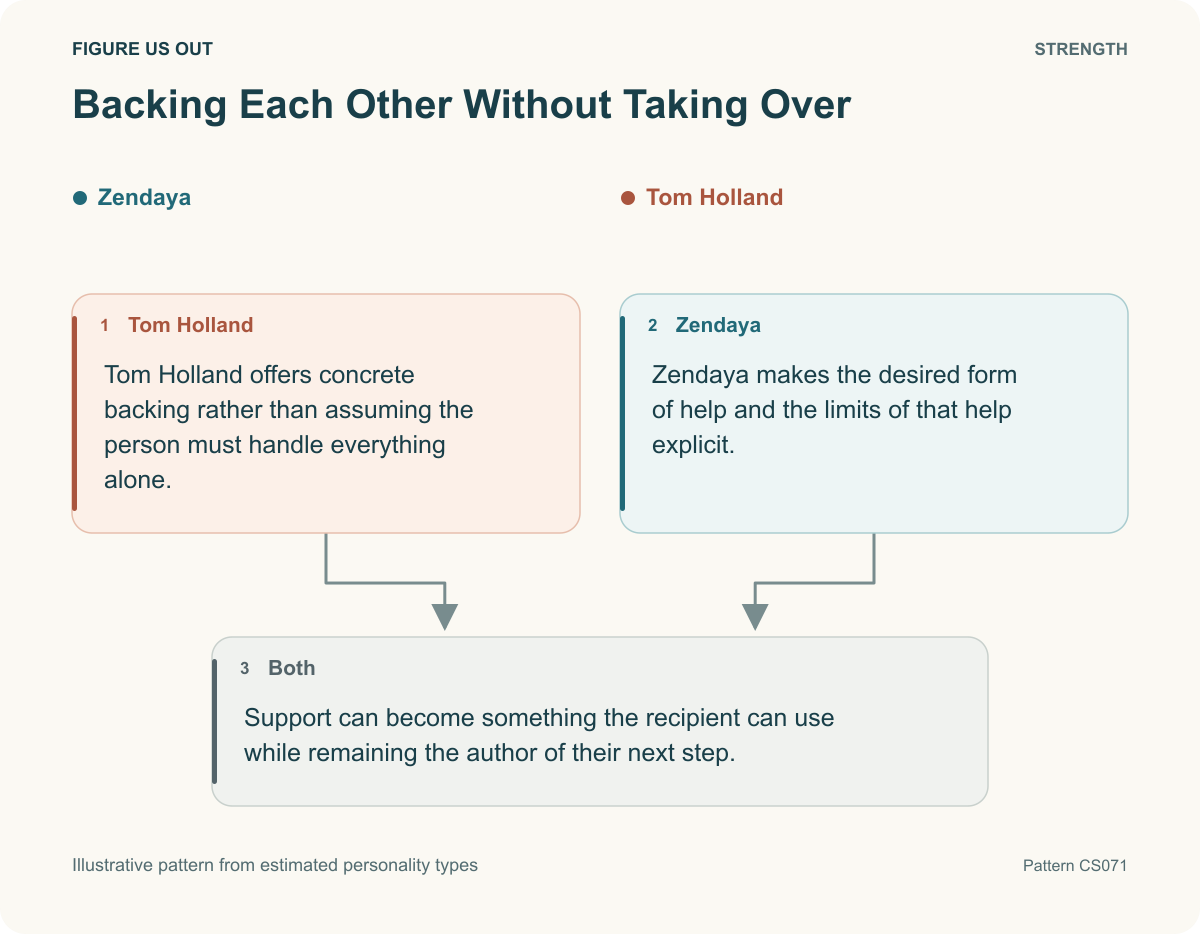
Two contributions combine in one possible benefit. This is not a sequence or a guaranteed outcome.
1. Tom Holland offers concrete backing rather than assuming the person must handle everything alone.
2. Zendaya makes the desired form of help and the limits of that help explicit.
3. Support can become something the recipient can use while remaining the author of their next step.
When a push to decide makes someone more cautious
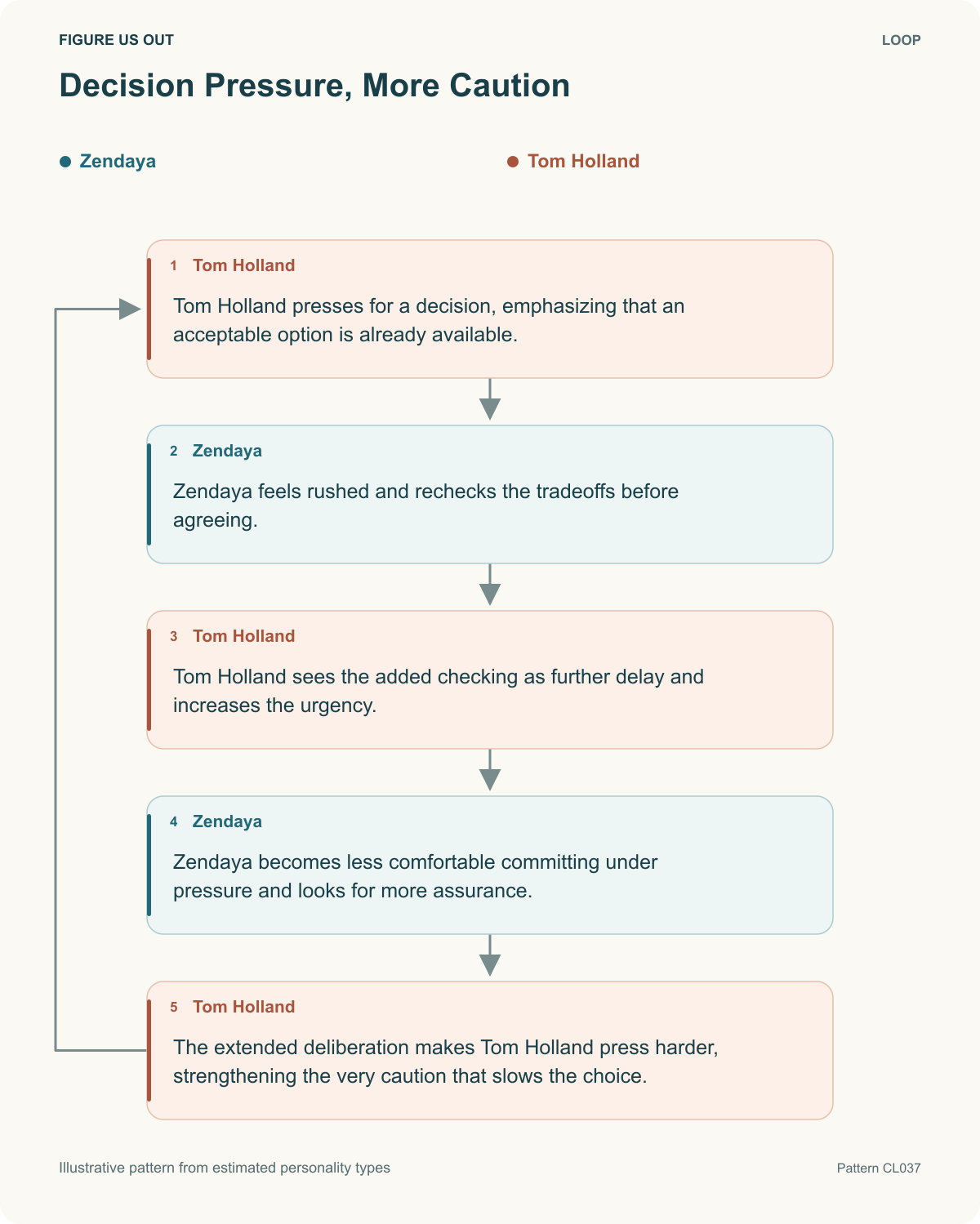
A possible repeating interaction, not a claim about a private event.
1. Tom Holland presses for a decision, emphasizing that an acceptable option is already available.
2. Zendaya feels rushed and rechecks the tradeoffs before agreeing.
3. Tom Holland sees the added checking as further delay and increases the urgency.
4. Zendaya becomes less comfortable committing under pressure and looks for more assurance.
5. The extended deliberation makes Tom Holland press harder, strengthening the very caution that slows the choice.
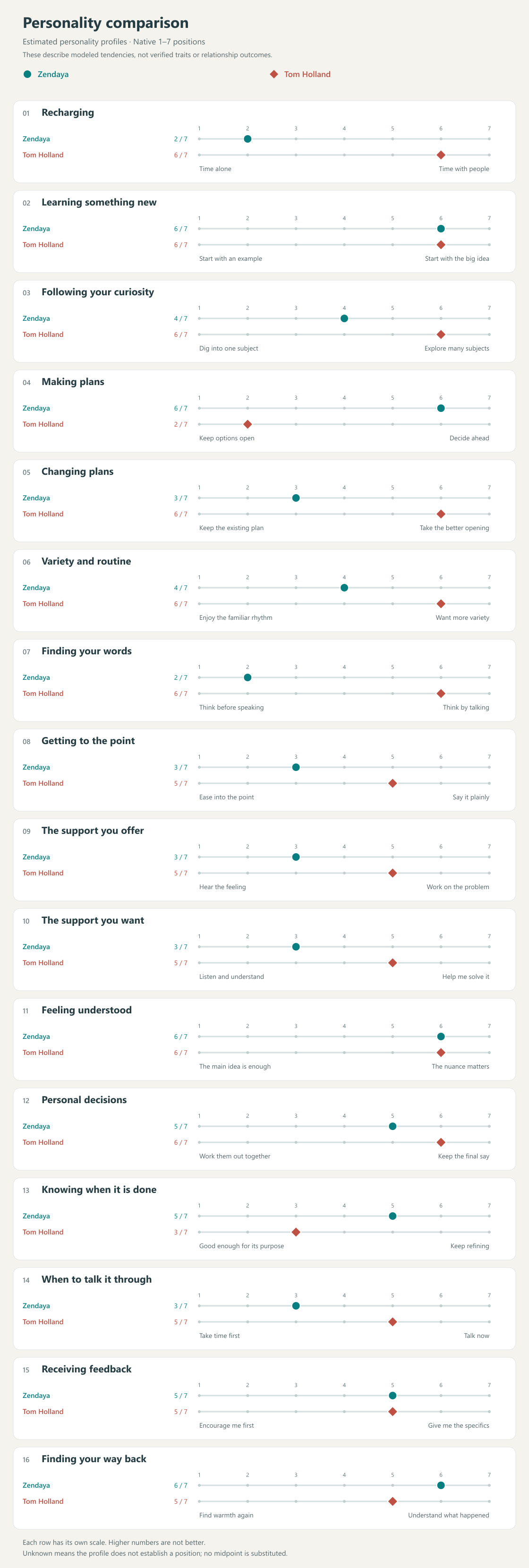
All 16 personality comparisons
These are type-based preferences on the original 1–7 scales, not personal test answers or percentages. Neither end is better.
Recharging
1: Time alone · 7: Time with people
Zendaya: 2
Quiet time usually helps you recover, although trusted company can also feel restorative when it is easy and supportive.
Tom Holland: 6
You often regain energy through warm conversation, shared excitement, and contact with people, though quiet time can still help you reset.
Learning something new
1: Start with an example · 7: Start with the big idea
Zendaya: 6
You usually want the main idea and its meaning first, then use examples to make the concept concrete.
Tom Holland: 6
You often want the larger idea first, then enjoy seeing how it works through examples and stories.
Following your curiosity
1: Dig into one subject · 7: Explore many subjects
Zendaya: 4
You can pursue a subject deeply while also following related ideas when they reveal useful connections or new possibilities.
Tom Holland: 6
You are likely to follow several connected interests, enjoying the links between subjects rather than staying with only one narrow path.
Making plans
1: Keep options open · 7: Decide ahead
Zendaya: 6
You generally feel better when important choices are settled ahead of time, leaving less uncertainty about what comes next.
Tom Holland: 2
You are likely to prefer leaving room for options and deciding some things as the day unfolds, especially when the plan feels restrictive.
Changing plans
1: Keep the existing plan · 7: Take the better opening
Zendaya: 3
You usually protect an agreed plan, but you can accept a change when the alternative is clearly better and its effects have been considered.
Tom Holland: 6
A promising alternative may quickly catch your attention, and you may enjoy revising a flexible plan when the change seems worthwhile.
Variety and routine
1: Enjoy the familiar rhythm · 7: Want more variety
Zendaya: 4
You may like stable parts of the day while still wanting enough variation to keep life interesting and open.
Tom Holland: 6
Repeated days can start to feel limiting, so you are likely to want variety, fresh input, and some changing possibilities.
Finding your words
1: Think before speaking · 7: Think by talking
Zendaya: 2
You are more likely to form a thought privately and speak once it has enough shape, rather than discovering the whole idea while talking.
Tom Holland: 6
You often discover and sharpen your ideas by saying them aloud, making conversation part of the thinking process.
Getting to the point
1: Ease into the point · 7: Say it plainly
Zendaya: 3
You are likely to soften the opening of a difficult message, then state the important point clearly once the other person is ready to hear it.
Tom Holland: 5
You are inclined to state the important point fairly plainly, though you may soften the opening when protecting the connection matters.
The support you offer
1: Hear the feeling · 7: Work on the problem
Zendaya: 3
You tend to hear what is wrong while also looking for a useful next step. When the situation feels uncertain, you may move toward practical help to make it feel safer and clearer.
Tom Holland: 5
You tend to look for a useful way forward while still recognizing that the feeling matters.
The support you want
1: Listen and understand · 7: Help me solve it
Zendaya: 3
When upset, you are likely to want understanding first, but practical thinking can become welcome once the situation feels accurately understood. A solution offered too early may feel incomplete rather than entirely unhelpful.
Tom Holland: 5
When upset, you may appreciate understanding but also want help finding a useful next step rather than staying only with the feeling.
Feeling understood
1: The main idea is enough · 7: The nuance matters
Zendaya: 6
You are likely to want more than the general idea to be understood; the motive, meaning, and important distinctions behind it matter too.
Tom Holland: 6
You usually want people to understand not only your main point but also the motive, meaning, and nuance behind it.
Personal decisions
1: Work them out together · 7: Keep the final say
Zendaya: 5
You tend to value having ownership of decisions that mainly affect you, while still wanting trusted input when uncertainty is high. Advice is most useful when it helps you think rather than replaces your judgment.
Tom Holland: 6
For decisions that mainly affect you, you generally want meaningful input without giving away the final say.
Knowing when it is done
1: Good enough for its purpose · 7: Keep refining
Zendaya: 5
You are often drawn to another refinement when it makes the result more coherent, helpful, or aligned with your values.
Tom Holland: 3
You are often ready to stop once the result serves its purpose, especially when more polishing would drain energy from a new possibility.
When to talk it through
1: Take time first · 7: Talk now
Zendaya: 3
You are likely to want some time to understand your feelings and the facts before discussing a disagreement. Once the situation is clear enough, continued delay can become uncomfortable because uncertainty remains unresolved.
Tom Holland: 5
You often prefer to talk once the issue is clear rather than leave uncertainty hanging, but you may need a little room when the exchange feels trapping or emotionally overloaded.
Receiving feedback
1: Encourage me first · 7: Give me the specifics
Zendaya: 5
You are likely to value specific, actionable feedback once the purpose and trust behind it are clear. General reassurance may feel less useful when you are trying to understand what needs to change.
Tom Holland: 5
You are likely to appreciate feedback that gets to a useful, specific point rather than spending too long on a reassuring introduction. You still respond better when the correction respects your intentions and leaves room for choice.
Finding your way back
1: Find warmth again · 7: Understand what happened
Zendaya: 6
After tension eases, you are likely to want a clear explanation of what happened before warmth feels fully restored. Understanding the pattern can help you know whether the situation is safe and settled.
Tom Holland: 5
After tension eases, you may want to understand what happened before acting fully relaxed again. A clear explanation helps you know whether the disagreement is resolved or likely to return.
See the complete source chart
Story sources and a note about the personalities
Public interviews and reporting support the celebrity details. Personality interpretations come from Figure Us Out’s October 15, 2026 writer packet. The imagined exchanges are examples, not reports of private events. A real anecdote does not confirm a type or a private relationship pattern.
- ELLE: Aimée Lutkin, “Tom Holland Shares Sweet Story About Impressing Zendaya With Handyman Skills,” June 24, 2023. Reports the UNILAD interview.
- PEOPLE: “Zendaya and Tom Holland’s Relationship Timeline.”
- Us Weekly: Yana Grebenyuk, “Zendaya Is Asked Which Dune Costar Has Great Charisma,” February 22, 2024. Reports the BuzzFeed puppy interview.
- Men’s Health: “Tom Holland’s Rizz: An Inside Look at His Fitness, Sobriety, and Purpose,” January 2025 cover interview.
- British Vogue: Margaux Anbouba, “Zendaya On Beauty, Nostalgia, And The One Wellness Trend She Just Won’t Try,” July 29, 2026.
- Figure Us Out: Current couples-package page, checked October 16, 2026.
Estimated profiles and alternatives: Zendaya INFJ 6w7; Tom ENFP 7w6. Both unconfirmed. The packet notes disagreement about Zendaya’s typing and an ESFP alternative for Tom.
No celebrity endorsement is implied.


.jpg)